Showing posts with label guns. Show all posts

Saturday, November 06, 2021

Well, Damn

 Four years ago, I gave my daughter a Ruger American rifle in .308 Win.  She has deer hunted with it, and he frequent quote is, "I love my rifle."

She and her husband are out at the camp, doing a little shooting, and she texted me today that she has "blown the trigger guard off the rifle."  I doubted that initially, because one just doesn't "Blow" the trigger guard off a rifle.  So, she sent a photo:


Sure enough, that trigger guard is broken.  The Ruger American uses a one-piece, synthetic stock.  Her Husband will call Ruger next week on how to proceed.  But, my initial thought is to use a good glue or epoxy and glue it back on, at least for the rest of the season.

Anyone out there have any experience with Ruger Americans shedding their trigger guards?

Wednesday, August 25, 2021

Grinding Screwdrivers

 We all know that we shouldn't use a hardware store screwdriver on our firearms.  We need hollow-ground, parallel-tipped screwdrivers for gun work.  They fit the slot perfectly and minimize the risk of buggering up the screw slot.

I own a couple of sets of Brownell's screwdriver sets and I think that the Mag Tip is the bees knees.  But, several years ago I ordered a "Colt Set" from Brownell's.  These are specifically made for the Colt single action revolvers and the clones.  Playing the cowboy shooting games, this is the set that stays in the gun bag for quick screw tightening.  (Brownells #354-000-001WB)

Of course, I broke on.  And, it was the middle size, the one I used the most.  But, I'd been watching Mark Novak's channel, Anvil on You Tube, and he grinds screwdriver tips.  How hard can it be?  This morning, while doing checks on the revolvers  for this weekend's shoot, I decided to find out.

Take your time, go slow.  It ain't hard at all.


That worked just fine.  The tip fits the slots and feels solid.  Now, the screwdriver is back in service and should last until it gets buggered up again.  Don't be afraid to grind a screwdriver tip, guys.  If it is already broken, what do you have to lose?

Sunday, February 07, 2021

Putting Together a Lower

 A buddy of mine showed up today for lunch with a mostly-stripped lower, and a complete parts kit.  I've never put one together, but I happen to have a grandson who eats at my table, ad is a school-trained Small Arms Repairer, MOS 91F.  It took a bit over an hour, and there was a learning curve.  It appears that in MOS school, they never started with a stripped lower.  But, we got it all together.

There seems to be a problem wit the bolt hold-open.  My buddy believes that he got a defective part in the kit.  I don't know.  But, we put my upper on it and ran three rounds though it.  It goes bang, and that's done.

I wished I had taken pictures, but I didn't think about it unit the chore was over.

I see that there are some tools that would have made the job a bit easier, so I went over to Brownells and ordered the kid an Armorers Essential Kit. and a set of screwdrivers.  He's worth it, and it would have made this job a whole lot easier.

That's how I spent my Sunday afternoon.  

Thursday, October 15, 2020

Lever Carbies

 Regular readers know that I spent some time several years ago experimenting with handgun cartridges in lever carbines, specifically, in the .357 magnum.

Junior and I did some work in this regard, and if you follow the links, yo can see it here, and some more here.  Suffice it to say that both Junior and I regard the .357 magnum as perfectly capable for deer-sized game out to about 100 yards, especially when fired through a lever carbine.  

As it turns out, the Lucky Gunner recently revisited the question, with better equipment than either Junior or I had, and came much to the same conclusion.  In both cases, the .357 and .44 magnum showed the same energy at 100 yards from a carbine as the same rounds showed at the muzzle when shot from a 4" revolver.

The video below is interesting, if only because it tells me what I've known of years, that a handgun cartridge fired from a lever gun is potent medicine indeed, with the proper ammunition.

It is good to see our early work validated.

Thursday, July 16, 2020

Sight Upgrade

In 2003 I purchased a Kimber 1911A1 for duty carry and used it as a duty pistol until 2008, when the Sheriff bought a bunch of pistols and insisted we use them.  I retired that pistol and it became a off0duty, or range gun. I'm an old 1911 fan.  While I see utility in other platforms, to include the current crop of polymer pistols, I still like the 1911 a lot.  I carried it in the Army, and have since used it for sport and recreation.

In 2017 I started noticing that I had trouble seeing the front sight of any o my pistols, and after a prescription change, learned that I have something called macular degeneration, a disease of the retina.  It poses challenges in many ways, particularly in seeing small detail in the exact center of the visual field.  We caught it early, and I'm doing what the doctor tells me, and I'm learning to live with it.  But, that problem in the center of the visual field is the exact spot I use to find the front sight on a pistol.  I needed a big, honking front sight.

A couple of weeks ago, I was casting about, looking for alternatives, and went to  the XS Sight System web page.  I started researching the system, and thought that it might be what I was looking for.  I ordered a set for the Kimber..  They came in earlier this week, so I set about installing them.

The video from XS was a big help.  I've installed sights in dovetails in the past, and it is important to remember to file the sight base, not the dovetail in the slide.  Fit the sight to the dovetail..  About 30 minutes with a set of jewelers files and I was done. 

Screen grab from XS video
I can see that front sight, and all I'm looking for is minute-of-goblin out to 25 yards or so. I think that this sight is just exactly what I need.  Next week I'll get out and do some range work,   If they work as well and I expect them to, I may have to pick up a set for my Shield.

Sunday, May 17, 2020

Choices, Choices

Its's mid-May and deer season starts in late October, a scant five months away, so it's time to start making some decisions about the upcoming season.  After a hiatus of several years, I bought into a deer lease and I'll be back in the deer woods this season.

The area is north-central Louisiana piney woods.  It's basically a ridge line overlooking a creek.  I'll be hunting from a deer blind, looking down a shooting lane, maximum range will be about 150 yards.  I'll have a corn-feeder set up about 100 yards from the blind.

I've winnowed down the rifles, but I still have a choice to make.  Caliber is .308 Winchester.

It'll be one of these two.  The rifle on top is a Savage 10 FCM Scout.  The optic is a Burris Scout scope.  This particular rifle is the 3rd iteration of Savage Scout rifles.  I picked it up in January 2015, just before Savage announced the 4th generation.  This rifle has the Accustock, with the aluminum bedding block.    I haven't made meat with it yet, but it's been a solid performer on family range outings.  I feel really confident with this rifle.

The lower rifle is a Remington 700 ADL that I picked up in a pawn sop in 2011.  It is mounted with a Leupold VX-1 in 3X9.  It shoots very well, and I'm also confident of my ability to hit with this rifle.

My son and son-in-law both looked at them during our Sunday lunch.  They coon-fingered them completely, but didn't give me much guidance on the decision.

So, I have to choose between two perfectly suitable choices.  Black Scout rifle or old-school walnut and blued steel.  What to do, what to do?

Thursday, January 02, 2020

Colt Bringing The Python Back?

TTAG is announcing that Colt is bringing back the Python. - Really?  Cool.

Colt was, for decades a leader in wheel gun technology.  But, as I recall, Colt decided at some point that revolvers were too expensive to build; the gun-buying public wouldn't spend the money.  And, I suppose, their 1911s and AR-15s were making the company plenty of money and those military contacts were important.

But, some time ago, they resurrected the King Cobra.  I haven't seen one yet, but I understand that they are out there.

For the past several years I have focused my attention on single-action revolvers.  The Colt is still a thing, it trades on the secondary market,and several of us watch the prices, and a fellow can still order a Colt SAA new-in-box, but he'd have to put down a healthy deposit and wait a year or more before his revolver is delivered.  They are all custom-shop jobs, and the waiting period is what it is.  Or, a fellow can pay double o triple on the secondary market.

Evidently, Colt has decided that the revolve market is still worth mining.

Thursday, December 19, 2019

The Golden Age

I've said this for several years and I believe it now more than ever.  We live in the golden age of rifle shooting.  Never before in our history has the American gunner been better equipped.  When I began hunting in the 1960s, scoped rifles were the minority (at least locally).  My first rifle was a Marlin 336 in .35 Remington.  If one showed up in a deer camp in the late '60s, you might see a variety of lever rifles in .30-30 or .35 Rem, and a smattering of bolt guns in .30-06 and .270.  Ammo was likewise limited.  Winchester, Federal ad Remington made soft-point hunting ammo.  If you were a handloader, good luck finding bullets.  Oh, Siera and Hornady and Nosler made them, but you had to order them unless you were lucky enough to have a good handloading shop nearby.

Scopes were atrocious, fragile, and expensive.  The less said abut them, the better.  Oh, there were a few premium scopes out there, but the best were made by Weaver or Leupold, and were generally fixed 4X scopes.

In 1979, if my memory serves, Winchester came out with something called the Silver-Tip, a premium hunting bullet to compete with the Nosler Partition.  The Partition was a very good hunting bullet, but suffered from a reputation for poor accuracy, although most off-the-shelf rifles of the day were only capable of 3-inch groups at 100 yards.  If you wanted a super-accurate rifle, you went to a competent gunsmith to build the rifle.  The mythical 1-inch group was the holy grail.  It was often talked about, but rarely seen.  I had one rifle, a Remington in 7mm-08 that turned in bug-hole groups with standard Core-Lokt ammo.

In 1984 (again, if memory serves) Nosler came out with the Ballistic Tip, a premium match bullet that turned the shooting world askew.  It was superbly accurate, but fragile, with core separation a common complaint.  Bullet manufacturers were learning to make better bullets, and at the same time, optics were getting better and less expensive.

In the '90s, the internet was coming of age, and online gun communities came into being.  It was much easier to share information and the shooting companies began learning to use computers to design rifles, optics and ammo.  It may have been Savage Arms who led the way, producing the fist out-of-the-box rifle that would routinely shoot into MOA with any degree of regularity.  By the turn of the century, the gun companies had caught their stride, and were turning out rifles, ammo, and optics that let the American shooter take advantage of accuracy that we had never seen.

Nowadays we have better rifles, bullets and optics than we've ever had before, at prices that generally make it affordable to the large population.  Just three yeas ago, I picked up a new rifle (Ruger American), a new scope (Leupold Rifleman) and put together a box of ammo using new components.  The first group out of it hovered around that magical one-inch mark, and with with subsequent shooting got much better.  For less than $600 I had put together a combo that was simply much better than anything that was obtainable 50 years ago at thee times the price.

I've said it before, and I'll say it again.  We are living in the golden age of rifle shooting.

Wednesday, June 26, 2019

Uberti's Answer to the Transfer Bar

One of the design bugs of the old Colt SAA is that it is basically unsafe to carry with six rounds in the chamber.  For us old aficionados, we always carried five, with the hammer down on an empty chamber.  To carry any other way was to risk and accidental discharge if the hammer was struck, as the firing pin was mounted to the hammer.  We've known about this problem since 1873.

Ruger got around this problem with the transfer bar, and they've been very successful in the trade, but even with my Rugers, I always carried five (Load one, skip one, load four.)  It's an old habit.

Because we live in a litigious society, gun makers are all about saafety.  So, Uberti realized that they had a problem ad set about to fix it, while keeping the gun looking authentic.  Their solution was a floating firing pin that is only able to reach the primer when the trigger is held firmly to the rear.

My current favorite CFDA gun is a Cimoarron Model P, made by Uberti.  I bought it last year.  I noticed, out o the box that it didn't have a safety click on the hammer.  It's basically a 3-click Colt clone.  But I didn't think anything about it until I started a thread on Facebook about it.  Then I went digging through YouTube until I found this video.


That explains it.  And, I'm going to leave that video right here so that I can find it later.  It might come in handy the next time my gun is inspected at an equipment check.

Wednesday, May 01, 2019

My Old Savage

Regular readers know my fondness and preference for Savage rifles, especially my old Model 110 in .30-06.  There is nothing whiz-bang about it.  It's as plain as they come.  It started life as a synthetic stock, but the Savage stocks in those days were terrible, and I broke it when I dropped it from a tree stand, so I ordered a 90% stock from somewhere and finished this one the way I like it. 

Oh, I own other rifles, but this is the one I grab when something needs to be whacked with a medium caliber.  It puts a 168 grain bullet where I want ti to go, and I've only had to shoot one deer twice.  She was an old barren doe, and I hit her hard at 125 yards and anchored her.  When I got to her about ten minutes later, she was still breathing, so I put one in her neck to end the suffering.

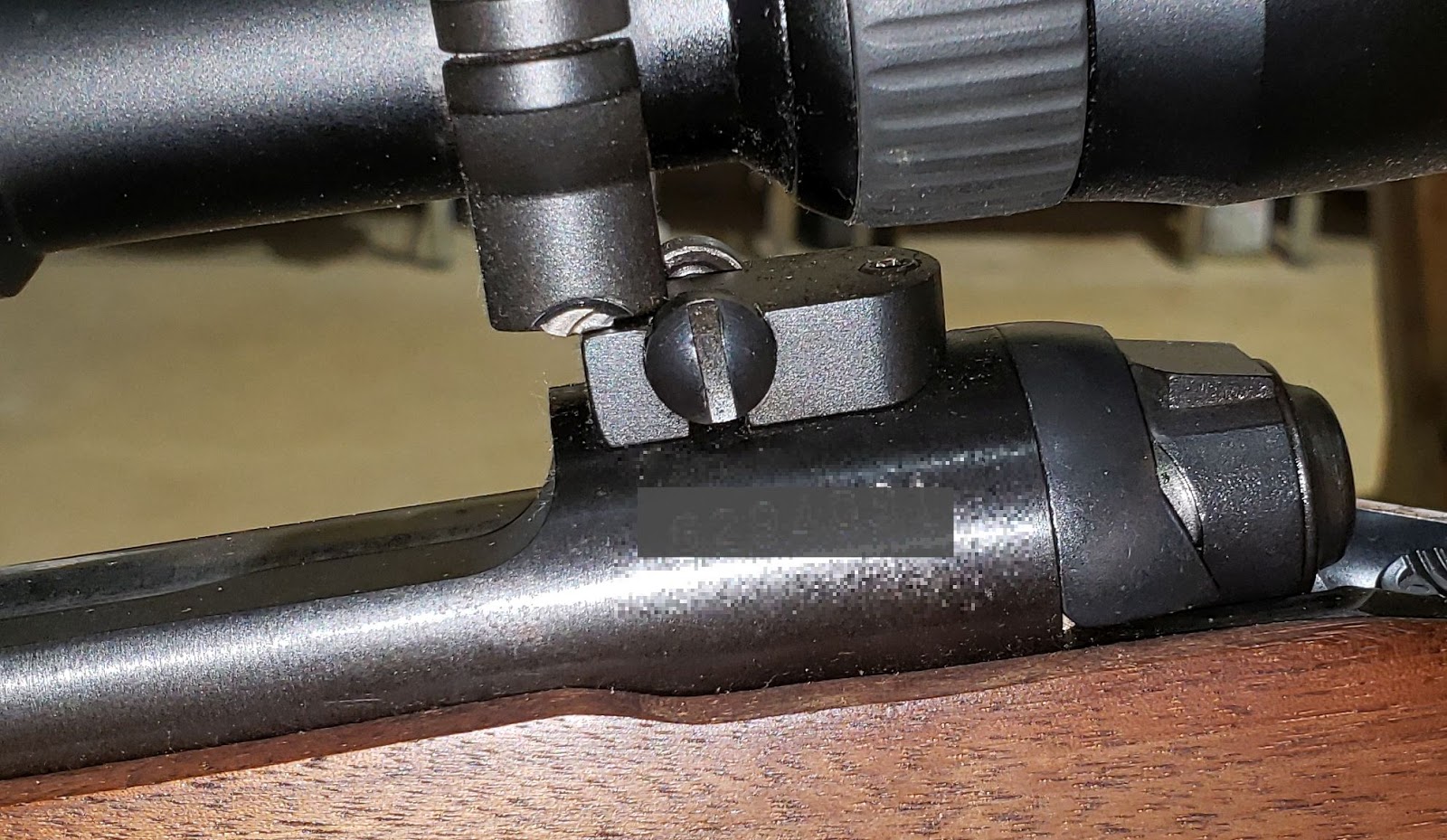
I shot the rifle last autumn, but haven't shot it since.  I picked it up yesterday and noticed that the scope was loose.  Horror!  A closer look showed the problem.


The rear scope ring had turned loose from the base.   Probably under recoil.  Here's a closer look.


It was an easy fix, and gave me an excuse to spend an hour with the rile, making sure everything was tight and right.  I put Redfield bases and rings on this rifle, back in 2006, and they've always done me right.  This gives me an excuse to head to the range ext week, to verify the zero.  I don't expect tack-driving accuracy from this rifle, but I do expect it to shoot where it looks, and so far it's always done that.

Today is May 1st, and deer season is only six months away.  It might be time to put a screwdriver on everything and make sure your rifle is tight and right.

Sunday, April 21, 2019

Belle Likes

My favorite-est gal, Belle, is a fan of the .32 revolver.  She loves them, she does.  Her current carry is an old Cold D frame in .32-0.  Not the most potent of firearms, but eminently shootable.  She likes it, is comfortable with it, and its okay with me.

She was surfing around this morning and came upon a new .32 revolver, this one from Charter Arms.  They call it the Professional, and Belle likes it a lot.  It is chambered in .32 H&R Magnum, has a 7-shot cylinder,, and weighs just 22 ounces with a 3-inch barrel..

Evidently it was designed in cooperation with Concealed Carry Magazine.


Grabagun has it listed at $404.99 but it is not in stock.  I told them to give me an email when they get one.  Belle already had her card out, ready to order.  I think that she wants to retire the old D frame.

Tuesday, March 26, 2019

Thinking About The .270 Winchester

A family member was asking me about the .270 Winchester cartridge.  While I have no personal experience with the cartridge, except for three shots I fired with a Howaa 1500 back in 2009, I do know folks who use it and do well with it.

I do know that the .270 Win was much beloved by Jack O'Connor and thousands of folks who read his work.   It's a serious game caliber, and nothing to sneeze at with good bullets and loads.  It seems to be inherently accurate.

Both my brother-in-law and my son-in-law shoot the .270 and have no trouble keeping venison in the freezer.  BIL tailors handloads using Reloder 22 powder and Nosler BT bullets.  He makes neck shots on deer because he doesn't like tracking, and his kills are usually a bang-flop.  He tells me that with a full case of RL22, he gets a little better than 3000 fps from his barrel, and low pressures.  Alliant powder lists 58 grain of RL22 as the max load with a 130 grain bullet at 2947 fps. 

With a good rifle and decent glass, that would let you sight in 1.6" high at 100 yards, be dead-on at 200 yards and down just 6.6" at 300.  That means a fellow could hold on hair all the way out to 300 yards and hit one of our smallish whitetail deer with no problem.  That's about as far away as I'd want to send a bullet at a game animal.  Your mileage might vary.  There are lots of fine long-range shooters out there, but I'm not one of them.

A fellow could do a lot worse than the .270 Winchester for most North American game.  It's not the newest or the flashiest, but it gets the job done. 

Monday, February 18, 2019

Respect

Is someone disparaging the Guru?  That's not a good idea.

I started my journey with handguns about the same time that the Colonel published his book, The Principles of Personal Defense.  It was a bible, a handbook, a clarion of the Modern Technique.  It is still relevant today, and the techniques that Cooper taught are still being taught worldwide.

Jeff Cooper was a forward-thinking person who espoused what was at the time, the very best he could offer, and he was not above reviewing other techniques and taking the good while discarding the frivolous.  But, if we distill his writings and teachings, what he truly espoused was mindset.  The mental activities that must occur before a fight to put one in the proper thinking for mayhem.

Are there better handguns than the 1911?  We can debate that.  Is the Weaver stance still relevant today?  It's certainly a good tool to have in your tool box.  Are there better tools available today?  Well, science, technology, and man's understanding moves forward.  The automotive world still stands on the breakthroughs that Henry Ford delivered.  The world of physics still studies the theories of Newton.  In every field of human endeavor, we stand on the shoulders of the people who came before us, and in the world of handguns and practical pistol-craft, we still stand on the shoulders of Jeff Cooper.

Sunday, February 10, 2019

Saturday Shooting

We hosted the cub yesterday as we do ever other Saturday, and after the practice was over, youngest son asked how many guns we use for CFFA shooting.  I told him that honestly, I hand't counted in a several months, but I haven't bought any guns in the past year.So, we drug them out for inventory purposes.

These are used solely for CFDA shooting.  They are all in .45 Cot, used exclusively with wax bullet ammunition.  While I own other single action revolvers in other calibers, Belle and I decided when we started that we would never own, any standard ammunition in .45 Colt, specifically because we don't want any accidents.  If anyone family or friend wants to shoot a heavy revolver, we'll find a suitable range and drag out the .44s, but in this caliber, it's wax bullet ammo ony.

Having said that, here are the family's competition guns, currently in use.

BottomL Ruger (old) Vaquero.
L-R Traditions Liberty Model, Taylors & Co, Cattleman, Traditions Rawhide, Ruger New Vaquero, Ruger New Vaquero, Cimarron El Malo, Cimarron Model P, Stoeger Hombre
This represents a range of guns commonly seen on any CFDA range nationwide, and there is something there to suit anyone.  We tell new shooters to find a club ad try as many guns as they possibly can before they make a decision on a specific model.  Belle has tiny hands, I have larger hands, and minuscule differences in frame size and grip size have a huge effect on how a gun fels ad performs in competition.  We let anyone try any of our guns before they make up their minds to buy a specific model, and we're fortunate that we can have the different models that we have.

Wednesday, January 16, 2019

Tight Chambers

Rugers are known for tight champers.  I'm not hating on Ruger, I'm just saying that they are known for tight chambers.    You might want some evidence, so, to wit:

In Cowboy Fast Draw, Belle ad I own several .45 Colt revolvers.  Pietta, and Uberti in several flavors, and a couple of Ruger New Vaqueros.  We bought some laser cartridges for practice, ad while they'd work right out of the bubble pack in the others, in the Rugers they would't completely chamber.  The fix was simple,  with an emery board, reduce the case mouth just a bit ad the lasers would fit the cylinder.

I load .308 Win for several rifles.  My daughter owns a Ruger American.  Ammo that will fit in the Savages or the Remingtons will chamber very tightly in the Ruger.  I've learned to seat bullets for her rile just a bit deeper, a hair under SAAMI length for best chambering in the Ruger.

We have a couple of old Ruger Model 77s in .25-06.  Likewise, tight chambers.

Which brings me to my Ruger LCP.  Nice little gun, but factory ammo simply will not completely chamber.  The slide stops ever-so-slightly before going fully into battery.  I suppose I could find a suitable mop, fill it with jeweler's rouge or valve compound and polish the chamber, but I'm loathe to do that. 

My preferred solution is to take a few minutes and run the factory ammo through a Lee Factory Crimp die.   A while back, I loaned the Elsie Pea to a friend to try out, and later got it back.  Recently I learned to my horror that I was out of ammo, so I stopped by the store to pickup another box.  Good, hollow-point ammo.  And, I spent 15 minutes at the bench.


In just a few minutes I had run that bx of ammo through the die and filled the magazines.  Everything works, ad we're ready to drop the little pistol into my pocket come springtime.

Rugers have tight chambers.  It's a good thing to know.

Tuesday, December 04, 2018

Lessons Learned

Eaton Rapids Joe talked about it yesterday.  In 1986, eight FBI agents got involved in a shootout with two very bad actors, and changed the way police look at firearms, tactics, ammunition, and equipment.  The aftershocks of that fight were seminal to how law enforcement looks at fatal encounters.

At the time I was a young peace officer and I remember reading the reports, following the FBI testing and trying to digest the data that came out for several years There were some interesting things that came out of that event and the subsequent reassessment.

The 10mm cartridge.  The 10mm is a direct result of the FBI testing that followed the shootout.  The problem is that most people can't handle it, it's a high energy cartridge designed for semi-auto handguns and is more demanding than the vast majority of folks find it uncomfortable.  That, and it beat the early guns to death.  Handguns designed for it seem to do okay, but it is tough on handguns.  Interestingly, the .40 SW cartridge is the little sister of the 10mm.  Many cops carry a .40 SW today, and we never heard of it before the shootout.

Better bullets.  The FBI tested a lot of bullets in the aftermath, and the bullet manufacturers paid attention.  There were some startling things learned, and for a while, it seemed that everyone was testing bullets.  We started learning about things like tissue displacement, penetration, wound cavities and how bullets acted when shot through various mediums.  The result of all that testing and evaluation is that we have a better understanding of terminal ballistics and we have much better bullets, across the board, than we had in 1986.

We also learned that the old things work.  The fight, with all its savagery and horror was ended by a determined FBI agent shooting a revolver.  Probably using the FBI standard load, which was a .38 Special +P load.  Sometimes good enough is good enough.

It's been over 30 years since that fateful day in Miami, and lots of things have changed in police work and in the gun community in general since that time.  A lot of it came out of  that day in April 1986.

Wednesday, October 10, 2018

Grips

So, there's this gun coming, and from the pictures I've seen, it screams for ivory.  Nowadays, we can't get ivory in this country, so we settle for the next best thing.  Some kind of faux ivory made from synthetics.  It's going to be okay.  They look fine, and I won't have to run afoul of the import laws.

So, we're stuck with faux ivory.   I ordered a set from these fine people, and got a reply email today.  Words to the effect of "will be made to order and is estimated to take 1 day to 4 weeks."  They gave me the option to cancel, but this revolver is screaming for nice grips.  So I told them I'd wait.  It's no big hurry, and I like the way these grips look.


One day to four weeks?  In this time of instant gratification and two-day shipping we tend to lose patience when ordering stuff..  Patience is fine, and I'm okay with waiting.  I can remember a time when I'd order something by filling out an order form, putting it in the mail, knowing as sure as shooting that I wouldn't see my package for four weeks or longer.   This four week wait will give me time to start learning the gun before I switch grips.  And, they said "1 day to 4 weeks" so it might be here much earlier.  We'll see.

Sunday, October 07, 2018

The Keith #5

The tale of American handgunning can't be told without Elmer Keith.  There are others, of course, but Keith tended to be a dominate voice in the 20th century and was instrumental in shaping onions about what constituted the perfect revolver.  He is best known for his work with bog bore magnum revolvers and is considered the father of the .44 Remington Magnum.

In his long-range work prior to the introduction of the .44 Magnum in 1955, Keith worked with the .44 Special cartridge for a number of reasons.   Basically, both calibers were chambered in the same gun and the cylinders were the same size.  The .44 Special had a smaller diameter , so there was more steel in the .44 cylinder than the .45, so the cartridge could be loaded to a higher pressure without running the risk of a burst cylinder.    Plus, the .44 Special brass had a stronger web than the balloon-head brass of the .45 Colt of the era.

Keith's work in this regard also focused on the revolver itself.  Better sights, a stronger base-pin latch, a different grip.  This work culminated in a gun that he called the #5.  In 2015,  Keith's #5 cane up for auction and Forgotten Weapons did a video on this remarkable revolver prior to the sale.  They tell the story better than I do, so I'll let them tell it.


I'm a big fan of the .44 Special, preferring it over the .44 Magnum.  While the magnum has its place,  and if you are enamored of it, by all means, use it.  Were I going up north, where I might encounter big bears, I might carry more than the .44 Special could provide, but for the little bears we have hereabouts ad the other fauna lurking around here, the .44 Special provides all the thump I think I"ll ever need from a belt-carried revolver.

In the .44 Special, I prefer Skeeter's Load.  Promulgated by the late, great Skeeter Skeltonn, it features a hard-cast 240 or 250 grain Keith bullet over 7.5 grains of Unique.  My research tells me that Skeeter found it in Elmer Keith's writings, which ties us back to Keith, but it was Skeeter who talked about the load.   What I like about it is that it has more thump than the standard .44 Special at 750 fps.  This load runs the bullet out at about 950 fps which makes it perfectly suitable for 95% of whatever you want a big bore handgun to do.

I tell you all this because my love affair with the .44 Special ain't over, and I'm about to open another chapter inn my infatuation with this cartridge.  More to come, soon.

Saturday, September 22, 2018

An Argument for Octagon Barrels

I've been trying to learn to produce low-cost, YouTube videos.  It's a lot harder than it looks.  A little 8-minute video on the argument for octagon barrels took me seven hours.  You do not want to see the out-takes.  But, I feel pretty good about it.  Lots of editing.


Time for a stiff drink.

Tuesday, September 18, 2018

Lyman 17

I bought a Sharps reproduction in 2002, and got familiar with it over the course of a couple of years.  Wrote about the foibles of loading black powder here.  After a couple of years, my interest moved to other things, so the Sharps got put in the cabinet and became a safe queen.

Last weekend, younger grandson was asking questions about rifle actions, so we went to the safe and took out some samples.  I grabbed the big Sharps, and during the intervening discussion, I was holding the rifle with the barrel vertical and felt something hit the back of my hand.  The Lyman 17 globe sight had disassembled itself.

We found the sight insert and the locking sleeve and attempted to put it back together again, and found that the locking sleeve is stripped and won't hold tight.  It looks like it's time to order another Lyman 17.  The rifle came out of the box with a nice, silver blade sight, but it really needed a nice globe sight for the best accuracy, and the Lyman fit the bill.  The next time I make an otder from Brownells, I'll have them drop one in the package.