An important safety tip from Mark. Those of us who love shotgunning know this. Especially those of us who have run 12 gauge guns in close proximity to 20 gauge guns. Keep the ammo separate, very separate.
Showing posts with label shooting. Show all posts
Showing posts with label shooting. Show all posts
Sunday, May 08, 2022

Friday, March 18, 2022
Marksmanship
Lucas is my 11-year-old grandson. He started CMP competition this year through the 4H club at his school. They do position shooting with .22 rifles.

Lucas went to his first competition yesterday and performed well for his first time out. He scored 254 out of 300. Not bad at all. He didn't qualify for State, but he put in a good showing, and there is always next year.
We may have a marksman in the family. For all you guys who think you can shoot, get off the bench, put your butt on the ground, and see where your bullets go.
Friday, November 12, 2021
Savage Scout Update
Back in 2015 I bought a Savage Scout, Model 10FCM. I had been enamored with the Scout concept, and wanted to play with the concept. I was pleased, and still am happy with the rifle. This rifle was bought as new-old stock. IT is a 2nd generation scout, with the Accustock. Because it was built three years before I bought it, I got a screaming deal on it.
Time goes on, and I still like the rifle, I still have it in the safe. I don't hunt as much as I did ten years ago, so don't do much centerfire rifle work. But, the last time I took it out, I noticed feeding problems with the 10-round magazines. Mags wear out, and I know that.
Surfing around, looking for new magazines, I couldn't seem to find what I was looking for. I called Savage customer service and they tell me that the 10-round magazine for the 10 FCM is no longer in production and hasn't been made in quite a while. They still offer the 4-round magazines.
Well, crap. I may have to start looking for custom magazine builders who make a magazine to feed my now out-of-production rifle.
Wednesday, August 25, 2021
Grinding Screwdrivers
We all know that we shouldn't use a hardware store screwdriver on our firearms. We need hollow-ground, parallel-tipped screwdrivers for gun work. They fit the slot perfectly and minimize the risk of buggering up the screw slot.
I own a couple of sets of Brownell's screwdriver sets and I think that the Mag Tip is the bees knees. But, several years ago I ordered a "Colt Set" from Brownell's. These are specifically made for the Colt single action revolvers and the clones. Playing the cowboy shooting games, this is the set that stays in the gun bag for quick screw tightening. (Brownells #354-000-001WB)
Of course, I broke on. And, it was the middle size, the one I used the most. But, I'd been watching Mark Novak's channel, Anvil on You Tube, and he grinds screwdriver tips. How hard can it be? This morning, while doing checks on the revolvers for this weekend's shoot, I decided to find out.
Take your time, go slow. It ain't hard at all.

That worked just fine. The tip fits the slots and feels solid. Now, the screwdriver is back in service and should last until it gets buggered up again. Don't be afraid to grind a screwdriver tip, guys. If it is already broken, what do you have to lose?
Wednesday, June 09, 2021
Shooting A Tire
I didn't know that Widener's had a YouTue channel. And, I didn't know that they had a blog. Cool stuff
At any rate, they decided to shoot a tire for the fun of doing that.
Thanks, Jason, or the heads-up.
Friday, March 26, 2021
Celebrating Freedom
Belle and I are in Sapulpa, OK, attending the Oklahoma State Championships of Cowboy Fast Draw. We were here last year when we found out that many states were shutting down, and we entered the Covid era.
Oklahoma State normally draws 80-ish shooters, and we blew through that today. I was talking with the Match Director today and he expects upwards of 120 shooters tomorrow. This will stress range capacity, but they've had today to sake out the bugs, and things should go smoothly. No one really cares, because it's been a year with no major matches, and everyone is willing to go-along-to-get-along. It's going to be fine. CFDA is a family, and this is like being at a family reunion with people you like.
I got into a couple of really interesting matches today, but didn't cover myself in glory. Belle, on the other hand, won third place in her category, so we'll be bringing home at least one trophy. And honestly, that's the way it normally works out. I travel around the country, getting into gun fights, and my lady is the one who brings home the trophies. She is a nationally known competitor, a Range Master, and an expert with a single-action revolver.
Is it any wonder why I try to treat her as well as possible?
Thursday, October 15, 2020
Lever Carbies
Regular readers know that I spent some time several years ago experimenting with handgun cartridges in lever carbines, specifically, in the .357 magnum.
Junior and I did some work in this regard, and if you follow the links, yo can see it here, and some more here. Suffice it to say that both Junior and I regard the .357 magnum as perfectly capable for deer-sized game out to about 100 yards, especially when fired through a lever carbine.
As it turns out, the Lucky Gunner recently revisited the question, with better equipment than either Junior or I had, and came much to the same conclusion. In both cases, the .357 and .44 magnum showed the same energy at 100 yards from a carbine as the same rounds showed at the muzzle when shot from a 4" revolver.
The video below is interesting, if only because it tells me what I've known of years, that a handgun cartridge fired from a lever gun is potent medicine indeed, with the proper ammunition.
It is good to see our early work validated.
Sunday, July 26, 2020
Thursday, July 16, 2020
Sight Upgrade
In 2003 I purchased a Kimber 1911A1 for duty carry and used it as a duty pistol until 2008, when the Sheriff bought a bunch of pistols and insisted we use them. I retired that pistol and it became a off0duty, or range gun. I'm an old 1911 fan. While I see utility in other platforms, to include the current crop of polymer pistols, I still like the 1911 a lot. I carried it in the Army, and have since used it for sport and recreation.
In 2017 I started noticing that I had trouble seeing the front sight of any o my pistols, and after a prescription change, learned that I have something called macular degeneration, a disease of the retina. It poses challenges in many ways, particularly in seeing small detail in the exact center of the visual field. We caught it early, and I'm doing what the doctor tells me, and I'm learning to live with it. But, that problem in the center of the visual field is the exact spot I use to find the front sight on a pistol. I needed a big, honking front sight.
A couple of weeks ago, I was casting about, looking for alternatives, and went to the XS Sight System web page. I started researching the system, and thought that it might be what I was looking for. I ordered a set for the Kimber.. They came in earlier this week, so I set about installing them.
The video from XS was a big help. I've installed sights in dovetails in the past, and it is important to remember to file the sight base, not the dovetail in the slide. Fit the sight to the dovetail.. About 30 minutes with a set of jewelers files and I was done.
I can see that front sight, and all I'm looking for is minute-of-goblin out to 25 yards or so. I think that this sight is just exactly what I need. Next week I'll get out and do some range work, If they work as well and I expect them to, I may have to pick up a set for my Shield.
In 2017 I started noticing that I had trouble seeing the front sight of any o my pistols, and after a prescription change, learned that I have something called macular degeneration, a disease of the retina. It poses challenges in many ways, particularly in seeing small detail in the exact center of the visual field. We caught it early, and I'm doing what the doctor tells me, and I'm learning to live with it. But, that problem in the center of the visual field is the exact spot I use to find the front sight on a pistol. I needed a big, honking front sight.
A couple of weeks ago, I was casting about, looking for alternatives, and went to the XS Sight System web page. I started researching the system, and thought that it might be what I was looking for. I ordered a set for the Kimber.. They came in earlier this week, so I set about installing them.
The video from XS was a big help. I've installed sights in dovetails in the past, and it is important to remember to file the sight base, not the dovetail in the slide. Fit the sight to the dovetail.. About 30 minutes with a set of jewelers files and I was done.
 |
| Screen grab from XS video |
Wednesday, May 13, 2020
Gun Bags
A buddy and I were talking yesterday and the subject of gun bags came up. He was complaining that his bag was too small. Once he loaded two belts, holsters, guns, ammo, and related items, he had trouble fitting it all in the bag.
I told him that I have been shooting competitively (off and on), for decades. Olympic skeet, small bore, USPSA, and now Cowboy Fast Draw. I told him that every sport differed, but my experience dictated that when I found a gun bag I liked, one that I was convinced would hold everything, to cull that one and buy the next larger size.
The problem comes when you fill that big bag, and can't lift it off the floor. Then, it's time to go to several smaller bags, Then get a wagon to carry all those bags. And, if your partner gets involved in the sport, or a grandkid, the number of bags increases exponentially. Which is why I bought a van, to haul all that excess. Some of the bags never leave the van, but they are always packed. If I leave the gunsmithing tools and spare parts at home, sure as God makes little green apples, I'll break a bolt spring.
It's all part of the game.
I told him that I have been shooting competitively (off and on), for decades. Olympic skeet, small bore, USPSA, and now Cowboy Fast Draw. I told him that every sport differed, but my experience dictated that when I found a gun bag I liked, one that I was convinced would hold everything, to cull that one and buy the next larger size.
The problem comes when you fill that big bag, and can't lift it off the floor. Then, it's time to go to several smaller bags, Then get a wagon to carry all those bags. And, if your partner gets involved in the sport, or a grandkid, the number of bags increases exponentially. Which is why I bought a van, to haul all that excess. Some of the bags never leave the van, but they are always packed. If I leave the gunsmithing tools and spare parts at home, sure as God makes little green apples, I'll break a bolt spring.
It's all part of the game.
Friday, March 27, 2020
The Wron-Hole
I found a correspondent in my inbox, a fellow who inherited his grandfather's old Winchester 94. And he asked me about cast bullets in the .30-30.
Let's drop down this worm=hole, shall we? His question:
So I can't use the same load data for FMJ for lead ammo ? What's a good manual you recommend? I've found this load data but I wanted your expert opinion.
I bought some 155 grain lead bullets without the gas check can I use the same load data as a 155 grain with gas check?I feel sorry for this guy. He's about to drop down a worn-hole with the best of intentions. It's a world where sane men sometimes venture and learn that everything they thought they knew was patently false.
My latest answer:
My rule of thumb. Below 1500 fps, no check. Between 1500 to 1900, gas check. Above 1900, jacketed. A gas check is important s that bore gasses don't erode the base of a plain based bullet. This becomes more important as speed, and pressure increases.
Be cautious using factory made cast bullets. Many of us use a lot of factory cast in handguns, but in rifles, you're getting into that range of speed whee alloy really matters. You ca't drive a soft, pure lead bullet much over 1200 fps and expect it to perform properly. Over 1200 fps, you need to alloy the melted lead to give it toughness. Many of us grew up using wheel weights, which used to contain 95% lead, 3% tin, and 2% antimony. This was a great alloy for cast bullets, and approximated the Lyman #2 alloy. Some of us alloyed our own metal with pure lead and Linotype metal. Be careful using wheel weights today because most of them are made of zinc, which is totally unsuitable to casting bullets and will ruin your alloy.
Getting in to cast bullets is like going down a worm-hole, and you might not be the same person when you come out the other side. Everything you thought you knew about reloading is wrong.
For hundreds of years prior to the late 1800s, everything was shot with pure lead bullets, but they used black power as the only propellant. Black powder is a low-pressure propellant and is perfectly suited to pure lead. However, in the late 1800s two things happened, almost simultaneously: the invention of smokeless powder and the invention of the cupro-nickel jacketed bullet. Smokeless powder gave higher pressure, and velocity and the jacketed bullet let us take advantage of that pressure.
In 1895, Winchester unveiled their new cartridge, the .30 WCF (.30-30) which was the very first cartridge designed to use smokeless powder, and the world changed. It was advertised as a whiz-bang modern wonder, capable of taking any game in North America, to include grizzly bear. In the intervening century, advances in smokeless powder almost mad the lead bullet obsolete for rifle cartridges.
Surprisingly, the most popular cartridge today, the most sold ammo in the United States is ab obsolete design that uses a heeled, pure lead bullet and is loaded to black powder velocities. The .22 Long Rifle.
The very best resource for cast bullets, almost a bible among cast bullet enthusiasts, is the Lyman Cast Bullet Handbook, available from Amazon. It is a wealth of knowledge from cover to cover. It covers bullet casting, alloys, and has load data or almost every cartridge suitable for cast bullets.
Have fun going down this worn-hole. Stay safe.I hope I didn't scare the guy off.
Tuesday, March 10, 2020
Trajectory
It's hard to explain to people what a bullet does when it leaves the barrel and how the interaction of gun, sights, and shooter all combine to make a bullet fall down at a particular spot.
So, there's this guy, Mark Novak, who works on guns, and explains things. He will take you down a rabbit hole, as long as you are willing to follow. This episode is about trajectory.
Yes, there is math involved.
So, there's this guy, Mark Novak, who works on guns, and explains things. He will take you down a rabbit hole, as long as you are willing to follow. This episode is about trajectory.
Yes, there is math involved.
Friday, December 20, 2019
Zero-ing the AR
I bought an AR-15 several months ago and realized that although we had mounted a sight and had been tinkering with it for several months, we have't zeroed it.
I needed to rectify that problem, and my grandson, who is going to Army Basic training next month, needed the experience. So, we grabbed some mags and ammo and headed to the range this morning.
Grandson has chosen the MOS of 91F (Small Arm Repairman) to begin his military career, and I'm sure that some of that training, bot in Basic and in AIT will revolve around the M4 Series weapons. I've been teaching him standard disassembly and basic maintenance, and it was time to see if he could shoot the darned thing. I had downloaded and printed this target so that we could start at 25 yards and have a close 100 yard zero.
Afte three shots, an adjustment, and three more shots, we went down ange to change targets. He took his time, gave me three good shots and after the range went cold, we went down to find this target.

Not bad for someone new to the AR platform. We brought in the target butt, and I told him to pick out a dirt clod on the 100 yard berm and see if he could bust it. He did, then started picking out oher dirt clofs on the berm to get a feel for running the AR. Unfortunately, this range doesn't allow for position work, but hopefully we'll find time before he leaves to get out to another range and work on positions.

It was a great morning for PawPaw and grandson. He finished high school yesterday and he's ready to launch. He plans to do Basic and AIT, then come back here for college. He's in the National Guard, which will help pay for his education.
As for me and Belle, we're going to hate to see him go.
I needed to rectify that problem, and my grandson, who is going to Army Basic training next month, needed the experience. So, we grabbed some mags and ammo and headed to the range this morning.
Grandson has chosen the MOS of 91F (Small Arm Repairman) to begin his military career, and I'm sure that some of that training, bot in Basic and in AIT will revolve around the M4 Series weapons. I've been teaching him standard disassembly and basic maintenance, and it was time to see if he could shoot the darned thing. I had downloaded and printed this target so that we could start at 25 yards and have a close 100 yard zero.
Afte three shots, an adjustment, and three more shots, we went down ange to change targets. He took his time, gave me three good shots and after the range went cold, we went down to find this target.

Not bad for someone new to the AR platform. We brought in the target butt, and I told him to pick out a dirt clod on the 100 yard berm and see if he could bust it. He did, then started picking out oher dirt clofs on the berm to get a feel for running the AR. Unfortunately, this range doesn't allow for position work, but hopefully we'll find time before he leaves to get out to another range and work on positions.

It was a great morning for PawPaw and grandson. He finished high school yesterday and he's ready to launch. He plans to do Basic and AIT, then come back here for college. He's in the National Guard, which will help pay for his education.
As for me and Belle, we're going to hate to see him go.
Thursday, December 19, 2019
The Golden Age
I've said this for several years and I believe it now more than ever. We live in the golden age of rifle shooting. Never before in our history has the American gunner been better equipped. When I began hunting in the 1960s, scoped rifles were the minority (at least locally). My first rifle was a Marlin 336 in .35 Remington. If one showed up in a deer camp in the late '60s, you might see a variety of lever rifles in .30-30 or .35 Rem, and a smattering of bolt guns in .30-06 and .270. Ammo was likewise limited. Winchester, Federal ad Remington made soft-point hunting ammo. If you were a handloader, good luck finding bullets. Oh, Siera and Hornady and Nosler made them, but you had to order them unless you were lucky enough to have a good handloading shop nearby.
Scopes were atrocious, fragile, and expensive. The less said abut them, the better. Oh, there were a few premium scopes out there, but the best were made by Weaver or Leupold, and were generally fixed 4X scopes.
In 1979, if my memory serves, Winchester came out with something called the Silver-Tip, a premium hunting bullet to compete with the Nosler Partition. The Partition was a very good hunting bullet, but suffered from a reputation for poor accuracy, although most off-the-shelf rifles of the day were only capable of 3-inch groups at 100 yards. If you wanted a super-accurate rifle, you went to a competent gunsmith to build the rifle. The mythical 1-inch group was the holy grail. It was often talked about, but rarely seen. I had one rifle, a Remington in 7mm-08 that turned in bug-hole groups with standard Core-Lokt ammo.
In 1984 (again, if memory serves) Nosler came out with the Ballistic Tip, a premium match bullet that turned the shooting world askew. It was superbly accurate, but fragile, with core separation a common complaint. Bullet manufacturers were learning to make better bullets, and at the same time, optics were getting better and less expensive.
In the '90s, the internet was coming of age, and online gun communities came into being. It was much easier to share information and the shooting companies began learning to use computers to design rifles, optics and ammo. It may have been Savage Arms who led the way, producing the fist out-of-the-box rifle that would routinely shoot into MOA with any degree of regularity. By the turn of the century, the gun companies had caught their stride, and were turning out rifles, ammo, and optics that let the American shooter take advantage of accuracy that we had never seen.
Nowadays we have better rifles, bullets and optics than we've ever had before, at prices that generally make it affordable to the large population. Just three yeas ago, I picked up a new rifle (Ruger American), a new scope (Leupold Rifleman) and put together a box of ammo using new components. The first group out of it hovered around that magical one-inch mark, and with with subsequent shooting got much better. For less than $600 I had put together a combo that was simply much better than anything that was obtainable 50 years ago at thee times the price.
I've said it before, and I'll say it again. We are living in the golden age of rifle shooting.
Scopes were atrocious, fragile, and expensive. The less said abut them, the better. Oh, there were a few premium scopes out there, but the best were made by Weaver or Leupold, and were generally fixed 4X scopes.
In 1979, if my memory serves, Winchester came out with something called the Silver-Tip, a premium hunting bullet to compete with the Nosler Partition. The Partition was a very good hunting bullet, but suffered from a reputation for poor accuracy, although most off-the-shelf rifles of the day were only capable of 3-inch groups at 100 yards. If you wanted a super-accurate rifle, you went to a competent gunsmith to build the rifle. The mythical 1-inch group was the holy grail. It was often talked about, but rarely seen. I had one rifle, a Remington in 7mm-08 that turned in bug-hole groups with standard Core-Lokt ammo.
In 1984 (again, if memory serves) Nosler came out with the Ballistic Tip, a premium match bullet that turned the shooting world askew. It was superbly accurate, but fragile, with core separation a common complaint. Bullet manufacturers were learning to make better bullets, and at the same time, optics were getting better and less expensive.
In the '90s, the internet was coming of age, and online gun communities came into being. It was much easier to share information and the shooting companies began learning to use computers to design rifles, optics and ammo. It may have been Savage Arms who led the way, producing the fist out-of-the-box rifle that would routinely shoot into MOA with any degree of regularity. By the turn of the century, the gun companies had caught their stride, and were turning out rifles, ammo, and optics that let the American shooter take advantage of accuracy that we had never seen.
Nowadays we have better rifles, bullets and optics than we've ever had before, at prices that generally make it affordable to the large population. Just three yeas ago, I picked up a new rifle (Ruger American), a new scope (Leupold Rifleman) and put together a box of ammo using new components. The first group out of it hovered around that magical one-inch mark, and with with subsequent shooting got much better. For less than $600 I had put together a combo that was simply much better than anything that was obtainable 50 years ago at thee times the price.
I've said it before, and I'll say it again. We are living in the golden age of rifle shooting.
Wednesday, May 01, 2019
My Old Savage
Regular readers know my fondness and preference for Savage rifles, especially my old Model 110 in .30-06. There is nothing whiz-bang about it. It's as plain as they come. It started life as a synthetic stock, but the Savage stocks in those days were terrible, and I broke it when I dropped it from a tree stand, so I ordered a 90% stock from somewhere and finished this one the way I like it.
Oh, I own other rifles, but this is the one I grab when something needs to be whacked with a medium caliber. It puts a 168 grain bullet where I want ti to go, and I've only had to shoot one deer twice. She was an old barren doe, and I hit her hard at 125 yards and anchored her. When I got to her about ten minutes later, she was still breathing, so I put one in her neck to end the suffering.
I shot the rifle last autumn, but haven't shot it since. I picked it up yesterday and noticed that the scope was loose. Horror! A closer look showed the problem.

The rear scope ring had turned loose from the base. Probably under recoil. Here's a closer look.

It was an easy fix, and gave me an excuse to spend an hour with the rile, making sure everything was tight and right. I put Redfield bases and rings on this rifle, back in 2006, and they've always done me right. This gives me an excuse to head to the range ext week, to verify the zero. I don't expect tack-driving accuracy from this rifle, but I do expect it to shoot where it looks, and so far it's always done that.
Today is May 1st, and deer season is only six months away. It might be time to put a screwdriver on everything and make sure your rifle is tight and right.
Oh, I own other rifles, but this is the one I grab when something needs to be whacked with a medium caliber. It puts a 168 grain bullet where I want ti to go, and I've only had to shoot one deer twice. She was an old barren doe, and I hit her hard at 125 yards and anchored her. When I got to her about ten minutes later, she was still breathing, so I put one in her neck to end the suffering.
I shot the rifle last autumn, but haven't shot it since. I picked it up yesterday and noticed that the scope was loose. Horror! A closer look showed the problem.

The rear scope ring had turned loose from the base. Probably under recoil. Here's a closer look.
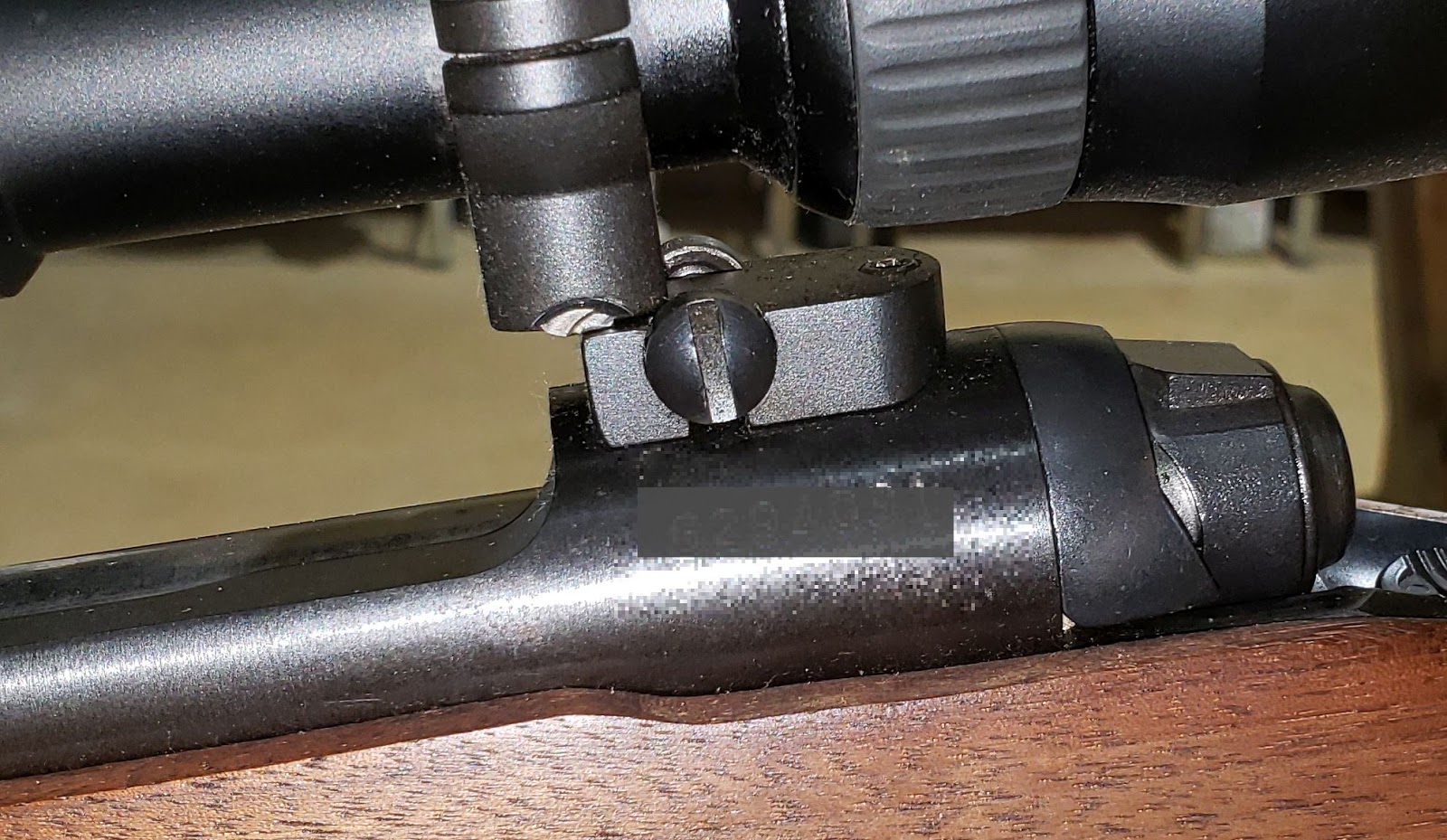
It was an easy fix, and gave me an excuse to spend an hour with the rile, making sure everything was tight and right. I put Redfield bases and rings on this rifle, back in 2006, and they've always done me right. This gives me an excuse to head to the range ext week, to verify the zero. I don't expect tack-driving accuracy from this rifle, but I do expect it to shoot where it looks, and so far it's always done that.
Today is May 1st, and deer season is only six months away. It might be time to put a screwdriver on everything and make sure your rifle is tight and right.
Sunday, April 21, 2019
Belle Likes
My favorite-est gal, Belle, is a fan of the .32 revolver. She loves them, she does. Her current carry is an old Cold D frame in .32-0. Not the most potent of firearms, but eminently shootable. She likes it, is comfortable with it, and its okay with me.
She was surfing around this morning and came upon a new .32 revolver, this one from Charter Arms. They call it the Professional, and Belle likes it a lot. It is chambered in .32 H&R Magnum, has a 7-shot cylinder,, and weighs just 22 ounces with a 3-inch barrel..
Evidently it was designed in cooperation with Concealed Carry Magazine.
Grabagun has it listed at $404.99 but it is not in stock. I told them to give me an email when they get one. Belle already had her card out, ready to order. I think that she wants to retire the old D frame.
She was surfing around this morning and came upon a new .32 revolver, this one from Charter Arms. They call it the Professional, and Belle likes it a lot. It is chambered in .32 H&R Magnum, has a 7-shot cylinder,, and weighs just 22 ounces with a 3-inch barrel..
Evidently it was designed in cooperation with Concealed Carry Magazine.
Grabagun has it listed at $404.99 but it is not in stock. I told them to give me an email when they get one. Belle already had her card out, ready to order. I think that she wants to retire the old D frame.
Tuesday, March 26, 2019
Thinking About The .270 Winchester
A family member was asking me about the .270 Winchester cartridge. While I have no personal experience with the cartridge, except for three shots I fired with a Howaa 1500 back in 2009, I do know folks who use it and do well with it.
I do know that the .270 Win was much beloved by Jack O'Connor and thousands of folks who read his work. It's a serious game caliber, and nothing to sneeze at with good bullets and loads. It seems to be inherently accurate.
Both my brother-in-law and my son-in-law shoot the .270 and have no trouble keeping venison in the freezer. BIL tailors handloads using Reloder 22 powder and Nosler BT bullets. He makes neck shots on deer because he doesn't like tracking, and his kills are usually a bang-flop. He tells me that with a full case of RL22, he gets a little better than 3000 fps from his barrel, and low pressures. Alliant powder lists 58 grain of RL22 as the max load with a 130 grain bullet at 2947 fps.
With a good rifle and decent glass, that would let you sight in 1.6" high at 100 yards, be dead-on at 200 yards and down just 6.6" at 300. That means a fellow could hold on hair all the way out to 300 yards and hit one of our smallish whitetail deer with no problem. That's about as far away as I'd want to send a bullet at a game animal. Your mileage might vary. There are lots of fine long-range shooters out there, but I'm not one of them.
A fellow could do a lot worse than the .270 Winchester for most North American game. It's not the newest or the flashiest, but it gets the job done.
I do know that the .270 Win was much beloved by Jack O'Connor and thousands of folks who read his work. It's a serious game caliber, and nothing to sneeze at with good bullets and loads. It seems to be inherently accurate.
Both my brother-in-law and my son-in-law shoot the .270 and have no trouble keeping venison in the freezer. BIL tailors handloads using Reloder 22 powder and Nosler BT bullets. He makes neck shots on deer because he doesn't like tracking, and his kills are usually a bang-flop. He tells me that with a full case of RL22, he gets a little better than 3000 fps from his barrel, and low pressures. Alliant powder lists 58 grain of RL22 as the max load with a 130 grain bullet at 2947 fps.
With a good rifle and decent glass, that would let you sight in 1.6" high at 100 yards, be dead-on at 200 yards and down just 6.6" at 300. That means a fellow could hold on hair all the way out to 300 yards and hit one of our smallish whitetail deer with no problem. That's about as far away as I'd want to send a bullet at a game animal. Your mileage might vary. There are lots of fine long-range shooters out there, but I'm not one of them.
A fellow could do a lot worse than the .270 Winchester for most North American game. It's not the newest or the flashiest, but it gets the job done.
Monday, February 18, 2019
Respect
Is someone disparaging the Guru? That's not a good idea.
I started my journey with handguns about the same time that the Colonel published his book, The Principles of Personal Defense. It was a bible, a handbook, a clarion of the Modern Technique. It is still relevant today, and the techniques that Cooper taught are still being taught worldwide.
Jeff Cooper was a forward-thinking person who espoused what was at the time, the very best he could offer, and he was not above reviewing other techniques and taking the good while discarding the frivolous. But, if we distill his writings and teachings, what he truly espoused was mindset. The mental activities that must occur before a fight to put one in the proper thinking for mayhem.
Are there better handguns than the 1911? We can debate that. Is the Weaver stance still relevant today? It's certainly a good tool to have in your tool box. Are there better tools available today? Well, science, technology, and man's understanding moves forward. The automotive world still stands on the breakthroughs that Henry Ford delivered. The world of physics still studies the theories of Newton. In every field of human endeavor, we stand on the shoulders of the people who came before us, and in the world of handguns and practical pistol-craft, we still stand on the shoulders of Jeff Cooper.
I started my journey with handguns about the same time that the Colonel published his book, The Principles of Personal Defense. It was a bible, a handbook, a clarion of the Modern Technique. It is still relevant today, and the techniques that Cooper taught are still being taught worldwide.
Jeff Cooper was a forward-thinking person who espoused what was at the time, the very best he could offer, and he was not above reviewing other techniques and taking the good while discarding the frivolous. But, if we distill his writings and teachings, what he truly espoused was mindset. The mental activities that must occur before a fight to put one in the proper thinking for mayhem.
Are there better handguns than the 1911? We can debate that. Is the Weaver stance still relevant today? It's certainly a good tool to have in your tool box. Are there better tools available today? Well, science, technology, and man's understanding moves forward. The automotive world still stands on the breakthroughs that Henry Ford delivered. The world of physics still studies the theories of Newton. In every field of human endeavor, we stand on the shoulders of the people who came before us, and in the world of handguns and practical pistol-craft, we still stand on the shoulders of Jeff Cooper.
Sunday, February 10, 2019
Saturday Shooting
We hosted the cub yesterday as we do ever other Saturday, and after the practice was over, youngest son asked how many guns we use for CFFA shooting. I told him that honestly, I hand't counted in a several months, but I haven't bought any guns in the past year.So, we drug them out for inventory purposes.
These are used solely for CFDA shooting. They are all in .45 Cot, used exclusively with wax bullet ammunition. While I own other single action revolvers in other calibers, Belle and I decided when we started that we would never own, any standard ammunition in .45 Colt, specifically because we don't want any accidents. If anyone family or friend wants to shoot a heavy revolver, we'll find a suitable range and drag out the .44s, but in this caliber, it's wax bullet ammo ony.
Having said that, here are the family's competition guns, currently in use.
This represents a range of guns commonly seen on any CFDA range nationwide, and there is something there to suit anyone. We tell new shooters to find a club ad try as many guns as they possibly can before they make a decision on a specific model. Belle has tiny hands, I have larger hands, and minuscule differences in frame size and grip size have a huge effect on how a gun fels ad performs in competition. We let anyone try any of our guns before they make up their minds to buy a specific model, and we're fortunate that we can have the different models that we have.
These are used solely for CFDA shooting. They are all in .45 Cot, used exclusively with wax bullet ammunition. While I own other single action revolvers in other calibers, Belle and I decided when we started that we would never own, any standard ammunition in .45 Colt, specifically because we don't want any accidents. If anyone family or friend wants to shoot a heavy revolver, we'll find a suitable range and drag out the .44s, but in this caliber, it's wax bullet ammo ony.
Having said that, here are the family's competition guns, currently in use.
 |
| BottomL Ruger (old) Vaquero. L-R Traditions Liberty Model, Taylors & Co, Cattleman, Traditions Rawhide, Ruger New Vaquero, Ruger New Vaquero, Cimarron El Malo, Cimarron Model P, Stoeger Hombre |
Wednesday, January 16, 2019
Tight Chambers
Rugers are known for tight champers. I'm not hating on Ruger, I'm just saying that they are known for tight chambers. You might want some evidence, so, to wit:
In Cowboy Fast Draw, Belle ad I own several .45 Colt revolvers. Pietta, and Uberti in several flavors, and a couple of Ruger New Vaqueros. We bought some laser cartridges for practice, ad while they'd work right out of the bubble pack in the others, in the Rugers they would't completely chamber. The fix was simple, with an emery board, reduce the case mouth just a bit ad the lasers would fit the cylinder.
I load .308 Win for several rifles. My daughter owns a Ruger American. Ammo that will fit in the Savages or the Remingtons will chamber very tightly in the Ruger. I've learned to seat bullets for her rile just a bit deeper, a hair under SAAMI length for best chambering in the Ruger.
We have a couple of old Ruger Model 77s in .25-06. Likewise, tight chambers.
Which brings me to my Ruger LCP. Nice little gun, but factory ammo simply will not completely chamber. The slide stops ever-so-slightly before going fully into battery. I suppose I could find a suitable mop, fill it with jeweler's rouge or valve compound and polish the chamber, but I'm loathe to do that.
My preferred solution is to take a few minutes and run the factory ammo through a Lee Factory Crimp die. A while back, I loaned the Elsie Pea to a friend to try out, and later got it back. Recently I learned to my horror that I was out of ammo, so I stopped by the store to pickup another box. Good, hollow-point ammo. And, I spent 15 minutes at the bench.

In just a few minutes I had run that bx of ammo through the die and filled the magazines. Everything works, ad we're ready to drop the little pistol into my pocket come springtime.
Rugers have tight chambers. It's a good thing to know.
In Cowboy Fast Draw, Belle ad I own several .45 Colt revolvers. Pietta, and Uberti in several flavors, and a couple of Ruger New Vaqueros. We bought some laser cartridges for practice, ad while they'd work right out of the bubble pack in the others, in the Rugers they would't completely chamber. The fix was simple, with an emery board, reduce the case mouth just a bit ad the lasers would fit the cylinder.
I load .308 Win for several rifles. My daughter owns a Ruger American. Ammo that will fit in the Savages or the Remingtons will chamber very tightly in the Ruger. I've learned to seat bullets for her rile just a bit deeper, a hair under SAAMI length for best chambering in the Ruger.
We have a couple of old Ruger Model 77s in .25-06. Likewise, tight chambers.
Which brings me to my Ruger LCP. Nice little gun, but factory ammo simply will not completely chamber. The slide stops ever-so-slightly before going fully into battery. I suppose I could find a suitable mop, fill it with jeweler's rouge or valve compound and polish the chamber, but I'm loathe to do that.
My preferred solution is to take a few minutes and run the factory ammo through a Lee Factory Crimp die. A while back, I loaned the Elsie Pea to a friend to try out, and later got it back. Recently I learned to my horror that I was out of ammo, so I stopped by the store to pickup another box. Good, hollow-point ammo. And, I spent 15 minutes at the bench.

In just a few minutes I had run that bx of ammo through the die and filled the magazines. Everything works, ad we're ready to drop the little pistol into my pocket come springtime.
Rugers have tight chambers. It's a good thing to know.
Subscribe to:
Posts (Atom)