We're on the road and the dog is at a border's place. Lots of dogs to play with and he's got his bed, his bowl, and his food. The border is the same outfit that does the grooming, so she knows him, and he seems to always have fun when he goes for grooming. We're convinced that he's in good hands.
This picture was taken earlier this week as we watched TV.
Oh, yeah! He's got it going on, doesn't he?
Sunday, July 15, 2012
Saturday, July 14, 2012
Bonus
Drinking coffee in the hotel room this morning, Milady wandered into the bathroom and exclaimed that we have a whirlpool tub. The hell you say! I'd have never noticed. I can't remember the last time I took a sit-down bath, but I understand that some like them. Me? I'm a shower guy. Still, I don't ever remember having a whirly-pool bath in a side-of-the-highway motor court, ever before.
Just for the record, we're staying at a Jameson Inn. We've stayed in others on other road trips and we've found them to be consistently clean, quiet, inexpensive rooms for the night. My standards in hotel accommodations might not be very high, having spent lots of nights in tents with the Guard. While I like a grand hotel with all the amenities, I also like inexpensive rooms where I know that certain standards are maintained, and Jameson Inns seem to keep those standards. Next time you're on a road trip, you might give them a chance. They're PawPaw approved.
Friday, July 13, 2012
Vacation, Day 1
We left the house this morning at 6:20 a.m. and took our time across Louisiana, Mississippi, and Alabama. We're currently in Georgia, ensconced in a cheap hotel. We got through Atlanta relatively painlessly, even though we hit the outskirts of town at 5:00 local. It didn't turn into a large parking lot, although it was touch and go for a few minutes. Top speed, about 25 mph, but Atlanta is behind me.
We'll hit the road after breakfast tomorrow morning, planning to close on Myrtle Beach at about 3:00 p.m. local time.
Thursday, July 12, 2012
Those California Bankruptcies
I'm reading about those California cities going bankrupt and everyone seems to think that this is something new. Oh, no, my child. Cities have been going bankrupt since mankind bound together to live in cities. Poor fiscal management, an imploding economy, lack of jobs, declining housing market, all these things conspire to make people move away. Sometimes it's a trickle, sometimes it's a flood, but folks have been building and abandoning cities since time immemorial. Remember studying Troy? Point at it on a map.
More recently, in the late 19th, early 20th century we made a lot of boom towns here in the US, then abandoned them. Google "ghost town" and see how many hits you get. Wikipedia is a great asset when you want to talk about ghost towns. Folks move in, folks move away. After a while, it just doesn't make any sense to stay in that spot, so we pull up stakes and go where the opportunity is. It's the American way.
This ain't nothing new, folks. It's as American as apple pie.
More recently, in the late 19th, early 20th century we made a lot of boom towns here in the US, then abandoned them. Google "ghost town" and see how many hits you get. Wikipedia is a great asset when you want to talk about ghost towns. Folks move in, folks move away. After a while, it just doesn't make any sense to stay in that spot, so we pull up stakes and go where the opportunity is. It's the American way.
This ain't nothing new, folks. It's as American as apple pie.
Destroy the Pyramids
It seems that some clerics in Egypt want to destroy the Pyramids.
UPDATE in comments: It's a hoax, but I don't put it past them. Look what they're doing to Timbuctu.
Hat tip to Jeff, at Alphecca.
According to several reports in the Arabic media, prominent Muslim clerics have begun to call for the demolition of Egypt’s Great Pyramids—or, in the words of Saudi Sheikh Ali bin Said al-Rabi‘i, those “symbols of paganism,”Yeah. Y'all have fun with that. In fairness, Egyptians built them, so I guess Egyptians can tear them down. It'll be really interesting to see what they do with all the rubble, or if aliens show up to help them. Of course, the whole world will decry the loss of antiquities. And, that will remove a huge tourist, academic, and economic draw from the country and the whole place might descend into the middle ages, which seems to the intention of every Muslim cleric who has made the news lately.
UPDATE in comments: It's a hoax, but I don't put it past them. Look what they're doing to Timbuctu.
Hat tip to Jeff, at Alphecca.
Rain
It has rained every day for the past four days on my little acre and outside right now we're having a gentle rain. Today, though, I'm packing for a well anticipated vacation. I had hoped the rain would cut me a break, so that I could mow the lawn before we left, but that's not in the cards. It's wet out there, too wet to run a lawnmower. Milady and I, indeed, the whole clan are leaving tomorrow for Myrtle
Beach, SC where we'll all meet on Saturday afternoon and spend a week
under the same roof.
It's not the whole clan, but it's enough of us that we've had to rent a big house. By my last count, there will be 45 of us under that roof. So, I'm working my lists, making sure the little things are taken care of. I'll be blogging during the festivities and you'll get plenty of updates. And, I still have yet to make a couple of decisions. Big camera or small? LCP or J-frame? Those two might be spur-of-the-moment.
We're pulling out shortly after daylight tomorrow morning and we'll drive past Atlanta before we hunker down for the night. I've been looking forward to this for a long, long time.
It's not the whole clan, but it's enough of us that we've had to rent a big house. By my last count, there will be 45 of us under that roof. So, I'm working my lists, making sure the little things are taken care of. I'll be blogging during the festivities and you'll get plenty of updates. And, I still have yet to make a couple of decisions. Big camera or small? LCP or J-frame? Those two might be spur-of-the-moment.
We're pulling out shortly after daylight tomorrow morning and we'll drive past Atlanta before we hunker down for the night. I've been looking forward to this for a long, long time.
Wednesday, July 11, 2012
So Predictable
This is so predictable it's no longer worthy of mention. But, I'll mention it anyway.
Earlier today, Attorney General Eric Holder addressed the NAACP Nation Convention at the George R. Brown Convention Center in Houston, Texas. What did media need in order to attend? That's right, government issued photo identification (and a second form of identification too!), something both Holder and the NAACP stand firmly against when it comes to voting. Holder's DOJ is currently suing Texas for "discriminatory" voter ID laws.You need an ID to get in the conference, but you don't need an ID to vote. Are these people stupid, or just brain-washed? In Holder's case, he's evil. Louisiana has a voter ID law, we've had it for years. For some reason, Holder et al has yet to question it. It seems that all these places with voter ID laws would do well to emulate the Louisiana statute. Just sayin'.
3-Shot Groups
Rifle guys are always looking for that magic load that puts all the shots into the same hole and some of us have fixated on three-shot groups. Three-shot groups are fine for some things, like basic, very basic load development. If you can't get three shots to shoot into pretty much the same area on the target, the probability is that ten shots won't group there either. The problem comes in when we start to depend on three-shot groups as a valid indicator of good accuracy. It just ain't so.
Let's take my Savage 110 for example. A standard hunting rifle in .30-06, it's got the sporter barrel and a wooden stock. It's a solid dependable hunting rifle and it generally turns in groups that hover between one and 1.5 inches with good ammo. It's not a benchrest gun, but it turns in some amazingly small three-shot groups. Like this target I fired this morning.
That's a one-inch dot, by the way, and it shows five shots on paper. Three of them fell into 0.379 which is magnificent shooting for a bone-stock .30-06. The other two opened the group to almost 1.5 inches, which is about what I expect from this rifle and my indifferent bench technique. Let's look at another target that I fired last week from the same rifle, with a different load.
That target represents ten shots fired from the same rifle. All ten shots fell into two inches, but if you look at the 1-inch squares on the target, you'll see several sub-MOA three-shot groups, yet the entire string of ten shots fell into just a little over 1.5 inches, which is what I expect from this rifle.
Do I use three-shot groups? Sure I do. If ammo won't group well with three shots, it won't group well with ten shots, so I use a three-shot group early in load development to show me what won't work. As I start to fine tune a load, I'll go to five shot, and ten shot groups. Those groups show me something about the rifle, my technique, and the ammunition.
Don't get hung up on three shot groups.
Let's take my Savage 110 for example. A standard hunting rifle in .30-06, it's got the sporter barrel and a wooden stock. It's a solid dependable hunting rifle and it generally turns in groups that hover between one and 1.5 inches with good ammo. It's not a benchrest gun, but it turns in some amazingly small three-shot groups. Like this target I fired this morning.
That's a one-inch dot, by the way, and it shows five shots on paper. Three of them fell into 0.379 which is magnificent shooting for a bone-stock .30-06. The other two opened the group to almost 1.5 inches, which is about what I expect from this rifle and my indifferent bench technique. Let's look at another target that I fired last week from the same rifle, with a different load.
That target represents ten shots fired from the same rifle. All ten shots fell into two inches, but if you look at the 1-inch squares on the target, you'll see several sub-MOA three-shot groups, yet the entire string of ten shots fell into just a little over 1.5 inches, which is what I expect from this rifle.
Do I use three-shot groups? Sure I do. If ammo won't group well with three shots, it won't group well with ten shots, so I use a three-shot group early in load development to show me what won't work. As I start to fine tune a load, I'll go to five shot, and ten shot groups. Those groups show me something about the rifle, my technique, and the ammunition.
Don't get hung up on three shot groups.
Tuesday, July 10, 2012
Impossible
It seems that Chicago is experiencing a spike in gun violence, gang-bangers shooting at each other and killing innocents. The Mayor is trying to appeal to their values. Really.
(Mayor Rahm) Emanuel -- President Obama's former chief of staff -- told anchor Scott Pelley. "And it is about values. As I said then [when a 7-year-old girl was shot and killed last month], who raised you? How were you raised? And I don't buy this case where people say they don't have values. They do have values. They have the wrong values. Don't come near the kids -- don't touch them."Yeah, I'm sure that's going to work. Appeal to the values of gangbangers. Of course, all this is un-possible because Chicago is the last bastion of gun-banning America. Another failed social experiment that doesn't work, another failed Democratic policy. Chicago is awash in guns and is living the hell of gang warfare and it doesn't allow law-abiding people to own guns.
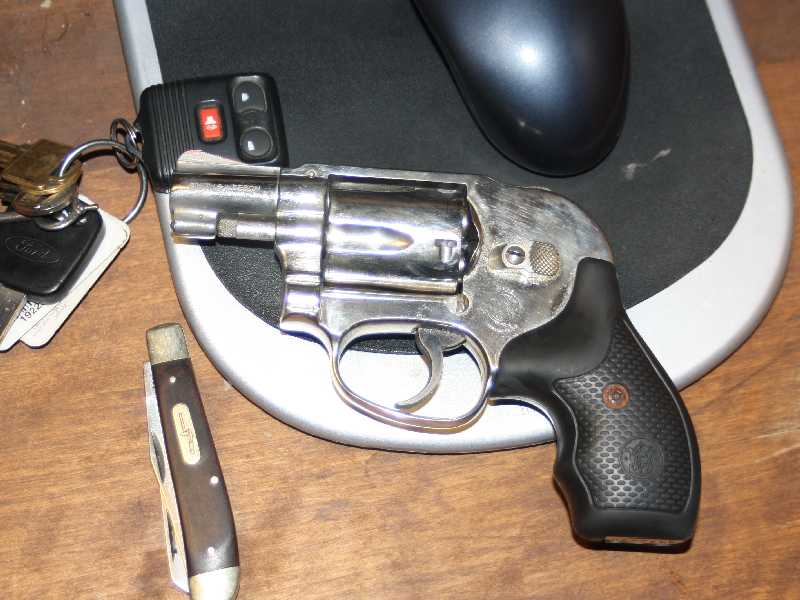
Range Day
Just back from the range, I went out today because I knew that a bunch of my brethren would be shooting their annual qualifications and the range officers always make time for those of us who want to qualify with off-duty pieces. So, I took the Model 38 that I picked up earlier this year.
Our course with a 5-shot the course is fired at the same distances as with a service revolver or pistol. Same course, from 25 yards down to 2 yards, shot on the LA P1 target. The only break they give us is that you're scored on the capacity of the revolver, 5 rounds as opposed to six. Everything else remains the same and you must score 80% to qualify. When all was said and done, I had shot an 86, which earned me the qualification I needed. I had 38 in the center-mass 2-ring, I had 8 in the perimeter 1-ring and I had 4 in the paper outside the scoring area. The little revolver is not hard to shoot, but it's hard to shoot well. I need a lot more time with this little revolver before I'll feel good about the little pistol, but sometimes Good Enough is good enough and this morning I qualified. That's good enough.
Monday, July 09, 2012
Before air conditioning
I grew up before air conditioning. Oh, it had been invented, but it wasn't common technology. I seem to remember that Dad had installed an air conditioner in the house on Edwards Street when I was a tiny child, but he only used it when he had to work nights. It was a window unit that rumbled in Dad's bedroom when he was sleeping during the day.
Not so the house on Airview. We moved there when I was in the second grade (1962?) and it didn't have air conditioning at all. It had a big old attic fan with nice windows and we learned to stay close to the windows at night. Our car didn't have an air conditioner, and theft wasn't much of a problem. I suppose that there were weeks when the windows stayed down on the car. I do recall that Daddy put a wooden block inside the door of the back windows on the car, so the baby wouldn't fall out. Child seats? Surely you jest. No one had yet dreamt of such a thing. In 1964 Momma got a new car, a Ford Galaxy station wagon. We didn't have A/C in the house, but we had it in the car. Louisiana afternoons were spent underneath the pecan tree in the back yard, or in the bedroom near the window. The attic fan made a breeze even when the air was still and the afternoons scorching. Yeah, we had 100 degree days then too, but they didn't seem to bother us so much.
I recall, too, the first time I felt real air conditioning. Momma was in the A&P and I realized that my legs were cold. Common attire in those days was blue jean shorts and a tee-shirt, barefoot from June until August, and I realized that I was chilled. Shocked. The whole store was air-conditioned. Several years later (1971), I graduated from Bolton High School and the school wasn't air conditioned. Hell, it was just barely heated. Cold in the winter and hot in the summer, the school had huge box fans in the hallways to move the warm air. It was something I guess.
Dad didn't install air conditioning in the house until I went in the Army in 1973. I came home on leave and noticed that the house was cool. "When did you do that, Pop?"
"Shortly after you left, son."
"Thanks, Pop."
What we're having here isn't global warming, folks. What we're having here is summer. It gets hot in the summertime. It has been getting hot for a long time in Louisiana.
Not so the house on Airview. We moved there when I was in the second grade (1962?) and it didn't have air conditioning at all. It had a big old attic fan with nice windows and we learned to stay close to the windows at night. Our car didn't have an air conditioner, and theft wasn't much of a problem. I suppose that there were weeks when the windows stayed down on the car. I do recall that Daddy put a wooden block inside the door of the back windows on the car, so the baby wouldn't fall out. Child seats? Surely you jest. No one had yet dreamt of such a thing. In 1964 Momma got a new car, a Ford Galaxy station wagon. We didn't have A/C in the house, but we had it in the car. Louisiana afternoons were spent underneath the pecan tree in the back yard, or in the bedroom near the window. The attic fan made a breeze even when the air was still and the afternoons scorching. Yeah, we had 100 degree days then too, but they didn't seem to bother us so much.
I recall, too, the first time I felt real air conditioning. Momma was in the A&P and I realized that my legs were cold. Common attire in those days was blue jean shorts and a tee-shirt, barefoot from June until August, and I realized that I was chilled. Shocked. The whole store was air-conditioned. Several years later (1971), I graduated from Bolton High School and the school wasn't air conditioned. Hell, it was just barely heated. Cold in the winter and hot in the summer, the school had huge box fans in the hallways to move the warm air. It was something I guess.
Dad didn't install air conditioning in the house until I went in the Army in 1973. I came home on leave and noticed that the house was cool. "When did you do that, Pop?"
"Shortly after you left, son."
"Thanks, Pop."
What we're having here isn't global warming, folks. What we're having here is summer. It gets hot in the summertime. It has been getting hot for a long time in Louisiana.
Sunday, July 08, 2012
Dirty Rice
Dirty rice is a staple of Louisiana cooking, alternatively known as rice dressing. It's an easy recipe and I talked about it first in this earlier post. It's a filling way to use what's available and make something tasty that goes well as a side dish.
This is my updated recipe.
Dirty Rice.
The picture above is a double batch and I made it a little differently than I did the first time I talked about it. It's easy, peasy and I'll tell you how I made the big batch.
2 lbs ground beef
2 lbs bulk sausage
2 packs of seasoning vegetables (onion, peppers, celery)
6 cups dry rice
6 chicken bullion cubes
6 cups water
In a large iron pot, brown your meat. Don't drain it, but take it out and set aside, then sautee the vegetables in the meat drippings until clear. Drain vegetables and put them in a big baking dish. As you can see, I've used an aluminum steam table tray. Add rice. Stir. Put the bullion cubes into some hot water and dissolve them, then combine to make 6 cups chicken broth. Add to meat mixture. Cook uncovered in a 350 oven until the rice is tender and the liquid absorbed.
I made this pan of rice last night to take to a family gathering and we fed 20 people, of course we also had a pork roast, beans, country ribs, fried zucchini and a variety of desserts. I brought the left-overs home and fed about 12 of those same people for lunch.
This recipe is easily halved and is just as tasty for a more intimate gathering. It's a staple of cajun cooking. For a little variety, add a cup or two of chopped chicken livers when you're browning the raw meat. It's good stuff either way.
This is my updated recipe.
Dirty Rice.
The picture above is a double batch and I made it a little differently than I did the first time I talked about it. It's easy, peasy and I'll tell you how I made the big batch.
2 lbs ground beef
2 lbs bulk sausage
2 packs of seasoning vegetables (onion, peppers, celery)
6 cups dry rice
6 chicken bullion cubes
6 cups water
In a large iron pot, brown your meat. Don't drain it, but take it out and set aside, then sautee the vegetables in the meat drippings until clear. Drain vegetables and put them in a big baking dish. As you can see, I've used an aluminum steam table tray. Add rice. Stir. Put the bullion cubes into some hot water and dissolve them, then combine to make 6 cups chicken broth. Add to meat mixture. Cook uncovered in a 350 oven until the rice is tender and the liquid absorbed.
I made this pan of rice last night to take to a family gathering and we fed 20 people, of course we also had a pork roast, beans, country ribs, fried zucchini and a variety of desserts. I brought the left-overs home and fed about 12 of those same people for lunch.
This recipe is easily halved and is just as tasty for a more intimate gathering. It's a staple of cajun cooking. For a little variety, add a cup or two of chopped chicken livers when you're browning the raw meat. It's good stuff either way.
Sunday Morning Dawg
It's been a hot, sultry week in central Louisiana, with a couple of afternoon thunderstorms. The dog has been trying to keep cool, inside as much as possible, but when he's outside he's likely in the shade under Milady's chair.
Unless there's a thunderstorm in the area, at which time he high-tails it for the area under my desk, where he cowers in fright until the storm passes. With lightning about, he's a scaredy little dog.
Summertime is tough on a fuzzy little dog.
Unless there's a thunderstorm in the area, at which time he high-tails it for the area under my desk, where he cowers in fright until the storm passes. With lightning about, he's a scaredy little dog.
Summertime is tough on a fuzzy little dog.
Saturday, July 07, 2012
Vacation Time
We're taking a big family vacation beginning July 13, fifty of us meeting in Myrtle Beach, SC. It's going to be a hoot. Some of the family have already left, planning to vaca with the other side of their respective families and meet us on the beach.
Below, a picture of one grandson in Mobile AL. Astute squids will know immediately where he's touring.
I bet that he had fun crawling around that old hull.
Below, a picture of one grandson in Mobile AL. Astute squids will know immediately where he's touring.
I bet that he had fun crawling around that old hull.
SUL
Speed reholstering, bad idea. Say Uncle links to an article talking about the problems inherent in holstering a pistol. The worst part is that you're liable to shoot yourself, which is bad juju at best.
Draw your pistol with the speed necessary, of course. As Wyatt Earp so famously said, “Fast is fine but accuracy is final. You must learn to be slow in a hurry.” Once you've taken the pistol out, there's no reason to be in a hurry to put it back. Take your time.
"But, PawPaw," you ask, "how do I present myself as non-threatening if I don't immediately intend to shoot?" Simple, my child. SUL position. It's explained here, but a picture is worth a thousand words.
Hands on belly, thumbs interlocked, muzzle down. Elbows at side. It's very safe. In the SRO business, we call it the schoolhouse position. The firearm is immediately ready for action, but it's non-threatening. I can holster here at leisure, or be immediately ready to re-engage, at my option.
Once you draw the pistol, everyone is going to know that you're carrying. There's no rush to put it back in your holster, indeed, it shouldn't be holstered until whatever prompted you to draw in the first place has ceased to be a threat. You can re-holster at leisure. Safely, with your finger off the trigger. Learn to use SUL. It's a great gun-handling skill.
Draw your pistol with the speed necessary, of course. As Wyatt Earp so famously said, “Fast is fine but accuracy is final. You must learn to be slow in a hurry.” Once you've taken the pistol out, there's no reason to be in a hurry to put it back. Take your time.
"But, PawPaw," you ask, "how do I present myself as non-threatening if I don't immediately intend to shoot?" Simple, my child. SUL position. It's explained here, but a picture is worth a thousand words.
Hands on belly, thumbs interlocked, muzzle down. Elbows at side. It's very safe. In the SRO business, we call it the schoolhouse position. The firearm is immediately ready for action, but it's non-threatening. I can holster here at leisure, or be immediately ready to re-engage, at my option.
Once you draw the pistol, everyone is going to know that you're carrying. There's no rush to put it back in your holster, indeed, it shouldn't be holstered until whatever prompted you to draw in the first place has ceased to be a threat. You can re-holster at leisure. Safely, with your finger off the trigger. Learn to use SUL. It's a great gun-handling skill.
Sing it, Reba
Driving home last night, listening to a Classic Country station, they played this little piece and I wondered how long it had been since it was recorded. Long time, it turns out.
Just as good as it was then.
Reloder 15
If you're a reloader, assembling metallic cartridges, you've probably got a can of Unique on your bench. Marketed by Alliant powder, it's a staple of the pistol cartridges. I trust Alliant powder, having used them since I began reloading in the mid '70s. I've burned a bunch of Red Dot, Herco, Blue Dot in shotshell loads and Unique and Bullseye in pistol loads.
When I began casting about for a rifle powder for the .308 several years ago, I first looked to Alliant. Scrolling down through the powder list, I came upon their webpage for Reloder 15 and saw this little blurb.
As I used it more, I became aware that it shares many properties with other great powders. At #97 on the Hodgdon Burn Rate Chart, it falls in with a number of good mid-range powders, like IMR 4064 and Hodgdon Varget. If the Army uses it, I can be assured that it's relatively temperature stable. And when I loaded it in the .308, it turned it wonderful accuracy. So much so that my go-to load for the .308 is 43.0 grains of Reloder 15 under either a 150 or a 168 grain bullet. That load isn't in the top of the velocity range, but it is wonderfully accurate in the four .308s that my family uses and it's been as accurate in the few other rifles I've fired it through. If a .308 won't shoot that load, look at the gun, or the scope, or the shooter. It's a great load, and one of my pet loads.
The other day I was casting about for a .30-30 powder and pulled down my manuals. Reloder 15 was listed in several of them. "Really?" I thought. So, I loaded a few and gave them a whirl in my Winchester 94. Not bad at all. I'm getting older and my eyes aren't what they used to be. I still use iron sights on my lever rifles, but the RL15 load turned in better accuracy than I've been getting from both of my other pet loads in that caliber. Interesting stuff.
This morning I went to the Alliant website again and looked at the calibers where RL15 has an application. From .17 Remington to .458 Lott, there is a load listed with that powder. Thirty-eight (38) calibers listed with an application. I'm no fan of the Alliant website, and it takes a while to learn to use it to best result, but it's easy to see that Reloder 15 is very versatile. I reload for about 12 different calibers and RL15 will cover all the bottleneck cartridges I currently load for.
If you're casting about for a mid-range rifle powder, you could do worse than to give Reloder 15 a look. It's been good for me for several years, and it has the PawPaw seal of approval.
When I began casting about for a rifle powder for the .308 several years ago, I first looked to Alliant. Scrolling down through the powder list, I came upon their webpage for Reloder 15 and saw this little blurb.
Selected as the powder for U.S. Military's M118 special ball long range sniper round.Well, hell, if the Army is using it for sniper ammo, that's good enough for me. I've long used surplus military powder in other cartridges, particularly the .30-06. So, I bought a jug and commenced to load .308 cartridges with it. It's an extruded propellant, a stick powder, but it meters relatively well. I normally set my measure to drop the charge just a little light, and trickle up to the preferred weight. However, when I'm using RL15 and get my Lyman 55 set, the thrown charge is really, really close to what I want to use. Most of the time, trickling isn't necessary.
As I used it more, I became aware that it shares many properties with other great powders. At #97 on the Hodgdon Burn Rate Chart, it falls in with a number of good mid-range powders, like IMR 4064 and Hodgdon Varget. If the Army uses it, I can be assured that it's relatively temperature stable. And when I loaded it in the .308, it turned it wonderful accuracy. So much so that my go-to load for the .308 is 43.0 grains of Reloder 15 under either a 150 or a 168 grain bullet. That load isn't in the top of the velocity range, but it is wonderfully accurate in the four .308s that my family uses and it's been as accurate in the few other rifles I've fired it through. If a .308 won't shoot that load, look at the gun, or the scope, or the shooter. It's a great load, and one of my pet loads.
The other day I was casting about for a .30-30 powder and pulled down my manuals. Reloder 15 was listed in several of them. "Really?" I thought. So, I loaded a few and gave them a whirl in my Winchester 94. Not bad at all. I'm getting older and my eyes aren't what they used to be. I still use iron sights on my lever rifles, but the RL15 load turned in better accuracy than I've been getting from both of my other pet loads in that caliber. Interesting stuff.
This morning I went to the Alliant website again and looked at the calibers where RL15 has an application. From .17 Remington to .458 Lott, there is a load listed with that powder. Thirty-eight (38) calibers listed with an application. I'm no fan of the Alliant website, and it takes a while to learn to use it to best result, but it's easy to see that Reloder 15 is very versatile. I reload for about 12 different calibers and RL15 will cover all the bottleneck cartridges I currently load for.
If you're casting about for a mid-range rifle powder, you could do worse than to give Reloder 15 a look. It's been good for me for several years, and it has the PawPaw seal of approval.
Friday, July 06, 2012
Zucchini
Ha! Breda planted zucchini, and now it's taking over. Serves her right.
I planted zucchini once, in a fertile Louisiana bottom-land garden. Inside a month it had strangled the garden and taken over two acres of pasture. It was climbing pecan trees and theatening to strangle the cattle while they slept. It was worse than kudzu, like Jack's Beanstalk run amok.
I'll never again be so weak as to plant zucchini.
I planted zucchini once, in a fertile Louisiana bottom-land garden. Inside a month it had strangled the garden and taken over two acres of pasture. It was climbing pecan trees and theatening to strangle the cattle while they slept. It was worse than kudzu, like Jack's Beanstalk run amok.
I'll never again be so weak as to plant zucchini.
Savage 110
Regular readers know the affinity that I have for my Savage 110. In .30-06, it's been with me for several years and the more I shoot that rifle the more I like it. Being the type of guy I am, I'm always chasing bughole groups and that Savage has been aggravating me lately. I bought a bunch of pulled bullets, billed as 150 grain Federal Fusions and I've been trying to get them to work in several .30 caliber rifles. Wonderfully accurate .308 rifles magically became 3" rifles with those bullets, so I decided I'd try them in the .30-06. My -06 isn't a bench rifle, nor would it be considered a state-of-the-art long range rifle. It is what it is, and that's a fairly accurate hunting rifle. It shoots about 1.5-2.0 inches with whatever ammo I put through it. It wears a Weaver fixed 6X scope and is not bedded in its wooden stock. It's a hunting rifle, plain and simple. Rugged, dependable, it has been lots of miles on the backs of ATVs and in my pickup truck. It gets beat around, taken out of it's case and fired at things that need to be shot. Whatever I shoot with it stays shot.
Anyway, I decided to try those Fusion bullets, the same ones that wouldn't shoot in the .308, and sure enough, they wouldn't shoot in the .30-06 either. I tried every trick in the book and they turned in a fairly repeatable 3" group with everything I shot them through. I was shooting them through the Savage this morning and accuracy was so horrible that I started doubting myself, doubting my rifle, doubting my scope. Is something wrong? Has my scope gone south? Is the sun in my eyes, or the wind playing tricks?
In a fit of pique, I decided the hell with it, let have some fun. I took out a box of Garand loads, 47.0 grains of IMR 4895 with the 165 Sierra Gameking bullet. This rifle has always liked this load, so I put the bags aside and shot off my elbows. I shot four shots at one target, then looked through the spotting scope. It was an okay group, but nothing to write home about, so I switched targets and fired six shots as fast as I could work the bolt and reload. I walked down to get the target before coming home and sat at the bench to look at my shooting. Superimposing one group over the other, I took my pen and circled the holes from one target onto another. Then thought "I'll be damned."
That composite target reveals ten (10) shots in under two inches, centered one inch over the aiming point. If my calculations are correct, that lets me shoot a game animal at about 250 yards and hold on hair the whole time. There is not a lot wrong with that for hunting purposes. Minute of deer out to 250 yards, with a hunting rifle, an un-bedded hunting rifle using a $200.00 scope.
It is true that I could spend some time and money, upgrading the scope, upgrading the stock, worrying about seating depths and doing ladder tests and I might find a load that works better in my rifle, but it won't make me a better hunter and it won't let me shoot farther than I can see on my lease. Lots of time we spend time, effort and money chasing a bughole group and that's fine if that's what you want to do. But I'm confident that my rifle and my load will seriously whack whatever I need to whack, and in the final analysis, isn't that what we want a rifle to do?
Sometimes good enough is good enough.
Anyway, I decided to try those Fusion bullets, the same ones that wouldn't shoot in the .308, and sure enough, they wouldn't shoot in the .30-06 either. I tried every trick in the book and they turned in a fairly repeatable 3" group with everything I shot them through. I was shooting them through the Savage this morning and accuracy was so horrible that I started doubting myself, doubting my rifle, doubting my scope. Is something wrong? Has my scope gone south? Is the sun in my eyes, or the wind playing tricks?
In a fit of pique, I decided the hell with it, let have some fun. I took out a box of Garand loads, 47.0 grains of IMR 4895 with the 165 Sierra Gameking bullet. This rifle has always liked this load, so I put the bags aside and shot off my elbows. I shot four shots at one target, then looked through the spotting scope. It was an okay group, but nothing to write home about, so I switched targets and fired six shots as fast as I could work the bolt and reload. I walked down to get the target before coming home and sat at the bench to look at my shooting. Superimposing one group over the other, I took my pen and circled the holes from one target onto another. Then thought "I'll be damned."
That composite target reveals ten (10) shots in under two inches, centered one inch over the aiming point. If my calculations are correct, that lets me shoot a game animal at about 250 yards and hold on hair the whole time. There is not a lot wrong with that for hunting purposes. Minute of deer out to 250 yards, with a hunting rifle, an un-bedded hunting rifle using a $200.00 scope.
It is true that I could spend some time and money, upgrading the scope, upgrading the stock, worrying about seating depths and doing ladder tests and I might find a load that works better in my rifle, but it won't make me a better hunter and it won't let me shoot farther than I can see on my lease. Lots of time we spend time, effort and money chasing a bughole group and that's fine if that's what you want to do. But I'm confident that my rifle and my load will seriously whack whatever I need to whack, and in the final analysis, isn't that what we want a rifle to do?
Sometimes good enough is good enough.
Thursday, July 05, 2012
The Winchester 94
I went to the range today at noon, the temperature a balmy 96F, with humidity at about 80%. Breezes calm. I was shooting my Savage 110 .30-06 with a Garand load, the load I'm going to use for hunting this year. It pushes a 150 grain Federal Fusion bullet to about 2750 fps with 49.0 grains of IMR 4895. It's a good load, and ought to whack our smallish whitetail deer just fine.
However, because I knew that sighting in the Savage wasn't going to take long, I also took along a rifle that I haven't shot in several years. It's a Winchester 94, the old top eject model. More particularly, it's called the Antique Model.
This is a standard Winchester Model 94, a post 64. Winchester built this model from 1964 to 1983 to appeal to customers who wanted an older-style rifle. One wag described it as "Winchester's attempt to put a dress on a pig." My particular rifle was made in 1965. I shortened the stock a few inches, added a recoil pad and installed a Lyman FP receiver sight.
I had forgotten how much fun it is to shoot this little rifle. I use the Lyman 311041, which is a flat nosed, gas checked design that weighs about 170 grains. I double-lube them with liquid alox, size to 0.309 and load over a middling charge of IMR4895. The little bullet leaves the muzzle at about 1850 fps and while that isn't sizzling by any means, it's nothing to sneeze at, either. It's not a bench rifle at all, was never designed to be, but if my eyes were better I might be able to shoot the rifle more accurately than I do. Sill, it's minute of deer accurate out to about 100 yards and it's still shooting into the front sight.
What does that mean? Shooting into the front sight? Simply, the front sight on my rifle is a standard Winchester bead, measuring 0.075" and the sight is 28 inches from my eye. By doing just a little geometry, we learn that the little front sight covers more and more area the further away the target is. In my case, it covers 4.8 inches at 50 yards and 9.6 inches at 100 yards. I've got the sights set so that whatever I cover with that little bead gets smacked by a bullet, so it is shooting into the area covered by the front sight.
I fired about 20 shots through it to verify the zero and to reacquaint myself with the rifle. At 6 lbs, 4 oz, it's a dandy little carrying rifle in a serious caliber. And, using cast bullets, it is very economical to shoot. I recently figured my reloading costs for the little rifle and I'm feeding the little gun for under 10 cents a pop.. Very inexpensive shooting.
However, because I knew that sighting in the Savage wasn't going to take long, I also took along a rifle that I haven't shot in several years. It's a Winchester 94, the old top eject model. More particularly, it's called the Antique Model.
This is a standard Winchester Model 94, a post 64. Winchester built this model from 1964 to 1983 to appeal to customers who wanted an older-style rifle. One wag described it as "Winchester's attempt to put a dress on a pig." My particular rifle was made in 1965. I shortened the stock a few inches, added a recoil pad and installed a Lyman FP receiver sight.
I had forgotten how much fun it is to shoot this little rifle. I use the Lyman 311041, which is a flat nosed, gas checked design that weighs about 170 grains. I double-lube them with liquid alox, size to 0.309 and load over a middling charge of IMR4895. The little bullet leaves the muzzle at about 1850 fps and while that isn't sizzling by any means, it's nothing to sneeze at, either. It's not a bench rifle at all, was never designed to be, but if my eyes were better I might be able to shoot the rifle more accurately than I do. Sill, it's minute of deer accurate out to about 100 yards and it's still shooting into the front sight.
What does that mean? Shooting into the front sight? Simply, the front sight on my rifle is a standard Winchester bead, measuring 0.075" and the sight is 28 inches from my eye. By doing just a little geometry, we learn that the little front sight covers more and more area the further away the target is. In my case, it covers 4.8 inches at 50 yards and 9.6 inches at 100 yards. I've got the sights set so that whatever I cover with that little bead gets smacked by a bullet, so it is shooting into the area covered by the front sight.
I fired about 20 shots through it to verify the zero and to reacquaint myself with the rifle. At 6 lbs, 4 oz, it's a dandy little carrying rifle in a serious caliber. And, using cast bullets, it is very economical to shoot. I recently figured my reloading costs for the little rifle and I'm feeding the little gun for under 10 cents a pop.. Very inexpensive shooting.
Subscribe to:
Posts (Atom)


