Friday, May 20, 2016

Plugged Barrel.

Old Grafton posts a picture of a plugged barrel, from what he reports is a Colt Officers Model in .38 Special.  We'll let Old Grafton explain:
I had the job of changing out this barrel on an Officer's Model Colt .38 a few years ago; kinda interesting. After I slabbed off the side out of curiosity, the next morning there were raised bumps on the exposed lead cores from compressed air trapped in the hollowpoints! I never did find out who did it; the revolver was purchased at auction by a friend. My only charge to him was that I got to keep the barrel.

Just Damn!  If you don't see holes in the target, maybe you should stop firing to figure it out.  I've stuck a couple of bullets in barrels over the years, but I've never stacked them like that.

Tip of the hat to The Guncounter Forum.

Thursday, May 19, 2016

Trailer Work

Today, between mowing grass, running errands, visiting with friends and other essential tasks, I hooked the trailer to the truck and dragged it around to the front yard so that I could begin prepping it for it's new life as a Town Folk Alley trailer.

The lights were put on that trailer about fifteen years ago.  They had become problematic, in that age and weather had caught up with them.  You never knew if you'd have trailer lights or not.  Fortunately, trailer lights are available everywhere, so I went to the store and got some new LED trailer lights.

The bolts holding the lights on were rusted, but I own a Saws-all.  In about fifteen minutes the old lights were off the trailer.  In another thirty minutes I had installed and tested new lights.


Now, we've got new, waterproof LED lighting on the back of the trailer.  I'll be safe pulling it down the road.

I had some boards on the floor of the trailer that were warped, in need of replacement.  The Saws-all again came into use, cutting those rusted bolts as well.  Those bolts responded to the saw, and everything is loose.  Tomorrow, I'll go to the lumber yard and see about some new floor boards for the trailer.


This is the "before" shot.  I'll keep you updated.  Oh, and in this post, Unknown commenter told me that Harbor Freight sells big, undyed drop cloths.  Thanks!  I'll have to look into that.  An undyed fabric will look better than a blue or silver tarp.  Thanks for the heads-up.

Wednesday, May 18, 2016

DC Power

As many of you know, I'm a school-.house cop.  I work in the schools, and as a school-house cop, we work a lot of extra hours.  PTA meetings, games, concerts, the school-house cop is there, and when the kids are off, we get to take those extra hours we've earned and take some down time.

The kids last day was yesterday, and we're working today, and a bunch of us, PawPaw included will be off tomorrow for several weeks.  I've been a school-house cop for thirteen years now, and this is what happens every year.

So, I plan a project.  Nothing big or fancy, but something to keep me occupied.  This year, I'm building a replica of a Conestoga wagon.  It will look kind of like a Conestoga if you're half blind, squint at it, and use your imagination.

I've got a 16-foot, double axle utility trailer that I've had for almost 20 years.  I want to put some minor modifications on it so that I can use it as what the CFDA calls a Town Folk Alley trailer.  A Town Folk Alley is a place where we introduce people to the sport of Cowboy Fast Draw.  Because our sport uses low-powered wax bullet ammo, we can construct a suitable range out of almost anything.  Wax bullets are easy to stop and many clubs use archery netting.

Something as simple as a tarpaulin will stop wax bullets, so I intend to create a trailer where I can set up two targets, cover it in PVC pipe and tarps, and let new shooters try their hand at Fast Draw.  I wish I could say that I came up with this idea, but many clubs use them, and some of them are very nice, dedicated to the game.  Mine won't be.  It'll be basic, but designed so that we can tow it to a site, set it up, and be firing in about 30 minutes.  After the event is over, we tear it down, tow it home, and it becomes a utility trailer again.

One problem on my checklist is that our timers are electrically powered.  If you have a source of AC power, that's not an issue, but many places don't conveniently have access to AC power.   Our timers, like most modern electronics, run off DC power.  The power cord converts the AC in the outlet to DC at the device.  And, our designers thought about this before-hand.  Our timers and lights require 12 volt DC power.  We can power our lights and timers off any 12 volt battery.

I've got a buddy named Rick who runs an electrical device shop.  I took him my factory built power cord and asked him if he could fashion a cord that would let me hook my timers to a convenient battery.  He looked at my connection plugs, while he heated his soldering iron and in a few minutes had fashioned a cord that is just exactly what I need.

Factory AC cord on top, RIck's DC cord on bottom.
When I asked what I owed him, he scoffed at me.  Wasn't worth writing a voucher on.  So, now I can power my electronics with a battery and I don't need an AC outlet.  Tomorrow, I'll start doing the prep work on that trailer and hopefully next week, my son and I will do a little welding.

That's one thing off my checklist.  This might be a fun project.

Tuesday, May 17, 2016

Natural Point of Aim

I was first introduced to Natural Point of Aim by the Army in the summer of 1973.  It's an interesting concept, so simple that many of us forget about it.  Basically, it's letting your body define where the bullet is going, through relaxed musculature.

Many of us get into a shooting position, and have to move the rifle to align with the target.  That's okay, as much as it goes, but there is one place where your relaxed body wants the rifle to shoot, and that's what we call the Natural Point of Aim (NPA).  If you know the position your body wants to relax in, that's the position you should use.

This guy explains it fairly simply.
The basic way to check your NPA is to get into your shooting position of choice to the point where you guess that you are aligned on target.  Now 1.) close your eyes 2.) take a breath 3.) relax completely 4.)  when you reach your respiratory pause, open your eyes.  Your sights should now be aligned on your NPA.
If your sights aren't aligned on your target, your body isn't properly aligned.  Make adjustments.  Then try it again.  When you get to the place where your relaxed body is keeping the sights on the target, you've found your NPA.

That works fine with rifles, but what about handguns?  I'm glad you asked.  This guy explains the same concept, with a handgun.
 1. Take up your natural relaxed shooting stance
2. Acquire your sight picture (sights on target)
3. Close your eyes
4. Take a couple of deep breaths to relax.
5. Open your eyes and see where your sight picture has moved to.
There are ways to adjust your stance to bring your handgun to the NPA, and he talks about them here.
You need to reposition your entire body so that you maintain your point of aim and get on target. In the standing position an adjustment of your rear foot position will allow you to do this. Moving it back will raise your sights, forward will drop them. Left or right movement of your rear foot will change your position on the target sideways. In prone or other positions you may have to rotate in relation to the target. Once you have done this recheck the above steps to make sure you are still in your natural point of aim and are on target. You may have to do this several times.
 You may ask why I'm taking you through this, and that's a valid question.  Simply, because I'm going through the same exercise in my head. I'm a CFDA shooter, you see.  We don't use sights, indeed, the front sight is optional in our sport.  It's completely extraneous.  However, as I've taken up this sport, I've had trouble getting 1) speed and 2) accuracy.  I've watched the good shooters, I've studied the videos, and I've talked shop with a lot of people who were willing to help.

In my particular case, when I line up on the target, I'm searching for consistency.  My target is a metal plate, 21 feet away and the center is 50 inches above the floor.  It should be fairly easy to hit.  But, I'm snatching the revolver out of the holster and tripping the trigger as fast as I can muster.   I miss a lot.  But, what I've noticed is that my shot group, (if you can call it that), is off the target, between 4:00 and 5:00 about eight inches from the target edge.  The group would generally fit on the target itself, it it were up about a foot, and left, about a foot.

So, I have to find that shooting position that will let me go as fast as possible, and keep my group on the target.  Sounds easy, right?  It's as much a mental exercise as anything, but it's got to be relaxed, and it must be repeatable.  I've got to practice enough to be able to stand at the line, get in position, and have that first shot hit the target.  And the second, and the third.  As fast as possible.  Because my competition isn't slowing down.

It's liable to be a long, hot summer.

Monday, May 16, 2016

Nixon, Reagan, and Bathrooms.

In 1974, President Nixon signed the Emergency Highway Energy Conservation Act, a bill that set a national speed limit at 55 mph.  It was a widely ignored law that created a nation of scofflaws.  What the bill intended to do was to save gasoline, and it told the states that if they didn't enforce the law, they'd risk loss of federal highway funds.

In 1984, President Ronald Reagan signed the National Minimum Drinking Age Act.  That law set the minimum age to consume alcohol at 21.  It also tied the drinking age to a loss of federal highway money.

I admit, freely, that I thought President Clinton had changed the drinking law.  Louisiana successfully bucked the trend for over a decade.  As this article records, it was President Clinton who finally forced Louisiana to change our drinking age or risk the loss of federal highway funds.  Louisiana was the last state in the union to change the drinking age from 18 to 21.

But, I'm saying all this to lay the groundwork for the current bathroom brouhaha.  I now you've all been busy this weekend, but you must have been under a rock if you haven't heard about this.  If not, let me give you a quick quote, from the link above.
WASHINGTON — The U.S. Department of Education will tell school districts Friday that federal law requires them to allow students to use restrooms and locker rooms "consistent with their gender identity," escalating the pressure from the Obama administration on the contentious public debate over transgender rights.
Failure to comply with the dictat might subject the schools to lawsuits and loss of federal education funds.  Etc, etc.

In one small school district I'm familiar with, the loss of federal education money would come to some $18 million.  That's a lot of coin, and a sizable percentage of the total money available to educate students.  I'm sure that elected school boards all over the nation will be talking about this in the coming weeks.  As well they should.

This whole exercise shows the danger of accepting federal money for something that should be a local exercise in government.  When you allow the federal camel to stick it's nose into the tent, before long, you've got to deal with the camel in the tent.

Many might say that Obama has gone too far, but it's my contention that Nixon went too far with his national speed limit, and that Reagan went to far with his national drinking age.  Obama is simply following where those two went.  The states knukled under before because they didn't want to lose federal money.  This ploy is only the latest iteration in a kabuki play that's been going on for most of my adult life.

If the Tenth Amendment to the US Constitution means anything, then the states are going to have to start defending it.  Understand, I don't blame Nixon or Reagan.  The folks who are to blame are the myriad state governors who allowed those two to have their way.  If we hadn't started taking federal money in the first place, we wouldn't be dealing with this problem now.

Sunday, May 15, 2016

Finis!

Last month, I commissioned a rig for my long gun.  My long gun is an old Ruger Vaquero with a very low serial number.  My son is a budding leatherworker, and expressed an interest in doing the work, so I sent my Ruger Super Blackhawk home with him to use as a pattern.

Ruger aficionados know that the original Vaquero was built on the Blackhawk sized frame and was dimensionally larger than the Colt Peacemaker.  Indeed, a comparison between my Super Blackhawk and the Vaquero showed very little dimension differences.  Tiny, in fact, and because he would probably wet mold the leather, I didn't want my Vaquero to be wet.  The Super Blackhawk is stainless and moisture won't hurt it.

He asked a bevy of questions and I answered all of them.  I didn't want black leather because I've worn black leather as a cop for over 30 years.  I'm tired of black.  Other than that, I've given him free rein.

He posted on his blog yesterday that it is done.  He is including a knife that he forged himself several years ago, and the knife is one that is period correct over several centuries.  I'll let him tell you about that.
The knife is one I forged from a lawnmower blade in 2009. It's a "boucheron", which is French for "butcher knife". They were very popular amongst the French in the 1700s, but the design is one that looks as if it could have been crafted by any Louisiana boy who knew his way around a forge from the 1700s up to today. Probably because it was! Lol. Actually I can't take all the credit for the forging. My blacksmithing Mentor, a French-Canadian named Marquito walked me through the whole process, and actually did most of the rough forging.
He put the family brand on the handle of the knife, a good touch that identifies the knife as family property.  My Dad and I designed that brad when we were in the cattle business, and we've since adopted it for general family use.  If you see that brand on anything, it belongs to my clan.  Click on the picture below for detail.  Really, there are little things there that this small format doesn't reveal.


I am stoked.  A new gunbelt, a hand-forged knife, a holster with border stamping, and leather cuffs to match.  I am pleased beyond words. 

He's coming up in two weeks, and I'll take possession.  Then, the training begins in earnest.  I've got to learn how to shoot this rig. 

Thanks, son.

New Oklahoma State Champ

It seems that my buddy, Whiplash, a shooter out of Vidor, TX is the new Oklahoma State Champion.  He beat out a bunch of good shooters to climb to the top.  His club, the Big Thicket Bushwackers out of Silsbee, TX, has produced a run of champions over the past several years, and I'm proud to call them all friends.

Here's the video, shamelessly stolen from another friend, who was up the bleachers watching the action.  Whiplash is the fellow on the right.  The fellow on the left is Everett Hitch, out of a club in Arizona that also produces some fine champion shooters.

Good job, Whiplash.  Hope to see y'all soon.

Beef TIps

I've talked about beef tips before,a simple, hearty, savory recipe that fills bellies.  It's about as simple as plugging in a crock pot.

Beef Tips and Rice

Ingredients:

5 lb good stew meat
Brown gravy mix
Salt
Pepper
Garlic Powder.

Prep
Get out your slow cooker the night before you want to serve beef tips.  Line it with a slow cooker liner, then add 5 lbs of good stew meat.  Cover the meat with mixed brown gravy mix.  Milady normally uses about 6 cups of liquid to cover five pounds of meat.  Add salt, pepper, garlic powder to the mix.  Cover the slow cooker, set it on low, and go to bed.

When you wake up, the kitchen will smell like heaven.  Drink your coffee and leave it alone.

About lunch time, make a pot of rice.  Milady usually serves creamed corn as a side veggie and yeast rolls to sop the gravy.  Five pounds will feed a regiment, unless you have teenaged boys in the mix.  If you're not careful, you'll find the teenagers using white bread to sop the remains out of the slow cooker.  But, that makes clean-up easy and you won't have to worry about leftovers.

Saturday, May 14, 2016

Planting a Camellia

Camellias are lovely bushes, here in the South, they're usually shrubs.  They  make a lovely, white flower with a pleasant smell.  A blooming camellia will fill the yard with a nice, sweet, aroma.

Milady likes camellias and soon after moving to our little acre, she planted a camellia near a fence, in a well-watered spot.  It grew for about seven years, providing greenery and flowers in season.  Then, last year, it took a blight and died.  She asked me to cut it down, so the chainsaw was put to use and the camellia went away in the back of the truck.

But, just down the road is a little town, Forest Hill, which has carved out a niche for itself as a place filled with plant nurseries.  She made the trek yesterday and came home with a nice, little camellia filled with buds,. This morning I got a shovel and asked her where she'd like it.  The spot she picked has good soil, unlike most of our acre, which is pit-run, gravel and clay.

So, with shovel in hand, I dug a generous hole, unbound the roots from the pot and installed the camellia in the preferred location.


That's done.  Hopefully, it likes living here.  I see that a bloom opened last night, and that's a good sign.

Several members of our shooting society have traveled to Oklahoma for the state championships.  PawPaw is going to clean his revolvers and make ready to go open the range for those members who didn't go to Oklahoma.  The doors open about 12:30 and we'll begin shooting at 1:00.  When everyone is done, we'll close the range and head home.  Magically, almost coincidentally, when Milady and I return from the range, we always notice that Happy Hour is upon us.  It's funny how it works out like that.

Y'all have a great Saturday.  Milady and I will be playing today.

Friday, May 13, 2016

Gun Culture 3.0

Great article here on the gun buyers seen at a major retailer, and how the trends are revealing themselves to the culture.  If you read our good friend, Michael Bane, you know that he coined a term several years ago that illuminated how the culture of gun-buying had changed under the current political climate.  He called it Gun Culture 2.0

I'm not a retailer, and I certainly don't keep track of trends in the gun market.  But, things that I've learned over the years reveal themselves in many ways, not the least being the idea that the gun market changes as fast as retailing everywhere.  With the internet, consumers are more educated than ever before.  It's important to distinguish between the "static" amid the good information, but educated buyers will be able to discern the "signal-to-noise" ratio.
The female customer at this BPS, I was told, was not shopping for a tiny, concealable handgun in .380 caliber. They were looking for small, concealable handguns. But they were looking for one that fit their hand and came in as large a caliber as they could manage. "I have large hands for a lady," said one staffer, "and I tell the guys they'd better consider fit before caliber. If it fits your hand, it's going to be easier to shoot than something that seems too-small."
Tiny was all the rage a couple of years ago.  Not so much, anymore.  Fit is important, and I've talked about it in these pages.  It seems like the message is taking hold.

Milady is a shooter.  She likes her handguns to fit.  When we're shopping and she stops to look at a gun, the first thing she wants to do is to hold it.  If it doesn't fit, doesn't feel good in her hands, she rejects it immediately.  If it does feel good, and she buys it, then after she shoots it a couple of times, she makes changes, often minuscule  changes to the grip until it fits the way she wants it to.  With our revolvers it's easy.  A little time with a file, or sandpaper, and I can make a grip fit her.  If she was a semi-auto shooter with today's plastic firearms, fit might be a bit more problematic.  But, fit is important.

So, what does the demographic look like for first-time gun buyers in Gun Culture 3.0?
It was interesting to note that of the 15 percent they described as "brand new" buyers last year, slightly more than half were women. This year, however, the percentage had climbed to approximately 56 percent female versus male in the category.
Female buyers are outnumbering male first-timers.  Why is that?
The staffers confirmed something everyone in attendance had taken as a "given": significant spikes in both traffic and sales could be tracked to either random shootings or anti-gun statements from politicians.
In short, personal safety and gun rights remain hot button issues. 
So, women are the majority of first-time buyers, both personal safety and gun rights are hot topics, and this leads me final point of this conversation.  I'm asked the question often, and as a matter of fact, was asked it yesterday.

"PawPaw," he asked.  "My wife wants a gun.  Which one should I get for her?"

"That's easy," I reply.  "Buy her the one she picks out."

"But" he replied, "Don't you think that an XYZ Widget Killer would be a good choice for a woman? I really like that gun, and I think it would be just right for her."

No one cares what you think.  A gun is a very personal item, and I'd no more buy a gun for a woman than I'd buy a bra for her.  It's that personal.  She's got to be comfortable with it.  Fit matters.  Personal safety matters.  Take her to the store, let her handle as many as are on the shelf.  Let her shoot as many as you can.  She'll tell you what she likes.

But, you can't pick her gun for her.  Because you don't have a clue.

Thursday, May 12, 2016

The Candidates

Digging through the internets on a pre-dawn morning, I happened to do a google search for Hillary's position on gun control.  Her platform is posted on the internet.  If you click over on her page about gun violence, we see a bunch of left-wing spew about how she's going to control gun violence.  There is a laundry list of things she wants to do to prevent gun violence, and as you might suspect, it's the standard bullet point list of things that you might hear from the Brady Bunch.  Click over if you must, but be advised.  As a gun owner, you aren't going to like it.  Just as an example, here are two of her bullet points.
Tightening the gun show and Internet sales loophole if Congress won’t. If Congress refuses to act, Hillary will take administrative action to require that any person attempting to sell a significant number of guns abide by the same commonsense rules that apply to gun stores—including requiring background checks on gun sales. 
Administrative action.  That means executive action.  No congressional approval.
Repeal the gun industry’s unique immunity protection. Hillary believes the gun industry must be held accountable for violence perpetrated with their guns. Hillary will lead the charge to repeal the so-called “Protection of Lawful Commerce in Arms Act,” a dangerous law that prevents victims of gun violence from holding negligent manufacturers and dealers accountable for violence perpetrated with their guns.
 She wants to be able to sue a manufacturer, not if the product is defective, but if it is criminally misused.  No manufacturer can protect against a criminal obtaining his product and using it to cause a crime.  Not Ford, not Chevy, not Colt, nor Smith and Wesson.  Under the PLCAA, normal product defects can be adjudicated if someone is harmed, but Ford can't be sued if a drunk driver runs over someone with their car.  The PLCAA protects gun manufacturers from liability in criminal misuse cases.  Of course, the left-side wants to repeal this leguslation, and sue the manufacturers out of business.

These are just two of Hillary's bullet points.  The rest is a similar litany of a left-wing wet-dream of gun bans, confiscation, taxation, and criminalization.  Read it if you must, but I've seen enough.

So, then, I clicked over to Donald Trumps platform page.  I was pleasantly surprised.
The Second Amendment to our Constitution is clear. The right of the people to keep and bear Arms shall not be infringed upon. Period.
The Second Amendment guarantees a fundamental right that belongs to all law-abiding Americans. The Constitution doesn’t create that right – it ensures that the government can’t take it away. Our Founding Fathers knew, and our Supreme Court has upheld, that the Second Amendment’s purpose is to guarantee our right to defend ourselves and our families. This is about self-defense, plain and simple.
Well, that's clear enough.  Let's look at some of his bullet points.

Enforce The Laws On The Books. We need to get serious about prosecuting violent criminals. The Obama administration’s record on that is abysmal.

GUN AND MAGAZINE BANS. Gun and magazine bans are a total failure. That’s been proven every time it’s been tried

NATIONAL RIGHT TO CARRY. The right of self-defense doesn’t stop at the end of your driveway. That’s why I have a concealed carry permit and why tens of millions of Americans do too

Again, you can click over to his page that I've linked above and look at the whole platform.  For myself, I like what I see.

I'd never vote for Hillary anyway.  I believe that she's a felon, a danger to the national security, a danger to the American Dream, and a stepping stone on the way to tyranny.

And, like many Republicans, I admit that I wasn't crazy about Donald Trump.  I have to give the man his credit, though.  He's weeded through the opposition, he's spoken his mind, time and again, and he's prevailed in a crazy, free-wheeling primary season.  After reading Trump's 2nd Amendment page, I'm fairly convinced that he's on our side.

PawPaw is endorsing Donald Trump for President of the United States.


Wednesday, May 11, 2016

On Indexing

Jerry The Greek makes a comment on yesterday's post.
I've seen movies where the cowboy makes a reload and then SPINS his cylinder, and it is so exquisitely timed that the cylinder is perfectly indexed.
He admits it's pure Hollywood, and it looks cool, but we all know it doesn't work like that.  However, with the old-style Colt actions, it is important to index the revolver so that the hammer-mounted firing pin is down on an empty chamber.

However, spinning the cylinder might have had a purpose.  I'm sure that the old-timers had the same problems with ammo that we have.  Poorly made ammo, especially high primers can tie up a revolver in a nanosecond.  So, if you've got sketchy ammo, it might be a good idea to spin the cylinder completely around to make sure that the cylinder is free.  So, there is that. I've had cylinders tie up.  Maybe there is an historical precedent for spinning a cylinder, other than the cinema cool factor.

Of course, we all known the proper way to load a single-action revolver is load one - skip one - load four, then fully cock the hammer and let it down gently on the empty chamber.  That's been the standard for carry since Colt introduced his revolver.  It works just as well with Rugers, or any of the hybrid revolvers that blend the Colt style and the Ruger style.  In many of those revolvers, it's safe to carry six chambers loaded, but the standard has always been to carry five in a single-action

Our game is a single-shot game.  We're allowed one shot at an illuminated target.  Many shooters load five anyway, but early on, I had problems with the ammo.  Our game uses special brass, cut to allow a shotgun primer to propel a wax bullet.  Manipulating the six gun is primary, and we don't have time for a locked up cylinder.  When your opponent is drawing and firing in the half-second range, dealing with a high primer slows down your time.  With our ammo, a high primer will show up on a fired cartridge.

Many competitors unload the fired cartridge after every shot, re-index and wait for the next light.  For myself, I've begun only loading one cartridge at a time.  Some have counseled me to load two shots.  In the event that I slip-cock on the draw and my opponent misses, I still have one cartridge for a recovery shot, because I get one shot per light.  I haven't gotten into that habit.  If I slip-cock, that's my fault.

How High Is "Too High" When it Comes to Pot

That's the question that a lot of people are asking, and I admit that as a law enforcement officer, I've wondered the same thing.  As states legalize (or de-criminalize) marijuana, we've got to come up with a way to tell if a person is intoxicated while driving a vehicle.

The law is fairly well set for alcohol, but for the other drugs it's a lot less so, and law enforcement generally operates on a fairly standard sobriety test as a precursor to more precise tests.  Jazz Shaw takes a look at the problem in this article at Hot Air.
Drunk driving laws based on blood alcohol content (BAC) are sketchy enough as it is in my opinion. People react to alcohol differently for a number of reasons. Small, thin people will, theoretically, get drunk faster than larger folks and the BAC measurement allegedly takes that into account. But some habitual drinkers may seem essentially unimpaired at a BAC of .010 while someone who never drinks may be slurring their words at .008. There are also significant questions about the legality of making people take a sobriety test without a warrant, and these are being looked at by the Supreme Court this year
It will be interesting to see what the Supremes have to say about the issue.

We need good science without a lot of hype on the issue of sobriety tests and driving while impaired.  I haven't worked traffic or standard patrol since 2003, so I'm not totally current on best practices right now, but I know that during a traffic stop, nothing is ever cut-and-dried.  

Tuesday, May 10, 2016

Cameo Brooch

In the mail today from my mother, a cameo brooch for Milady to wear as adornment with her period-correct clothing for CFDA events.

Isn't that nice?  It will go well with a variety of clothing, a pretty adornment that might have been worn in the Victorian period.  Cameos and Intaglios have been used as adornment for thousands of years and is considered correct across a range of time periods.

Thanks, Mom!  It's beautiful and we appreciate it.

A Tale of Two Vaqueros

In March 2015 I bought two Ruger New Vaqueros, practically identical except for serial numbers, for Milady and I to shoot in CFDA competition and practice.  I was not unfamiliar with the single-action platform, having owned a couple of Super Blackhawks over the years. They worked as advertised, just like they were supposed to.  Over the intervening year, I've learned more about the New Vaquero and the seeming differences between the New Vaquero and the (old) Vaquero.

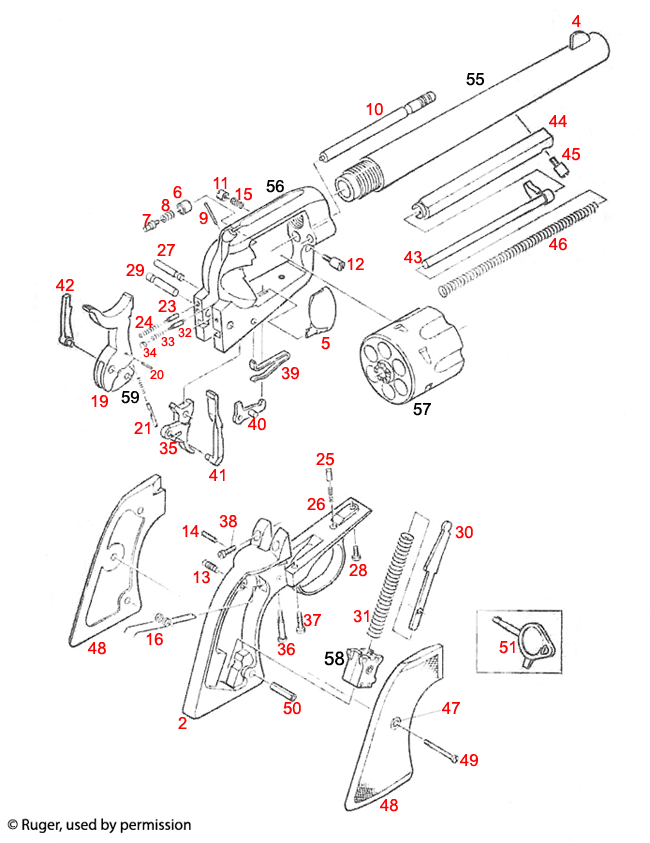
For example.  The New Vaquero is more svelte than the old.  It's built on a smaller frame, to more closely match the size of the Colt Model P.  Recently, though, I had a buddy who shoots Rugers have a malfunction that we traced to the reverse index plunger, which stops the cylinder from spinning in both directions.  It's a small, spring loaded plunger that stops the cylinder from spinning backwards.  In the below diagram, it's part numbers 32, 33, and 34.


Of course, you can click on the picture for a larger image.  Some of the Cowboy Action shooters remove that indexing plunger so that the cylinder will spin backwards.  They have some shoots where quick reloads and backwards indexing is a benefit, so they take out the indexing plunger.  Here's a picture of the indexing plunger.  Look at the plunger inside the red circle, just under the base pin.


I was looking at my Old Vaquero, made in 1993, the other night and took the cylinder out.  The Old Vaquero doesn't have the indexing plunger.  The cylinder is prevented from backwards rotation by the spring tension on the pawl.  Of course, some industrious cowboys have figured out a mod to allow reverse indexing on the old revolvers.  But, in CFDA, that mod is specifically disallowed.  Here's a picture of the recoil shield on that revolver.  With the red circle where the indexing plunger should be.


It's interesting to look at the design differences between the models.  In both of my Old models, the base-pin is captured.  You would have to remove the ejector rod to fully remove the base pin.  In the New models, the base pin comes fully away from the gun.  In the Old Models, we don't find the indexing plunger, but we find them in the New models.

Ruger is not finished making changes.  I've learned that this year's models have a new transfer bar.  They've identified some type of problem and made engineering changes to the revolver as they've gone along.  I don't have a problem with that at all, but it helps to know not only which model you have, but when the engineering changes occurred.

It's all part of the fun.

Monday, May 09, 2016

Updating the Grandson

On Saturday, after some range practice, Zach was hanging round the house.  He's a fast draw shooter and very capable with a Ruger New Vaquero.  He's shooting times in fast draw competition in the mid-half-second range.  His fastest time this weekend was a 0.540, to draw, cock, fire the revolver and hit the target, which gives him a time.  He's fast and deadly for a novice shooter, only being in the game for a year.

Since I've been a father and now a grandfather, it's been my practice to de-mystify guns.  When a kid asks, we take the gun down, make sure it's clear, and answer the questions.  Then, it's put away.  I've been doing this since my children were small with nary a problem.  Something that is not a mystery is not a problem.

Back to Saturday, Zach was hanging around and noticed the butt of a revolver on a high shelf and asked about it.  "PawPaw!  What's that gun up there?"

I took the revolver down from the high shelf, cleared it, and told him, "That's your grandma's Police Positive.  It's the revolver she carries sometimes for self-defense."

He inspected the revolver and made sure it was clear, then we walked outside.  Zach was thumbing the hammer.  I let him dry fire it a couple of times.  Then I showed him that it is double-action.

He pointed the little revolver in a safe direction, and pulled the trigger, which of course, rotated the cylinder, cocked the hammer and fired the gun, just like a double-action revolver is supposed to do.

He tried the double-action again.  "Well," he said, "That's certainly convenient."  He looked at me quizzically.  "When did hey invent that?"  He opened the cylinder and handed the gun back to me, just like an old pro.

"As far as I can tell", I told him.  "This gun was made in 1934."

The question-and-answer period was over, and he went inside to pester his grandma for something to eat.

The Police Positive Special was made, of course, from 1908 to 1995.  Grandma's gun is in .32-20, an archaic cartridge, but she's a fan of the .32 bore revolvers.  From my research of the serial number, I believe that hers was made sometimes  in 1934.  It is a very nice example and was cared for before it came into our possession.

Now that Zach is an expert with the Single Action revolver, it might be time to introduce him to the double action revolver.  Then, one day, I'll show him how a semi-auto works.  He might find that to be "very convenient" as well.

Sunday, May 08, 2016

Mother's Day

Happy Mother's Day to all the moms out there, but especially to my Mom, and Milady's Mom.

This is my Momma, taken in Gatlinburg, TN several years ago on a family vacation.

She's a powerhouse in the family, as she has always been.  Her green thumb is legendary, and she taught is all to be trustworthy and upright.  Her opinion matters a lot to me, as it always has.  Trust Mom to get it right.

In another half-hour, Milady and I are going to Jena, to celebrate the day with her mother.  Miss Reba is 94 years old, and the matriarch of the clan.  She still lives alone, keeps her own house, and keeps track of her considerable brood.  Here's a picture taken of her in Miami, about 2007.  We were touring around and inspected the intracostal waterway on a friend's boat.

Happy Mother's Day!

The Open Top

When cartridges came out, back in the early 1860s and started to get wide acceptance, Colt found themselves with an abundance of handguns that could be easily converted to cartridge use.  Unfortunately for Colt, a fellow named Rollin White had a patent on the bored-through revolver cylinder that made cartridge use easy in a revolver.

White defended his patent through the civil war, and Colt continued to produce revolvers for the US armed forces, percussion cap and ball revolvers.  A number of companies including Smith and Wesson, paid White a royalty for producing revolvers that would accept cartridges. White's patent expired on April 3, 1869.  Until then, Colt had never produced a revolver that would infringe on White's patent, but they were ready.

Two engineers working for Colt at the time, Charles Richards and William Mason, had designed a conversion that would allow cap-and-ball revolvers to use cartridges.  This is called the Richards-Mason conversion and several thousand revolvers of all stripes were converted to use cartridges.  In 1872, the Army adopted the .45 Colt cartridge as a standard for handgun use, and in 1973, Colt introduced the Model P, or the Model 1873, also called the Peacemaker.

I tell you all of this to get the history straight in my head, and to try to demonstrate how fast the firearms industry was moving at that time.  Cartridge conversions were fairly short-lived, although I'm sure that lots of fellows who had an old cap-and-ball revolver continued to buy conversion kits for several years thereafter.

Uberti is producing a conversion revolver in several varieties.  I managed to look closely at one yesterday at the club shoot.  Ricochet Rick, a fellow shooter, picked one up a week ago and I briefly got an opportunity to handle it.    Of course, these are allowed under CFDA rules and we call the Open Tops.  Rick says that his is a Navy conversion in .45 Colt, and it looks like this:


I must admit that I was quite taken with the little revolver.  It seemed much lighter in my hands than the other long-guns I've handled.  The little gun felt almost svelte.  Certainly lighter than my Turnbull Vaquero, and seemingly lighter than other Colt clones I've handled.

It's an interesting gun, from an interesting time period, and it's something I'll be thinking about in the near future.

Friday, May 06, 2016

Birds in the Backyard

Grandson Elyas installed a bluebird house in the backyard last weekend, and today I was pleasantly surprised to see a bluebird using it.  I couldn't get a picture of the birds using the house, but I did get a photo of the male sitting on the power line over the bird house.


Eastern Bluebird on the left, redwing blackbird on the right.

While I had the camera out, I noticed some humming birds zooming around, and caught a photo of a little female using the feeders we keep out there.


I stopped on the way home and picked up crawfish for supper.  Milady and I have now had a belly full of mudbugs and we're tippling.  She in the wine, me in the bourbon.  It's shaping up to be a very good Friday afternoon.

Security Risk

Is Donald Trump a security risk?  That's the question being asked.  Go to PJMedia for an article that asks pertinent question.
“My concern with Trump will be that he inadvertently leaks, because as he speaks extemporaneously, he’ll pull something out of his hat that he heard in a briefing and say it,” said a former senior U.S. intelligence official who has participated in the process of briefing presidential candidates.
Yeah, that could be a problem.  National Security briefings, I suppose, are classified, and you don't want to go "off the cuff" when you're talking about national security.

But, there's a larger donkey in the room. A large Democrat donkey. One with a documented history of security problems. She is, in fact, currently under an active FBI criminal investigation stemming from her use of a private email server.  I still wonder why she's not in jail for that little ploy.  Hopefully soon, but any security professional who trusts her does so at his own peril.

So, the question remains.  What happens if we elect a president who has documented security problems and cannot get a security clearance?  If Mr. or Madam President can't be trusted to not spill secrets inadvertently?  I suspect that those concerns are giving our national security team nightmares.