Monday, July 31, 2006

Tractor Tires

I own a tractor. A 20 horsepower 2 cylinder diesel Yanmar YM1600. It pulls a four-foot shredder. I bought it used about five years ago and basically ignore it except to check the fluids before I start it and change the oil once a year.

Last summer I noticed the tires had dry-rotted and pumped them back up till I finished mowing, then put the tractor in the barn and didn't think about it till this year. This little tractor gets run about 100 hours a season.


This morning I had to put tires on it. Firestone 8.3-24 R1 offroad/ag tires.

There are hundreds of thousands of these little tractors all over the US. They all use the same engine, the small diesel from Mitsubishi. In either the two or three cylinder variation, this engine powers IH, Case, John Deere and probably a couple of other brands. If it is a small diesel tractor, you probably have a Mitsubishi engine.

The tires never wear out on these tractors. They finally just dry-rot off the rims. I had a heck of a time finding two tires in this area, simply because there isn't much demand for them. I actually started last week trying to find some tires that didn't demand a king's ransom to buy and mount.

I got it done at a local place. I took the tractor off the trailer and sat in the shade swapping jokes and smokes with the tire mechanic, a guy about my age. He was kind of pissed, because, in his words, "The boss ran off all the other help and now he is on my case because he's behind. If you don't mind waiting, I'll change those tires right now, but I ain't getting in any hurry."

I propped up on a skidder tire and we talked while he worked. About half-way through the job, the boss came out and asked him to change one steering tire on a Kenworth tractor. He looked at me, and I shrugged my shoulders. He jacked that tire off the ground and changed it with the rim still on the truck, using tire irons. I offered the comment that it looked like he had done that a couple of times. He told me that he had been changing big tires for 29 years and that it was easier to change the tire on the truck than taking it off and putting it on the machine. In twenty minutes he was through, and got back to working on my tractor.

All told, with the jokes and the coke and everything, it took about two hours to put the tires on that tractor. I really enjoyed sitting and talking to a man who obviously understood his work.

That didn't last long

I see in this morning's Town Talk that Israel resumed air strikes after Hizbollah attacked an IDF tank. Evidently those guys just don't understand that a cease-fire works both ways.

It seems that the message got out to the residents, who Hizbollah lives among. If the civilians got the word, we can assume that the terrorists got it too.
By early afternoon Monday, roads from villages into the port city of Tyre and heading north along the coast were packed with thousands of refugees in pickup trucks and cars. With many of the main roads too shattered for use, cars drove on dirt side roads with white flags fluttering out windows or white sheets covering the roofs.
Getting out of harm's way seems prudent, indeed.

Hizbollah has no moral high-ground in this fight. They use reprensible tactics to attack the Israelis, both with rockets and on the ground. They hide behind civilians to further their goals. Captain Ed says it better than I could:
However, the world needs to temper their outrage over the accidental and collateral civilian deaths with a lot more outrage over the tactics of Israel's enemies. Hezbollah has from the opening momemts of this war targeted civilian populations on purpose, firing 2500 rockets at Israeli cities and displacing over 300,000 civilians in the process. They routinely position their fighters among civilian populations and dress them to blend into residential neighborhoods. Civilian deaths are not collateral damage in Hezbollah's strategy, but a key component of their battle plan.
The tactics of terrorists are despicable.

Sunday, July 30, 2006

Sumtin don't add up

Okay, I was over at SondraK's, and noticed this story on and IDF attack in Lebanon. It seems the Israeli Air Force attacked a building in the village of Qana at midnight, and it collapsed about 8:00 a.m. Following Sondra's links, I find that
The Council on American-Islamic Relations (CAIR) issued that call after an Israeli air strike killed at least 57 civilians in the town of Qana, the site of a similar massacre of civilians by Israel a decade ago. (In 1996, an Israeli air strike on a United Nations compound in Qana killed more than 100 civilians who had sought shelter there.) Lebanese officials said the majority of the dead in today's attack were children. Hundreds of Lebanese civilians have been killed in previous Israeli attacks.
The IDF says that an additional strike was launched at 7:30 a.m., but didn't strike the building in question.

My questions are these; Which father or mother would take children into a damaged building? Why were children there in the first place? Didn't all the parents get the leaflet drop telling them to get the kids out of harm's way? Or, is Hizbollah again using children as human shields? Were these children placed in harms way for a particular purpose? There are too many unanswered questions about civilian deaths in a building that collapses eight hours after an attack.

This is just another ploy from Hizbollah. Those children were directly placed in harms way as camera-fodder for the media.

I see from the Houston Chronicle that Israel has agreed to a 48 hour halt to air attacks. Good for them. This shows the world that Israel is willing to suspend air operations for humanitarian concerns. It will also give the parents in the area time to move the kids north. One concern is that Hizbollah will not recirocate, and will continue rocket attacks. If they do, Israel will have the absolute right to continue to pound the launch sites. If I were running the Israeli forces and Hizbollah violated the armistice, I would conduct unrestricted warfare and demand unconditional surrender before another cease-fire.

Let's not forget that Hizbollah started this mess. They can end it at any time.

Hat-tip to SondraK.

Saturday, July 29, 2006

Jihad

I noticed last week that Zawahiri said "the whole world is our battlefield."

I also notice that Seattle has had a problem with a lone Muslim gunman.

Didn't take long to connect those dots, did it? Wonder how long it'll take for the rest of the world to connect them?

Friday, July 28, 2006

Winchester 94

They aren't making these anymore. Sometime earlier this year, the New Haven plant shut down as part of Winchester's cost-saving measures.

Anyone who knows me knows that I am a lever action fan. If you do much shooting with me, you'll learn that the old .30-30 cartridge is every bit as useful today as it was when it debuted at the end of the 1800s. It created a lot of stir then as a hunting round, and it still generates campfire conversation today.

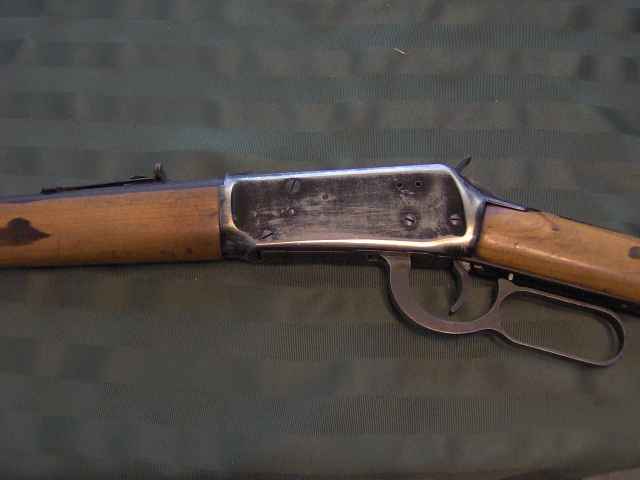
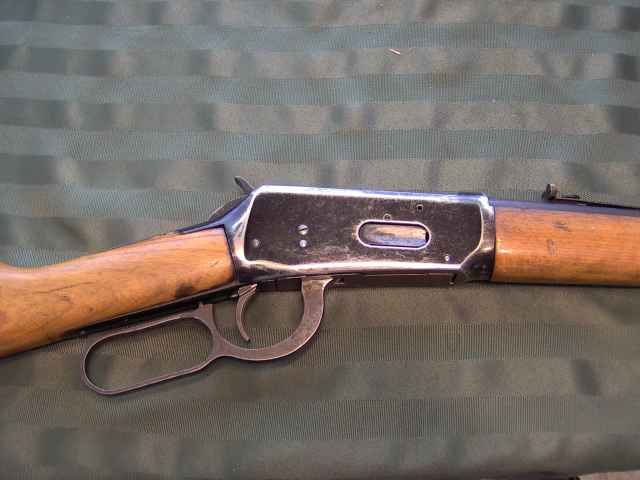
I bought another one today. It isn't new. In fact, it is older than my children. The reference website over at Arms Collectors shows this one was made in 1970. I was a junior in High School when this Winchester came out the factory. It has all the stuff I am looking for. It has no safety. It has a half-cock notch. It is tapped for a reciever sight, and it throws the empty brass straight up. It is not designed for scope mounting.


And, it is all beat to hell. This rifle was used, although the bore light tells me the rifling is in good shape. Cycling the empty action shows a little roughness in closing and this weekend I'll take it down and see what the problem is. The wood to metal fit is poor. It looks like someone tried to refinish the stock and failed. The wrist is poorly fitted to the reciever and the steel butt plate shows signs of being poorly refit. It is a beater rifle, yet Winchester ain't making these anymore.


Oh, it is a pickup rifle all right. That wear on the blueing looks like it has been slid in and out of a scabbard hundreds of times. It still sports the original semi-buckhorn sight which I intend to promptly replace with a reciever sight.

If I know Winchesters, this one has probably never been taken apart. There is very little information around on how to properly detail strip a Mod 94. While it isn't difficult, it will leave you scratching your head. Proper screwdrivers are important, as are the proper directions. One of the best I've found so far was written by my buddy, Junior, over at Castbullet. I'm betting that it has never been detailed for a thorough cleaning and that three decades of gunk and grit are hiding in the innards. We'll see soon.

What's something like this worth? The market is weird right now, because no one is making a Model 94. The Winchester plant recently closed and no one else has bought the licensing to produce them. We don't know if the Model 94 will ever again be produced and the market reflects the uncertainty. I'm not sure what it is worth even in the battered condition I found it. Similar rifles on Guns America are going for three times more than I paid for this one, yet these rifles will continue to show up in the pawn shop racks for the forseeable future. We'll have to let the market decide what they are worth.

Just for the record, if you guessed that I paid $200.00 for it, you'd be really high in your estimate.

Thursday, July 27, 2006

The Modern Battlefield

Oyster asks in comments: When you say the "modern battlefield", what do you mean, precisely? Does that include batttlefields in WWI and WWII, for example?

Good question, oyster. I might have better said "today's battlefield".

The concept of a modern battlefield is something that warriors talk about. It describes a mix of things that come into play in warfare, and includes such things as MOUT, the Air-Land-Sea battle, unconventional warfare, logistics and economies. It is much more than the tactical fight between opposing commanders.

Some might consider the US Civil War the first modern battlefield because it included for the first time, many of the parameters we usually set for a modern conflict. US Grant saw the war as a battle between economies and he focused his fight on destroying the enemy's ability to sustain a force in the field. Lee was defeated as much by his country's inability to sustain him as he was by tactical considerations.

In the European theater during WWII, our strategic forces concentrated on such things as ball-bearing factories, fuel supplies, and railroad stock as targets to bring the German army to heel. Patton rightly decided after the Ardennes campaign that the Germans were on their last leg because they were using horse-drawn carts to transport supplies.

During the Viet Nam war, we saw that an enemy in the field could be woefully smitten by our forces, but that political considerations at home would create the environment for an enemy victory. Vietnamese General Giap has said that he was nearly defeated in the field, but that the anti-war protests in the United States made military victory impossible for US forces.

All of these considerations enter into the concept of the Modern Battlefield.

My concern for Israeli forces is that the political will matches the military determination to finish the fight. Pressure is being exerted in international circles for a cease fire. Hizbollah is being beaten logistically and any army in the field that can't get beans to the soldiers will soon be defeated. I'm seeing concerns about "proportionality" for a conflict Israel didn't start. Yet, Fox news reports that Zawahiri understands the modern battlefield
"We cannot just watch these shells as they burn our brothers in Gaza and Lebanon and stand by idly, humiliated," al-Zawahiri said, adding that "all the world is a battlefield open in front of us."

"The war with Israel does not depend on cease-fires. ... It is a jihad (holy war) for the sake of God and will last until (our) religion prevails ... from Spain to Iraq," he said. "We will attack everywhere."
We and our allies are beating back the forces of terrorism, yet I see calls in the media for a cease fire. If the international community will allow the IDF to do what they set out to do, they'll win this thing and Hizbollah will be utterly destroyed. The question is not now so much the military victory as it is the political victory. The IDF might see tactical reverses on the ground, they are going to suffer casualties, they are going to be entering into a hard fight, but if the politicos demonstrate steadfast resolve, the Israelis will be victorious.

The question is the same here in the United States.

Wednesday, July 26, 2006

Late night musings

I'm watching Fox news and reading about the fight in Lebanon. For the record, I think that Israel is doing the right thing. Hizbollah started this mess, misinterpreting the will of the Israelis that they had taken all they intended to take. That raid two weeks ago was a terrible miscalulation on the part of the Hizbollah commanders.

As I watch this fight unfold, I am concerned for the IDF, not because I don't think they can handle the fight, but because don't think the media and the international community can handle it. Israel has shown that they want to bury Hizbollah, and the fighters in southern Lebanon have had time to dig in, to get set, and they are spoiling to fight the IDF on their home ground. All they have to do to win is survive.

Pete Longstreet noticed back in 1863 that with rifles and normally matched forces, the advantage rests with the entrenched defender. That dynamic hasn't changed in the last 140 years. The Israeli Army is engaged against defenders who know the terrain and have had plenty of time to plan a defense. The defenders don't have an air force, or much artillery, but they are pretty good infantry. A couple of good men in a foxhole who know how to use rifles can bog down an infantry company for a couple of hours. If the defenders have fall-back positions, the fight might last longer. If three or four such positions are mutually supporting, the fight might last all day.

I am reminded that Israel has good armor, excellent artillery and great logistcal support. While amateurs study tactics, professionals study logistics. The modern battlefield is a huge meat-grinder that costs in men, equipment, and material. Normal expenditure rates go out the window and are often tripled or quadrupled as the fight takes shape. Normally, whoever has the most stuff on the ground wins.

Fox is saying that the Israelis lost nine men today. That battle-count might pale in the next several days against an entrenched Hizbollah. I am reminded of the Marines fight on Iwo Jima, on Okinawa, and the Army's fight in the Hurtgen forest during WWII.

I think the Israelis have the stamina to prosecute such a fight. I'm not sure the diplomats and the media have the same stamina. It could get messy. It could get bloody, and it could sound the death-knell for Hizbollah.

The next few days could be really interesting.

Autorantic Virtual Moonbat

For added levity, I have added the Autorantic Virtual Moonbat on the bottom of the right sidebar. Anytime I want to read a left-wing rant, all I have to do is click the Rant button. Users are free to try it.

This is an invention of Sean Gleeson for the benefit of the blogging community. It's hilarious.

Of course, this virtual moonbat is not anything like my liberal friends. All names have been changed to protect the ignorant. Your mileage may vary. Only available by prescription. For prevention of disease and entertainment purposes only.

Rainy Wednesday

It's raining here in Central Louisiana, so I have time to linger over a second cup of coffee and think about things.

I read in the news about the Israeli airstrike on a UN observer post. Four UN observers were killed in the strike and Koffi Annan is upset about it. Rightfully so. Then I found this picture at SondraK's. I don't know enough about photoshop to know if this image has been altered, but if it is legit, we might understand how an Israeli pilot might have targeted it.


This purports to show a border observation post. From my experience, an observation post starts off with a couple of guys and a shovel. If the post overlooks something important, it gets bigger and more substantial every day. Eventually it looks like a permanent emplacement, with concrete and fences. This one shows the UN flag flying, which would tell a pilot that it is off limits. We also see a Hizbollah flag that would tell a pilot that it is a legitimate target.

Neutral observers have to take responsibility for their neutral status. They can't appear to favor either side in the conflict. To allow one side to use your facility for any reason tends to negate your neutral status and makes you a legitimate target.

Don't call the thunder unless you want to dance with lightning.

Tuesday, July 25, 2006

Second wall is up

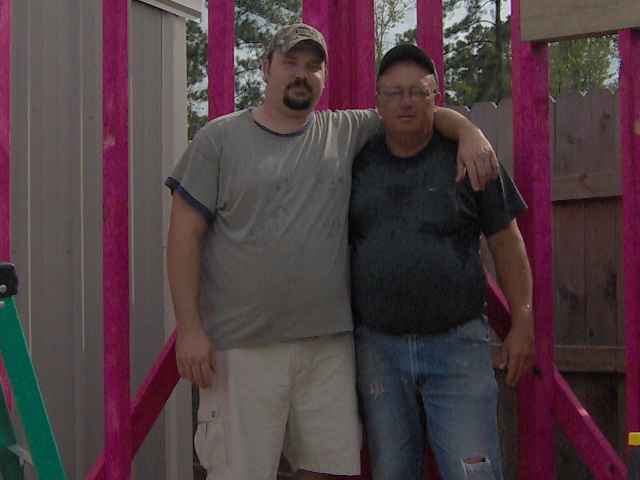
My elder son came over today and worked the nail gun while I measured and cut. We completed the framing for the air-conditioning and framed the second wall.


Carpentry goes a whole lot quicker when you have a helper. Tomorrow we'll stand up the two remaining walls, install the second header boards, then I can go buy materials for the roof.

First wall

I got the first wall standing up today. I framed it on sawhorses and Milady came out to help me stand it up. I have it braced three ways, so it ought to be there when I get back to it. With the outside temperature at 88 degrees with 100% humidity, and sun on the slab it felt a whole lot hotter. However, I now have studs standing up and I can see some progress.

I called Home Depot yesterday when I was pricing lumber and went through the whole call center aggravation before I was finally connected to someone in the lumber department. When you are buying dimensioned lumber, you ask for it in a basic number format. A standard board, probably the most common board in the world is the 2x4 (two-by four). They come in varying lengths (studs, eight, ten and twelve feet are common lengths). If you are looking for a 2x4x8, you ask for a two by four by eight. The lumber man should know what you are asking for. The conversation went something like this.

Him: "Lumber Department, can I help you?"

Me: "Yeah, I'm looking for some lumber. What are y'all getting for 2x4 studs?

Him: "I don't know, let me look....." ... ... "$2.43."

Me: "Okay, good. How about 2x4x8?"

Him "Hang on"... .... .... .... "Uuuh, I don't see them in the computer."

Me: "Are you telling me you don't have any two by fours?... Y'all are running a lumber yard down there, aren't you?"

Him: "I'm sure we have some, mister, but I can't give you a price on them."

Me: "You just lost a sale, buddy. Go tell your manager that whoever is entering prices in that computer is a dumbass."

Him: "Yessir. You have a nice day."

I bought my lumber at Martin Building Materials, a local store. A person answers the phone there, and although she has to transfer your call, the people at the sales desk know the prices of lumber back in the lumber yard. They also have workers in the lumber yard that will load your truck. The best part was that their prices for dimensioned lumber were cheaper than the national chains. They don't have a webpage, or I would have given them a link.

Sunday, July 23, 2006

Shrapnel and splinters

There seems to be some confusion over two individual types of metal used in bombs to cause personnel casualties.

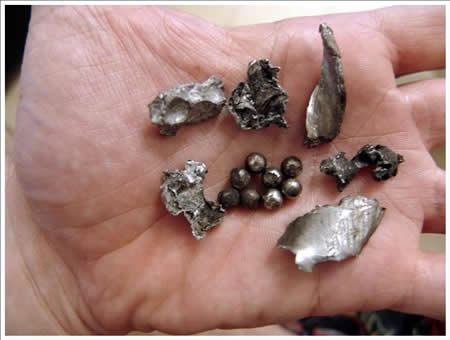
Bombs kill in any number of ways. One is concussion. The shock wave of a bomb destroys things, including flesh. Another is from splinters. The torn metal casing of the bomb deconstructs in the blast to make splinters. These metal splinters are of varying size and often do horrific damage by cutting and tearing as they fly through the air. Shrapnel is little metal balls that are included in the casing to add an increased volume of metal. They fly outward with the spinters from the metal casing, increasing the lethality of the bomb.


This picture shows the difference between splinter and shrapnel. They were found as part of the detrius of a Katyusha rocket fired by Hizbollah into Israel. This photo demonstrates the difference between shrapnel and splinter. The shrapnel are the little metal balls. The splinters are the jagged metal obects.

Either could be used against personnel or equipment. However, Hizbollah is using shrapnel in the Katyusha, an area weapon. These rockets are not being fired at military targets. They are being fired almost exclusively at cities to terrify and harrass.

Hat tip to LGF.

One more time

for those of you who aren't paying attention.

1. We are in a War on Terror.
2. Hizbollah is a terrorist organization based in Southern Lebanon.
3. Hizbollah started this latest wave of violence by raiding Israel and capturing soldiers.
4. Israel responded by bombing bridges, roads and airfields to prevent the captured soldiers from being moved.
5. Lebanon is unwilling/unable to contain Hizbollah. As such, they are a terrorist state. (You're either with us, or against us.)
6. Hizbollah hides behind civilians. Hizbollah knows that the international organizations find civilian casualties repulsive. Hizbollah doesn't care. Hizbollah wants to use civilians as shields.
7. Israel dropped leaflets warning civilians to get out. Hizbollah stopped the civilians from leaving.
8. Hizbollah is to blame for all the civilian deaths in the region. All of them.
9. UN resolutions mean nothing. The UN is worthless as tits on a boar hog.
10. Israel is an ally of the United States in the War on Terror. If they are killing terrorists, that is a good thing. If some civilians get whacked along the way, they were warned. See #6, 7, and 8, above.

100% Southern

According to this test, I am 100% Southern, on both the basic and advanced level.

Here is the link to the test.

That should come as no surprise to anyone, as I have spent all my life in the Deep South. (Army time is considered Southern, because it involves shooting, sleeping under the stars, and chewing tobacco.)

Saturday, July 22, 2006

Deconstructing Dickiet

In Comments, Dickiet says:
DickieT said...
What is it about Katrina that made everyone suddenly a Liberterian. I was in a safe, dry neighborhood too until the Corp's levees broke.
You probably should stay out of New Orleans for now. Too much to learn by seeing for yourself.
But if anyone wants to see how to do it for yourself come to New Orleans.
If you want to see where the Nanny state will take you come to New Orleans.
Or wait a few years until you can hang out in the French Quarter, get drunk with the other tourist and go home to tell the church group how decadent those New Orleans people are.
Well, hell, Pardner, it seems like everyone thinks I became a libertarian over night. That didn't happen over night. It took years of experience, and I'm really not a libertarian. I agree that there are some things the gummint does better. I don't believe that taking care of people is one of them. People ought to take care of themselves, and if they do something stupid, they ought to take responsibility for it. I'm big on personal responsibility.

Ya see, Dickie, I too was once flooded by the gummint. Back in the day, they built a big ole levee in Natchitoches Parish, but they called it Interstate 49. Before they figured out the floodplain, they flooded me out of my house not once, but twice. Six years apart. I learned all about drywall and mold and recovery. I learned about gutting houses. I learned all sorts of things that I didn't necessarily want to learn. My lil ole house on Bayou Derbonne has been remodeled three times in the past twenty years. The Feds didn't help at all. I did it all myself. I didn't whine about it, I just did it. I have the Tee-shirt. I know all about hundred year flood maps.

You're right that I should stay out of New Orleans right now. I like New Orleans and before the August 2005 debacle, I'd visit a couple of times a year and drop a couple of hundred in the local economy. I wouldn't get drunk, but I would appreciate the architecture, eat at a nice restaurant, have a drink at Pat's. Unfortunately, you people can't quit whining long enough to get your act together. New Orleans showed me it was unwilling to change when it voted Ray Nagin back in office.

Ya see, Scooter, New Orleans is the king of Whine right now. If you want the tourist dollar, you have to act like you want it. The streets have to be clean. The sidewalks have to be safe. The service has to be excellent, and above all, we don't want to hear you whine.

This year for example, I went to Laredo, Texas. Where they are having a frigging drug war. Where they find bodies every day. But where the people have quiet dignity and act like they want my tourist money. I didn't hear a single person whine about their problems. They were all happy to see me. We dropped a bundle in los dos Laredos.

All I'm hearing out of New Orleans is a victim class whine. "We were evacuated. We lost everything. The levees broke." No one wants to go on vacation and listen to that shit. You want to be decadent? Fine. All we ask is that you have a little class, a little style.

There are a lot of folks in the USA who have been disastered. I've been through it twice, so there isn't a damn thing that New Orleans can tell me about it. When it happens again, when you have rebuilt the second time, when the bills are paid and you've done the work you need to do, then you can talk about it with adults. Until then, shut the hell up. You've got work to do.

Mayoreo y Menudeo

I saw these two words everywhere in the Spanish speaking parts of Laredo (both sides). There is another Mexican cutie in the photo, but all you see is her back.


Mayoreo and Menudeo. At first, I thought Mayoreo was a nice play on words to describe Mayor Ray Nagin of New Orleans, but the fact that these words were painted on nearly every storefront made me believe that perhaps it means Wholesale and Retail or some other phrase that is significant to cross-border shoppers.

Anyone care to translate this for me?

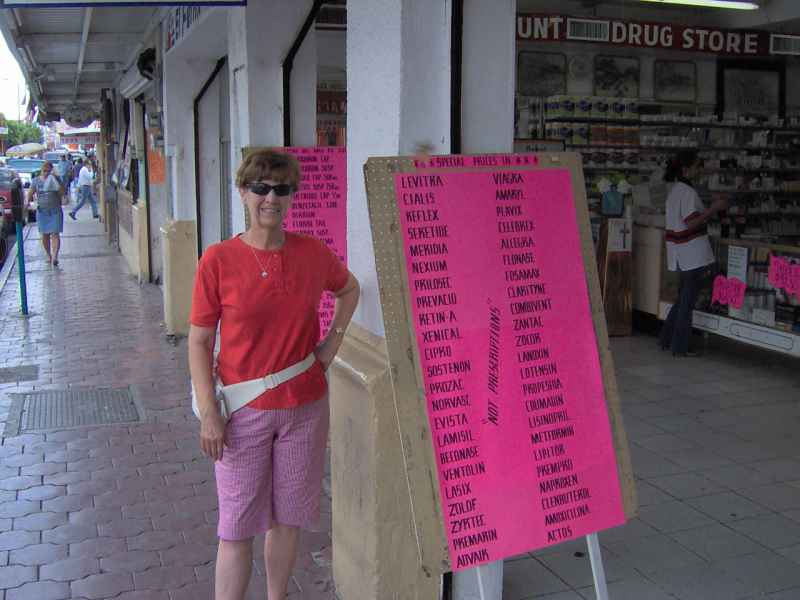
I love this photo, taken in front of a Mexican pharmacy. Lots of medicines that require a prescription in the US are sold OTC in Mexico. Here, Milady poses with a placard outside a main-street pharmacy.


You'll notice that the first three listed are Levitra, Viagra, Cialis. Numerous other brand-name medications are on the card too. Prescription medications are easy to find in old Mexico as OTC medications. Narcotics are controlled and require a physician, but other meds are sold across the counter.

Friday, July 21, 2006

Katrina and Beirut

This morning as we were packing, I noticed a CNN reporter interviewing US Citizens being picked up off the beach in Beirut. No screen shots or links.

Anyway, here comes this young mother with children in tow, being loaded on a US Navy landing craft and some reporter puts a microphone in her face. And she's talking about "We're from New Orleans and we lost everthing in Katrina and now we've been evacuated twice in one year." (Not a transcript)

My wife, my lady, looks at the TV and says: "How many times do we have to rescue you before you take those kids somewhere safe?"

All I could think was "Damn! What an idiot! Is there anywhere you go, anything you do, that you don't have to listen to Katrina refugees complain?"

I am calmed knowing that the dumb broad is on her way to Cyprus, again on the government nickel.

In other news, we made it home about 1:00. Everything is safe and all is right with the world. Laundry is working and I am about to go take a nap in my own bed.

I noticed on the driveway that my grass really needs cutting.

Thursday, July 20, 2006

Observations of the border

1. Anyone who swims the Rio Grande doesn't know how to walk.


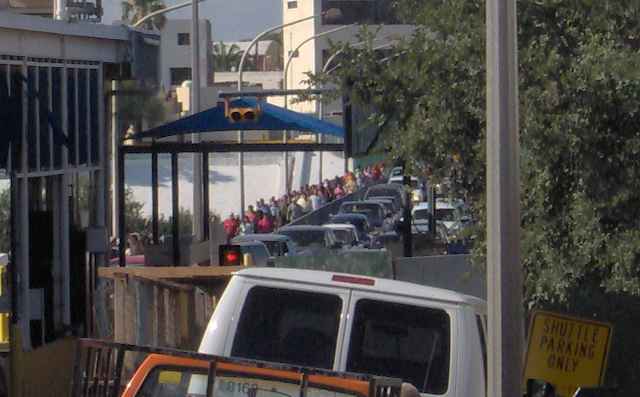
This photo is taken of the international bridge in Laredo, TX. Those folks walking across the bridge are Mexican nationals who work or shop in Laredo. I watched for an hour and a half. Steady, all the traffic the bridge could hold. Those who were shopping were buying those things that might not be available, or they were buying those things that were valuable for resale. At the end of the day, the traffic reverses and those folks who came over, go home. Those lucky enough to have jobs over here, pay Social Security and they are working for retirement, just like the rest of us working stiffs.

2. The women are beautiful, but not in the over-makeup, boob-job American sense. They are women as God intended them to be.


I don't know who this young lass is and it doesn't matter. She showed up in a photo I was taking of the street. Young, soft curves, delicate features in the morning light. She was shopping and she is representative of the young women who cross the bridge every morning. The older ladies have a soft dignity born of life. There is nothing artificial about them. What you see is what they are.

3. We were stopped by the border patrol about twenty miles north of Laredo in a common border checkpoint. The officers there cleared us quickly. We asked why there weren't more tourists in Nuevo Laredo and were told that there is a drug-turf war going on over there and they are killing about one person a day. The tourists are staying away and that is causing the border vendors a loss of business. We noticed on Wednesday that we appeared to be the only four gringos on the south side of the border, and that might explain the loss of cross-border American traffic.

4. The border problem is a whole lot more complicated than it seems at first glance. There are a lot of good people who will be affected, regardless of whatever the Congress decides to do about the border.

We've been east-bound since noon. We left Laredo after lunch and started home. We're spending the night at Baytown, Texas and tomorrow we'll make the final jump to central Louisiana. Vacation is about over.

Wednesday, July 19, 2006

Nuevo Laredo

I learned some interesting things today. One is that Blogger evidently allows only two photos per post. I can work around that.

Here is something else I learned. Honda sells different motorcycles in Mexico than it does in the US.


This is the Honda Cargo, (CG125) a neat little runabout that the Mexicans use as a delivery vehicle. It works great for small deliveries. I also learned that Burger King makes deliveries in Nuevo Laredo. That is a great idea they should export to the United States.

Milady loves shopping, which comes as no surprise to anyone.

Here she is surrounded by costume jewelry. She didn't make any purchases at this shop, but did buy a very unique ring at a jewelry shop down the street. Jewelry is sold by the gram across the border. When asked a price, the jeweler would weigh the piece and do a little figuring on a calculator. That was the starting price. The haggling began and a price was negotiated. Milady saved considerably on her purchases.

I bought a couple of belts made of sturdy harness leather. When I asked about the price, the girl told me that they were $10.00 a piece.

Then I asked, "What if I buy two?"

"Eight dollars apiece."

"Suppose I buy three?"

"Seven dollars apiece."

I enjoyed Mexico, but I am still wondering why it seemed that the only Gringos in Nuevo Laredo were in our party.

Laredo

We got into Laredo about noon today and immediately started shopping. Laredo is a beautiful old town, with narrow streets, duty free shops, and wonderful architecture. This is the first time I've been on the Mexican border so my observations are a bit jumbled.

This shot is of the central square of the old town in Laredo, TX. We walked down to the duty free shops and bought some liquor. After we made our purchase, the store owners had a guy who carried our shopping bag to the international bridge, where our purchase was checked by Mexican authorities, then we walked past the turnstiles, crossed the road, then came back through US Customs. We put our bags in the car and went to lunch.

After lunch, we went over to Nuevo Laredo, Mexico, where we took a carriage ride to the old market.

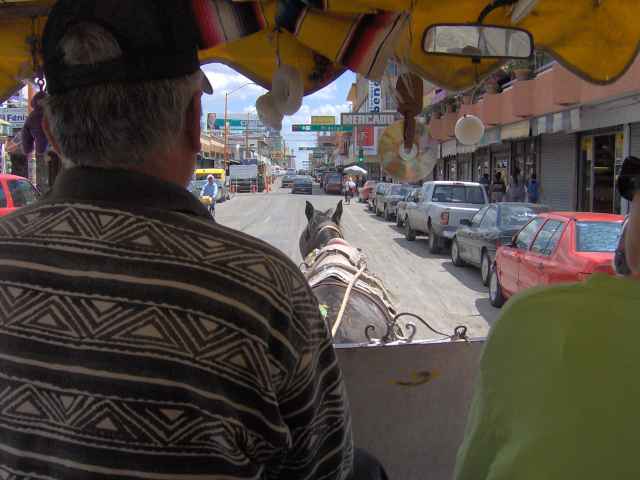
A view of Nuevo Laredo from the perspective of looking across a mule's behind. We bought some leather, and some jewelry, and some clothing. No problems there. US Dollars are universally accepted. There was some sort of weird butterfly infestation. There were literally millions of small butterflies in the old market. On the way back to the bridge, Jerome decided to buy some more tequila. He bought it at a duty-free shop and some guy who worked for the store took the bag and carried it to the bridge, where it was again checked by Mexican authorities and we took possession on the bridge.

I was amazed at the amount of cross bridge traffic, both pedestrian and vehicular. I don't see the problem with getting across the border. It is virtually porous. I didn't see anyone stopped going either direction. Anybody who actually swims the Rio Grande just doesn't want to walk across the bridge. One guy in Mexico asked if we could give him a ride to Fort Worth. We told him that we weren't going that way and he left.

Another thing that I noted was that we four were the only identifiable US citizens this afternoon in Nuevo Laredo. We stuck out like sore thumbs and we were treated with courtesy and dignity and respect. I never felt threatened or uncomfortable, but I was keenly aware that we were the only Gringos in the old market. The current exchange rate is a little over 11 to 1, and there are some very good bargains available in Mexico.

I wonder why there weren't more tourists over there this afternoon?