Saturday, January 21, 2012
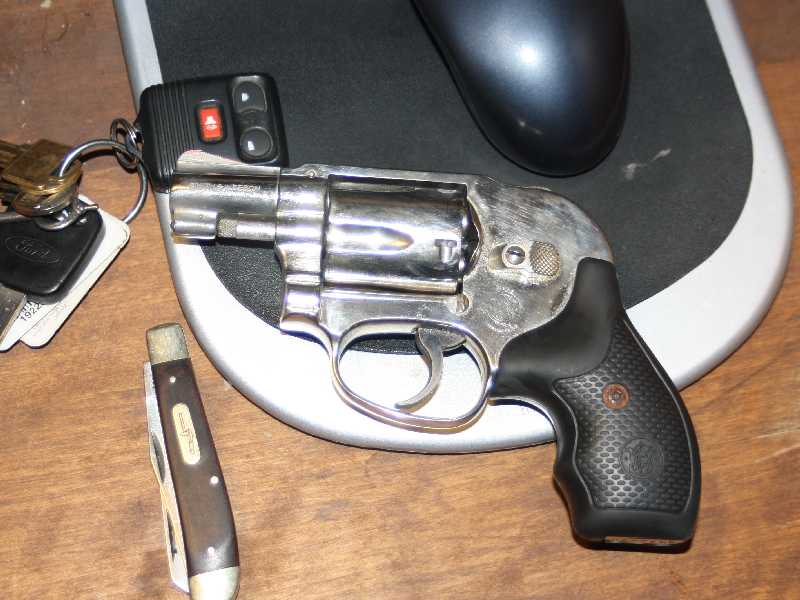
Model 38
Probably the most iconic image of the Bodyguard revolver is that unforgettable image that comes from Vietnam. Graphic in nature, the image shows Vietnamese general Nguyen Ngoc Loan shooting a Viet Cong captain named Bay Lop in the head. Historians agree that General Loan had sufficient justification for shooting Captain Lop, but this image is one that is forever tied to the Model 38.
My daughter-in-law wants to get her concealed carry permit, so I've been shuffling around, trying to find a suitable firearm. She told me that she liked a .38 special revolver, and she really likes my Model 60. She prefers a steel frame for the weight, which tends to mitigate recoil. In my browsings, I happened to stumble across a Model 38, and while I've never owned one of those revolvers, I've always wanted one. This morning I went to look at it again, did a Jim March Checkout and found the revolver to be solid. It's pinned, but SW never recessed this revolver. Herrit grips, which seem to fit my hand particularly well. The price was such that I promised the counter guy I'd never discuss it. He treats return customers surprisingly well.
After I got home, Milady happened to see it and wanted to inspect it more thoroughly. She then exclaimed that this is the revolver she wants to use to get her concealed carry permit.
Huh! I guess I'm still looking for a Model 38.
Sunday, March 03, 2019
J-Frames, Gawd, I Love Them.
I carried that Model 60 (in .38 Special) and stoked with with the Federal Ny-Clad ammo that was common in the day. I still have a few cylinders of Ny-Clad left. It served me well over the years, and had good reviews back in the day. I carred that Mode 60 until 2012. My daughter-in-law wanted a steel J-frame and I wanted an Airweight, so I happened upon a nice, clean Model 38 and gave her the old Model 60. I never looked back. I dropped the Model 38 in my pocket ad it has been a constant companion for over seven years. It's a gun that is carried a lot and shot little, although I did qualify with it on the Sheriff's range three or four years ago.
Yesterday, my son did a detail strip on the Model 38 and we found some corrosion under the cylinder release, between the aluminum frame and the nickel plating. Two sons inspected it, and declared that I should have the frame stripped and re-coated before putting it back into service.
Younger son is a pretty fair SW mechanic, and elder son worked for a while as a body-and-fender ma on aluminum aircraft. They both recommended immediate repair and I trust their combined judgement. So, my beloved Airweight is going to the body-and-fender shop. Probably for a Duro-coat job.
As younger son was leaving, he handed me a replacement J-Frame. "Here, Pop, carry this until your gun comes back from the shop."
"I've got carry guns, " I retorted. "You might need this one."
"I've got two more at home." he said. "I don't need this one right now."
So, I slipped it in my pocket and went about my business. I noticed it was heavier than my Airweight, but that is the nature of steel vs aluminum. It wasn't till this morning that I inspected it. Holy-Moly.
This is the Model 640-1, in .357 magnum. With Crimson Trace grips. And, yes, the barrel is marked SW 357 Magnum. It should be quite a handful if I ever have to touch it off.
On the other hand, it might be a lot of fun. Thanks, son. I'll try not to hurt it.
Wednesday, September 02, 2015
Pawn Shop Crawling
It was marketing genius to introduce it at the IACP conference, but the simple fact is that the J-frame revolver makes a lot of sense for a lot of people The .38 Special is a wonderful old cartridge, a cast-bullet dream, but the newer loadings from the ammo manufacturers today make the .38 Special into a perfectly capable defense package. Combine the light weight and small frame of the Chief's Special with the good ammo we find today and the little revolver is perfectly suited to defensive carry.
I've owned and carried several J-frames over the years. I like the little guns, and indeed, I carry a J-frame today, in the form of an Airweight Model 38, another revolver built on the J-frame. But, like most revolver fans, I like the Model 36. The Model 36, is of course, the basic Chief's Special, renamed when Smith and Wesson went to model numbers rather than names.
Yesterday, I walked into my favorite pawn shop. A family friend had asked me to look for a small handgun. I had an hour to kill between assignments and decided to see what Jimmy had in his gun case. He had the usual semi-autos and a few revolvers, but all by itself, over in the corner, lay a gun that caught my eye.
It' s a nickeled Model 36, but it has the heavy, 3" barrel. And Pachmayr grips. I asked to look at it, and the counterman handed it across the counter. It felt good in my hand, and those big grips may cover either the square butt or the round butt. Smith made the little gun with both grip styles. The little gun seemed tight, as most of them do. J-frames are guns that are generally carried much and shot little, and even the survivors from 50 years ago are normally pretty tight.
I looked at the price tag, and it seemed about right for a used revolver, but pawn shops are places where the price is flexible, and I've been buying in this shop for more than a decade, so the counterguy and I began the dance. Then along comes the shop owner, the world famous Cajun Pawn Star, and we started talking about other things. We walked toward the back door, and I shook Jimmy's hand and crossed the street to my parked truck.
I climbed up in the truck, started the engine, and realized that the counterguy and I had not finished our dance regarding the price. I texted my son and asked him what he thought, then got the checkbook out of the console and walked back in the shop. In a few minutes, the counterguy and I had come to a conclusion, so I wrote him a check to hold the gun on layaway. I'll get it out in a month or so.
Wednesday, January 28, 2015
Handguns From My Past
The Model 60
One day in late April, I believe it was in '87, I had to run over to the courthouse to have the judge sign a warrant. I talked with the judge's secretary. He was in court, but they were finishing up a trial and if I'd wait, she'd make sure I got in to see him. So, I waited, cooling my heels in the hallway outside the judge's office. After a while, the judge came down the hallway from the courtroom. He was holding a small plastic evidence bag, and inside I could see a small frame revolver. He looked distastefully at the little gun. "What am I supposed to do with this thing?" More a rhetorical question than anything.
"Give it to me, your Honor."
He looked at me. "You need to see me, Dennis?" He looked at the gun. "Come on in." We walked into his office and he called his secretary. "Take a minute entry," he said. "I'm ordering that this" he looked through the plastic on the bag "Smith and Wesson revolver, serial number. XXXXXX be given to Agent Dennis Dezendorf for the furtherance of law enforcement in Chinquapin Parish." He tossed me the pistol. "So ordered."
As the judge signed my warrant, I looked at the little piece. It had been used in a pistol-whipping. Blood was evident on the revolver and the trigger guard was crushed, pinning the trigger against the frame. That evening, at home, I got some hot, soapy, bleach water and washed the blood off of the revolver, then took down my 4" gun and removed the side plate, studying the internals. Then I took the side plate off of the little Model 60 and compared the internals The little gun didn't look hurt, simply held captive by the crushed trigger guard. I grabbed the trigger guard with a pair of vice grip pliers, got the guard in a good strong bind, and gave it a yank. It bent back out and the little gun worked. I tweaked it a little bit, and I had my Model 60.
As I recall, this was about 1987. I was promoted soon after and got a Don Hume Level II holster to carry it. I still consider that old Don Hume one of the very best holsters for belt carry. Unfortunately, they don't make that holster any more. Fortunately, I have two of them and they're very good leather. I carried that little pistol as a supervisor. My 4" gun still did duty as a woods and competition gun, and I turned in the 2.5" Model 66. It was a good gun, but I didn't need it.
That little pistol digested a lot of my 4.3 grain Unique load, but for duty, I carried Federal's Ny-Clad 125 grain load. At the time, that was the very best .38 Special ammo that ran standard pressure and I didn't want to beat the little gun apart.
One day in the late '90s I came home on a sunny afternoon. As I was getting out of the truck, I heard a boom and figured my elder son was target practicing in the back yard. So, I grabbed some ear muffs out of the truck and walked around the house. Elder son was standing there with his big Ruger .44 magnum. He had set up a hay bale about 25 yards away and had set a line of beer cans up on the bales. I watched him fire the big hogleg, then stepped around him, unholtered my Model 60, and peeled one can off the hay bale.
"Keep practicing, Slick. Front sight, trigger squeeze." I holstered my revolver and turned toward the house.
"I bet you can't do that again, old man." he retorted.
I kept walking. "I don't have to do that again."
I retired a couple of years later, and that Model 60 became my pocket pistol. Dropped in a jeans pocket, or in my slacks, the little gun was a constant companion. In late 2012 my daughter-in-law was looking for a steel J-frame. She had tried her husbands alloy frame and the recoil was too stout, but she liked the size of that frame. I had found a Model 38 Airweight and was considering using that for my pocket pistol, so I passed the Model 60 on, as a semi-permanent loan. She carries it today as her concealed carry piece, and from all accounts, shoots it just fine.
We did do a bob job on the hammer, because she carries it appendix carry and the hammer spur was digging into her skin. I now use the Ariweight for a pocket pistol and anytime you see me with pants on, you can be assured that the little gun is riding in my pocket. It suits me fine.
Oh, Missy. If you look on the bottom of the trigger guard, you might be able to see the marks that those vice-grips made so long ago. I never polished them out. They're part of the story, and the history of that little pistol.
Sunday, August 11, 2013
The Bob Job
Everyone has seen these little pistols, the first stainless steel revolver made by Smith and Wesson.
Until today, that's what it looked like. Classic, spur hammer revolver.
Last year, my daughter-in-law was looking for a pistol suitable for concealed carry. She had shot her husband's model 638, and she had shot my steel Model 60. She preferred the Model 60 for the extra few ounces of the steel frame. She said that those few ounces moderated the recoil of self-defense ammo, and I have to agree with her. Good, clean Model 60s are rare as hen's teeth around here, and I had recently acquired a Model 38, so I passed the Model 60 to her. She carried it for her CCW training, and she's carried it since, but that hammer spur caused her problems while she was working. That little spur kept working itself into her, and as she does a lot of bending and stooping at her job, she decided that she wanted the hammer bobbed.
Today, after church, the sons and I got out Kuhnhausen's manual, and did a quick read-up on the project. My elder son is a wizard with metal, and we enlisted his help in this delicate project. In about twenty minutes we had the hammer out of the frame, then we let him chuck the hammer in a lead-lined vise and let him work his wizardry. For about an hour, sparks flew, and motors whined, and in short order he had removed that offending spur.
I think he did a great job. The offending spur is gone and what's left is nicely rounded, de-horned and blends niceley wit the curves of the hammer. Here's a closer view.
I don't think we could have paid for better work. It's altogether a worthy project for a Sunday afternoon, and certainly worth the meal I fed him after the job was done. I'm very pleased.
Aw, heck, one more picture, from the very back of the pistol.
Is that good work, or what? My children are the greatest blessing of my life.
Thursday, September 04, 2014
Smith and Wesson Model 10-2
Last week, a coworker told me that there was a new gun shop in town, and he told me that there was an old Smith and Wesson revolver in the consignment rack. Today during a break I found the place, a tiny shop wedged into the corner of a building. I walked in and asked about the old revolver. The lady brought it out from the counter.
It's a 10-2, a 4" tapered barrel revolver. Fixed sights, .38 Special, pinned barrel, nothing special about this revolver at all, except that I'm a fan of old revolvers and according to this site, this particular one was made in 1961, I've never owned a Model 10, but I've always liked them as basic, rugged revolvers. They certainly have a time-tested design. I did a quick Jim March checkout, and while the outside of the revolver has flaws, the internals seem fine. It locks up tight, timing seems good, and the blueing is a lot nicer than the picture indicates.
After a little dickering, the price became right. Very right, and I filled out a 4473.
Friday, November 25, 2016
Detail Cleaning
I bought it, shot it a few times, qualified with it, then dropped it in my pocket where it has been almost a constant companion for the past four years. I didn't clean it much, because I didn't shoot it much, but lately, I've noticed that the action got a bit stiffer. I figured an accumulation of pocket lint and other goodies had worked its way into the action.
I don't know how to detail strip a J-frame, never bothered to learn. I have that most valuable of assets, a kid that knows how to detail strip a J-frame, so yesterday after lunch, I asked the question that all fathers learn to ask. "So, you want to teach me how to strip a J-frame?"
"Sure, Pop" he said, so we set up under the patio, and I got the cleaning gear. He took off the grip, looked into the fiddly bits, and exclaimed "OhmyGod".
Then he unscrewed the side plate screws, tapped off the side plate, and asked "Have you been carrying honey in your pocket? Maybe spilled Pepsi at some point?" Evidently, the accumulation of pocket lint, gun oil and solvent make the interior workings of the little levers and springs something special to clean, so we got out a can of carb cleaner to help with the de-greasing.
About ten minutes later, it was done. The interior of the frame was spotless, all the springs and levers had been de-funked. A few drops of oil, judiciously applied, and the fiddly bits replaced. A quick function check, and the trigger of my Model 38 feels much nicer. Very much nicer indeed.
Thanks, son. The old man appreciates it.
Tuesday, January 27, 2015
Handguns From My Past.
The Model 66
In 1970, Big Blue came out with their Model 66, the stainless version of the K-frame Model 19. A six shot revolver in .357 magnum, by the early '80s the Model 66 was almost a universal sidearm for police officers. You'll recall that the "wondernines" didn't come out until the late '80s and weren't widely accepted until the early '90s. You might also remember that Gaston Glock hadn't develop his pistol until the early '80s and the Austrian army didn't adopt them until 1982.
Back in the '80s the revolver still dominated police work, either as a duty gun or a plainclothes gun, and Smith and Wesson was the leading manufactory.
Sometime about 1983 or '84, my department bought a bunch of SW 66 pistols on contract. These were identical stainless pistols with round butts and 2.5 inch barrels. They were roll-marked LAPP on the water table, under the cylinder on the left side of the handgun. We were told that these were the handguns we'd use for duty work, and that was that. No matter that each of us had heretofore purchased our own handguns, the department was now issuing them, and no argument.
My Ruger represented a week's groceries and the department had issued me a pistol. The Ruger was excess inventory and I had kids at home, so it went on the block. I got $100 for it. I still regret selling that handgun, one of only four firearms I've ever sold. But, that Ruger and the subseqent Smiths began my love affair with the .357 magnum. Even today, I consider the .357 magmum cartridge one of the most versatile handgun cartridges ever developed.
If I had to limit myself to one handgun cartridge, the .357 magnum would get the nod. Loaded with light charges of fast powder and lead bullets it takes small game with authority. Loaded with a good flat point harcast bullet, it is the bees knees for medium game up close. In a carbine, it shines out past 100 yards, the limit of much of my shooting in the piney woods. With good expanding ammo, it's just right for holstering and rural law enforcement. I carried a Model 66 for well over 20 years in rural law enforcement and never considered myself under-gunned.
In the mid '80s, a good family friend came by and asked me to hold a near-mint Model 66. This one had a 4" barrel. She was in an abusive relationship, was going through a divorce, was afraid of her soon-to-be ex, and asked me to hold the revolver. I cleaned it, wrapped it in denim, and hid it in my closet. A year or so later, I asked her about it, and she told me to keep the gun. She didn't want it. Too many bad memories. I didn't ask any questions, but told her I appreciated it.
Woot! I suddenly had a 4" Model 66, probably the perfect woods cruising revolver, and a damn fine service revolver. I had just begun reloading and I settled on a practice load of Lee's great little tumble-lube 158 grain semi wadcutter over 4.3 grains of Unique and anybody's small pistol primer. Even today, 30 years later, that's still my favorite .38 special load. It gives me about 800 fps, is wonderfully accurate and very mild.
Over the next several years, the department started letting us use our personally owned revolvers, if we could qualify with them. I qualified with my 4" gun and got a leather rig for it. Over the years I won several department matches with that revolver and consider it one of my very favorite pieces. The only thing I didn't like about that gun was the square butt, but a new set of Pachmayr Signature grips and a half-hour on a belt sander, and I had a revolver that fit me like a glove. The grips look like hell, but they fit my hand. That gun served me for almost 20 years before I retired it, and it's got more stories than I can tell here. - - Well, maybe one.
One day in the late '80s I was hunting deer as part of a large group of folks in Red River parish, north of Coushatta, LA. We were "running dogs" across timber tracts late in the season. We'd ring a section of woods with standers, turn loose the dogs, and try to shoot the deer as they came out.
If your dog ran a rabbit, that was considered poor form, and the hunt-master that day swore that his dongs didn't run rabbits. They put me on a small utility cut in the middle of the damndest thicket you've ever seen and told me to watch one particular hole in the brush. They were going around to the other side of the woods, about a mile away and turn the dogs loose. "If a deer comes through that hole, shoot it. If you miss, catch the dogs, because there's nothing behind you but pine forest."
So, I found a convenient place to watch that hole and got comfortable. After just a little while, I heard the dogs "jump" and it sounded like they were heading straight for me. So, I hunkered down and watched that hole. The dogs got closer, and I tightened the grip on the shotgun. The dogs kept coming, and I shouldered the shotgun waiting for a deer to fill that hole. Suddenly, I could see dogs about 40 yards down the lane, hot on the trail of a big ol' cottontail rabbit.
The rabbit came out that hole into the utility cut and squatted down. I drew my revolver and shot the rabbit's head off from a range of about 15 feet. That same load of Unique with a 158 bullet. I caught the dogs and tied them before they could get across the cut, then waited for the driver. He was considerably dismayed that his dogs ran a rabbit, and I was considerably pleased that I could prove it to him. He took a lot of ribbing about that for the remainder of the weekend.
I retired that revolver in 2003 after 20 years of honorable service. I loaned it to a daughter-in-law to use for her concealed carry class, and it still lives in my elder son's gun safe. That old Model 66 is one of my very favorite revolvers. It may serve the family for another generation at least.
Saturday, January 23, 2010
On the Range
We started with a standard wadcutter loading, using a 148 grain hollow-based wadcutter loaded over 2.7 grains of Bullseye. This has proven to be a very accurate load in my revolvers.
With the Model 28-2, average velocity was 624.1.
With the Marlin 1894, average velocity was 602.4.
Interesting! The HBWC target load actually lost velocity in the longer Marlin barrel.
Next, we tried a light .38 special load, using the TL358-158 SWC bullet, loaded over 4.3 grains of Unique. This load has also proven to be a very accurate load in a variety of revolvers.
In the Model 28-2 we saw average velocity of 790.8.
In the Marlin 1894 we saw average velocity of 950.9.
That's an increase of 160 fps. I don't know yet what I'm going to do with that informaiton, but there it is.
We moved on to the .357 magnum case. First, we tried the TLC358-180 RF (Ranch Dog) bulet over 12.0 grains of 2400. This is a fairly stout magnum load throwing a heavy bullet.
The Model 28-2 showed us an average velocity of 1022 fps.
The Marlin 1894 showed us an average velocity of 1340 fps.
Then, we tried the same bullet, that TLC358-180 RF, but this time over 15.0 grains of Hodgdon Lil'Gun powder. You might recall that this is a gas-checked bullet.
The Model 28-2 gave an average velocity of 1190 fps.
The Marlin 1894 gave an average velocity of 1592 fps.
Understand, all these velocities are out of my guns, over my chronograph. All these bullets were lubed with Liquid Alox and while I was cleaning the barrels, I looked for lead and didn't see any on the brush or the patches.
Additionally, I shot the Ruger New Model Super Blackhawk.
With the Skeeter Shelton load, 7.5 grains of Unique under a 240 grain semi-wadcutter, I realized an average velocity of 971 fps. Recoil was mild to moderate and the revolver was very controllable. I did not get to post a target, so I was shooting directly into the berm, but I was able to pick off dirt clods.
Then I stepped up to the full-house load, 19.0 grains of 2400 under that same 240 SWC bullet. Average velocity was 1345 fps and recoil was interesting, although not severe. I knew I had a serious handgun and a serious load. Accuracy was okay, although these were the first shots from this revolver and as I get used to a single action, I'm sure my groups will improve.
Both loads from the .44 were fun. I can see the utility of having both of them in my ammo cache, and I'll probably shoot more of the Skeeter loads than the magnum loads. Still, the heavy load is nothing to be afraid of. I fired about 15 rounds of the full-house stuff with no ill effects. My Model 28-2 had more apparent recoil with the Lil'Gun load and I'm accustomed to firing full magnum loads through that revolver.
It was a very interesting morning.
Sunday, December 21, 2008
Overall Length
I'm a fan of the .357 magnum cartridge. All of my revolvers are chambered for either .357 magnum or .38 special. Recently, a bunch of us from over at the Cast Boolit forum made a group order for a special bullet mold. The mold in question is a custom Lee 6-hole mold that throws a tumble lube, .358 inch, 180 grain, flat point, gas checked bullet. It's a big ole bullet with a wide flat meplat. It was designed for the .35 Remington rifle cartridge, but I thought it might be the bees knees in the .357 cartridge.
It's a good looking bullet and last week I finally got around to loading some. I used Alliant 2400 powder and a CCI primer, trying to get a load that would fly at about 1300 fps out of my revolver. After I had loaded a couple, I thought they looked a bit long, so I picked up my SW Model 66 and loaded a couple into the cylinder. They fit fine, and weren't too long for the cylinder. Great! I loaded the remaining brass and set them aside.
This morning, I took another revolver, My SW 27 6", my Marlin 1894C, that loaded ammo, and went to the range. Imagine my surprise when I loaded a cylinder and had the cylinder lock up as soon as I closed it into the frame. A quick survey of the problem showed me that the ammo was too long for the cylinder. Of course, you can click on the picture for a bigger view.

I was considerably surprised at this development. The ammo fit fine in my K-frame Model 66, but wouldn't fit in my N-frame Model 27. I figured that SW chambers would be the same length, but I'd obviously be wrong about that. So, while I thought about how to get my cylinder un-stuck, I tried to run a few rounds through the Marlin lever action. The ammo was too long for that action, too. It wouldn't feed. Some more reloading was obviously in order, with the bullets seated more deeply in the cases.
The rangemaster at the range carries a K-frame SW Model 13, which is a close cousin to my Model 66. I asked him to try the ammo in his revolver and it fit just fine.

He ran a cylinder through and it shot surprisingly well in his revolver, turning in tiny groups. So, I gave him about 30 rounds, rather than having to pull the ammo down. He can shoot it and he'll return the brass at some point in the future. He says he might do some late season deer hunting with it, and it'll be perfect for that role.
Afterwards, we took my locked-up revolver to his shop and I whacked the cylinder with a rubber mallet. It opened and we got the ammo out. Again, I was considerably dismayed at this development.
I came home and measured the cylinders of those two pistols for total length. Both the M66 and the M27 cylinder are recessed and both barrels are pinned. The Model 66 cylinder length measured at 1.672 inches with my calipers. The Model 27 cylinder measured at 1.623 inches. That's almost five-hundredths difference in the two revolvers, and the small K-frame has a longer cylinder than the larger N-frame. The loaded cartridge, interestingly, measured at 1.662, which is over the SAAMI length, but it fit and functioned in the K-frame. I'd have thunk that all Smith and Wesson .357 cylinders were the same length, but I'd have been wrong. That's not a mistake I'm likely to make again soon.
I'll reload some more and pay attention to my OAL. This is a lesson I don't intend to repeat.
Wednesday, July 27, 2016
My Time With the .357 Magnum
In 1970, Smith and Wesson introduced the stainless steel version of their Model 19, and called it the 66. It was a stainless steel K-frame revolver and by the time I got into police work in 1981, probably 90% of the police officers carried them. Back in those days, the Model 66 was as ubiquitous in police work as the Glock is today. About 1982, I acquired a clean used one and began carrying it. Mine was the standard 4" revolver. It is still in my battery today.

What I liked about the revolver for police work was the ability to match the ammo to the task at hand. You could use the ammo like a throttle. Mild, .38 Special cartridges for target and training, or hotter stuff for longer range work. Back in those days I read a lot of Elmer Keith, Bill Jordan, and Skeeter Skelton's work. When I began reloading, the very first cartridge I reloaded for was for that revolver. Target loads in .38 Special. After a little while I started loading stouter loads for the magnum, and came to settle on a couple of pet loads.
Don't get me wrong, I'm not hating on semi-auto handguns. I like them just fine, but the ammo has to match the spring tension. Too light and the gun won't cycle. Too hot and you batter the gun. With a revolver, that's not a problem. From a squib load to the hottest magnum, if you can close the cylinder, the gun will probably fire and extract.
I continued to carry a revolver till the turn of the century, long after most officers had switched over to the semi. One day right in the winter of early 2002, I was at a training class. We had just qualified and the instructors wanted to send us through a firing scenario. It went like this. On our tactical range, we'd walk through a door and immediately engage two targets to our left, about 10 feet away. Then, looking downrange, you'd see three targets at the 50 yard line, with a covered position at 25 yards.
The idea was to engage the two close targets, then run downrange and engage the three targets from cover. But the instructors were nefarious. The targets downrage were heavy steel silhouettes. and we had to knock them over. I was halfway back in the line, and I saw the problem that the guys were having with their 9mm pistols. They would have to advance on those heavy steel silhouettes to knock them down. My revolver was stoked with standard .38 special training ammo, and I knew that I'd have problems.
But, one of my pet loads was a heavy magnum load. It consisted of a 180 grain hard cast bullet with a wide, flat meplat and was loaded with a stout charge of 2400. I knew what that load would do, and as importantly, I knew it was very accurate. And, it was visually impressive. It threw a fireball at night.
So, I walked out to my truck, and got a box of those stout loads. By the time I got back in line, I had swapped my pathetic training ammo for the heavy stuff, and when the instructor asked me if I were ready. I nodded and stepped through the door.
The first round caught the close steel target at the hinge, breaking it. The target flopped but I didn't see it. I was engaging the second target, one round and it fell too. Then I turned, kneeled, and engaged the 50 yard targets. One round each, high in the steel, and they flopped too.Five rounds, five targets, I was done. The first, close target was broken.
The instructor went ape-shit. I had just cleaned his course, his nefarious "advance on the target" course, but I hadn't taken two steps since I came through the door. He was livid. He was hollering and shouting. It was one of those spittle-flinging moments. He had carefully engineered this training so that the targets wouldn't fall with standard .38 or 9mm ammo. I had put the lie to it with my demonstration of magnum ammunition. He looked as if his head was going to explode. Then the Chief Instructor walked up.
The Chief cleared his throat. "Leave him alone. If you bring enough gun, you don't have to walk down there." He laughed. "If you bring the right gun, you can shoot them from right here."
That's the lesson of the .357 magnum, a very useful cartridge that can be tailored to a specific use. It's one cartridge that can be loaded mild or wild. My go-target load pushes a 145 grain wadcutter at about 650 fps. My standard .38 load pushes a 158 SWC at 750 fps. My heavy magnum load pushes a 180 grain WF bullet to just under 1300 fps. They all shoot from the same revolver. If I put those loads in a carbine, they gain velocity. My heavy load goes to just over 1500 fps in the carbine, a load suitable for hogs and deer at 100 yards or less. The .357 magnum is a handloader's dream. Accurate, easy to load for, it loves cast bullets.
Nowadays, as do most cops, I carry one of Gaston's pistols. It suits me, and the department, just fine. But that doesn't mean that the .357 revolver is obsolete. It has found it's niche in places other than a lawman's belt. We still see them in hunting camps and pickup trucks, and in gun safes and gun shops all over the country. If you're looking for a handgun that can go from mild to wild, the .357 magnum might be a good place to look.
Friday, March 28, 2025
Gun SHopping
I stopped by the local gun shop today to look thru his used gun rack. Specifically J-frame Smiths. He had one used Model 640 at over MSRP, and one Model 38 Airweight for over $900.00. I told him that I had seen a lot of things in my time, but I had never seen a $900.00 Airweight. I am not going to pay over MSRP for a used gun, it ain't happening.
I've been jonesing for another J-frame. I gave my last one away after a cerakoting and rebuild, and my daughter-in-law fell in love with it. It rides with her now. The model I'm looking at is the Model 60 3". In .357 Magnum, it might be quite a handful, but I like that longer barrel and the adjustable sights. And, I can get it for less than the local shop wanted for the used 640. I may have to order it closer to BAG day.
Saturday, February 15, 2014
Meme - Carry Gun
Okay, I'm an old-fashioned guy and I prefer a simple pocket pistol, tucked into my pocket. My standard has been the Smith and Wesson J-Frame, in .38 Special. A couple of years ago I gave away my Model 60 and opted instead for a Model 38.
It rides in my pocket constantly. If my pants are on, this little gun is in my pocket. I do have holsters for it and I had to use a holster last summer when I qualified on the Louisiana POST course with the little revolver, but this little gem slips so easily into jeans, or slacks that having a holster is almost redundant. And, it is hard to say it's not concealed when it is completely in the pocket.
Milady, on the other hand, is a fan of the .32 caliber, specifiically the .32 SW Long. She had me cast about for a nice .32 revolver so I found her a nice used Colt Pocket Positive last year. I looked around and found that Buffalo Bore makes self-defense ammo for that caliber, so I bought her a couple of boxes.and I feel that she's reasonably armed with the little gun. She shoots it well and it goes everywhere with her.
Those are our daily carry guns. What do you carry?
Sunday, September 13, 2015
Vintage Leather
Vintage leather appeals to me and when he told me that it was from the old Lawrence company, I was intrigued. I thanked him kindly and asked him to send it on. I talked with my leather-working son, who told me that when it came in, to treat it carefully. That old leather might need preservative techniques so that it wouldn't crack or split, and that if I had any questions, to get with him before I did anything. That's good advise.
Lawrence Gunleather used to be a huge name in the gun-leather industry. They made saddles and leather goods of all kinds. A complete history is here. They made very good leather products, and when I was growing up in the '60s and '70s I saw lots of ads for Lawrence leather products in the various hunting and fishing magazines I read. To say the least, I watched for that package with great anticipation.
It came in on Friday, packed in a Boyd's gunstock box. Milady asked if I had ordered a stock and I told her "No, but someone sent me a gift." Like an archaeologist opening a tomb, I gently opened the box wondering what I'd find.
Great Jumping Jehosephat! This leather is in great shape. Supple, well preserved, it looks almost as good as it did when it came out of the box a half-century ago. Let's take a look, shall we?
First up, we have an absolutely marvelous Lawrence Model 120BN holster for the Ruger Super Blackhawk. It's fleece lined and absolutely pristine. I don't think that it's ever been on a belt, indeed my SBH may be the first gun that has ever been in that holster.
Next, we have a box from the period.
Cool graphics, and reminiscent of the boxes I remember from my youth as I'd drool over those magazine ads. Of course, you can click on the picture for a better look. I think that the box is cooler than hell. But wait, there's something inside.
It's a Lawrence Model 79 holster for what looks like a Colt Single Action. Of course, I immediately grabbed a cowboy revolver and tried to holster it. That didn't work, the holster is simply too small by a degree to hold the Model P. So, I look at the fitment chart on the back of the box. This particular model is designed for the Ruger Single Six or similar sized revolver. I don't own one of those, but this holster is pristine, supple, and looks like new-old stock. I'll keep it in the box and I'm sure that eventually we'll find a home for it.
Then I found a gunbelt at the bottom of the box. Stilll supple, it feels like it was oiled regularly. It's tooled with cartridge loops, and just beautiful.
The stamp on the inside of the belt says that it's their Sportsman model and that it's cut for a 40" waist. The cartridge loops are adjustable and it is 1-3/4 inches wide. I may set it up for .45 Colt cartridges and see if I "lock" the adjustment in place. Either way, it will go in my spares bag as a trying belt for new shooters, grandkids, or other folks who need to borrow a belt. My tape measure tells me that it will fit from a 38" to a 42" waist, but the way we wear our belts in the cowboy game, it will likely be a good fit for someone with a 36" to a 40" waist size. It's a size that I don't have in the bag right now, and it's a really beautiful belt.
Thanks, Jim, for thinking of me. We'll use them for sure.
Tuesday, July 10, 2012
Range Day
Our course with a 5-shot the course is fired at the same distances as with a service revolver or pistol. Same course, from 25 yards down to 2 yards, shot on the LA P1 target. The only break they give us is that you're scored on the capacity of the revolver, 5 rounds as opposed to six. Everything else remains the same and you must score 80% to qualify. When all was said and done, I had shot an 86, which earned me the qualification I needed. I had 38 in the center-mass 2-ring, I had 8 in the perimeter 1-ring and I had 4 in the paper outside the scoring area. The little revolver is not hard to shoot, but it's hard to shoot well. I need a lot more time with this little revolver before I'll feel good about the little pistol, but sometimes Good Enough is good enough and this morning I qualified. That's good enough.
Thursday, October 01, 2015
Promises
I got it off layaway today. It's got that old-time silky-smooth feel of a hand-tuned revolver, and the single-action pull must be felt to be believed. I've promised this one to my son in exchange for some holster work. Promised kept, and he can pick it up this weekend. He's a cop, and it will make a great little off-duty or plainclothes revolver. Perfectly suitable for serious social work. I'll let him figure that out.
Another promise kept today. In that same shop, I've been looking at a Ruger (Old) Vaquero in the glass case. Deramus had it priced too high, at $750.00. But, it's the old model, in .45 Long Colt, with the 7.5" barrel. Bued steel, but the blueing is very nice. Case-hardened frame, it's really a pretty revolver, but he wanted too much for it.
However, if you look at the Ruger website, they're not making 7.5" Vaqueros right now. Of any flavor, so if you want a Ruger long gun, you either hit the pawn shops, or you try to find new-old stock. I had promised myself that if Deramus dropped the price any, I'd put it on layaway as well.
When I walked in the shop today to get the Model 36, the counter guy put the 4473 directly over the Vaquero. I, of course, noticed that the price had been reduced to $600. Crap, crap, crap! I put it on layaway as soon as the first transaction was complete.
Hey, Joey. When I get that one off layaway, you've got one more holster to make.
Tuesday, December 31, 2019
Old School
I, like many of my brethren, acquired a Model 66 and never looked back. I learned to shoot it and to trust it, and all of my kids learned to shoot handguns on that revolve. I carried it until 2003 because I was never smitten by the 9mm plastic-fantastic craze and the department wouldn't let me carry a 1911.
![]() |
| Model 66, pinned and recessed. |
But, eventually, my department started issuing guns, and in 2004 the Model 66 was retied for whatever the department issued. The old K-frame was retired and did duty as a training revolver. It remained largely forgotten, unless I needed it it to make a teaching point.
Last night, dressing for church, I decided to put it on I always carry at church, but the weather was cool and I wanted a jacket, so I threaded a pancake holster on to my belt loops, stoked the revolver with good ammo, and dropped it into the holster. The pancake tucked it in tight, and the sport coat concealed it completely. By the time I had walked down the hall, I had almost forgotten it was there. Like slipping on a comfortable pair of boots, it just seemed to fit perfectly.
Later, at church, one lady was talking about the horrific event in Texas on Sunday. She commented that she hoped that someone in our congregation was armed. I simply lifted the lapel of my jacket, exposing the revolver, and winked at her. Her eyes went wide and she smiled.
I guess it's time to put the old girl back in the rotation. Sometime soon, I'll order a set of Crimson Traces for her.
Wednesday, June 22, 2011
.35 Remington
When I was a tender youth, my buddy shot a .35 Remington and propounded on the advantages of the cartridge as a dense woods deer rifle. I couldn't afford a centerfire rifle, but I listened to my buddy and dreamed of the day I could put cash down on such a masterpiece of engineering. Then, one day when I was in college I was walking through a hardware store and saw a Marlin 336 in the rack. I asked to look at it and saw that it was chambered in .35 Remington. The price tag, new in box, was $87.50, still more than I could afford, but the counterguy told me that they had a layaway plan. So, I plunked down $10.00 to hold it, and started saving my pennies to buy the rifle. In ninety days it was mine, paid in full, and I realized I didn't have enough hard cash to afford ammo, so I waited another 30 days to afford $8.00 for a box of Remington ammo.
A friend of mine went with me to a convenient pipeline and we set up a target and sighted the rifle. I still had 10 rounds of ammo left at the end of that exercise and no more money in my pocket.
Several weeks later I was walking down a logging road with Joe Duhon, a classmate, in the Kisatchie Forest just south of Provencal, LA. We were late getting to the woods, Joe having stuck his Volkswagen in a mud hole. As we walked down Kisatchie creek, a deer stepped out of the trees and started across that tiny road. I threw the rifle up, snapped a shot and Joe and I were surprised to watch the animal spin around like he was pole-axed and drop into the dust, dead as Het. The deer kicked twice and lay still. Joe and I looked at each other, then started pacing the distance. Eighty-seven long steps. When I examined the deer, the reason for his demise was apparent. The big 200 grain bullet had entered at the point of the right jaw, traversed the neck and come out on the other side of his head. He was a middling spike buck, but for two starving college students he represented a lot of meat. Getting that deer into Joe's Volkswagen is another story. Suffice it to say that the front luggage compartment was covered in blood before we unloaded it.
The .35 Remington is considered a rather anemic cartridge. It throws a 200 grain bullet at about 2000 fps. It's long been overshadowed by other cartridges, but every deer I've killed with that rifle has exhibited much the same tendencies. They fall over, kick once, and die. There's something about putting a 200 grain slug into play that seems to end the discussion. The old slow-moving cartridges do a magnificent job when used the way the old-timers intended them to be used.
I use just one bullet in the .35 Remington. The Remington Core-Lokt 200 grain bullet. Pushed by IMR 4895, it trundles along and hits the target with surprising accuracy. Marlin still makes the 336 in .35 Remintgon. At 38 inches and 7 pounds, it's pretty much a perfect woods rifle. I suspect they cost more now than when I bought mine in '74. At some point, I put a 2X Simmons scope on my rifle and it's taken several deer over the past 38 years.
Several years ago, I passed that rifle down to my son, who also has sons. We were talking about an upcoming shooting trip and he mentioned that he was thinking about bringing the Marlin. I rummaged around on my bench and found some Winchester brass and a few old left-over Core-Lokt bullets. We'll see next week if the rifle can still shoot.
Yeah, there are faster, flatter shooting cartridges out there, but there's something special about the .35 Remington.
Thursday, March 02, 2017
Charter Arms Off-Duty
It's a Charter Arms Off-Duty, the original version with the exposed hammer spur, of course in .38 Special. It's a five-shot, snubnose revolver, suitable for concealed carry. It seems to be an aluminum framed gun, and I admit that I'm not that familiar with the history of this particular model, but I suspect that this one should be used with standard pressure ammo only..
However, a quick checkout indicated that the gun locks up tight, indexes properly, and has transfer-bar ignition. The double-action pull is heavier than the single-action pull, which has a little creep, but breaks cleanly. The little gun shows very little wear, and I suspect that it was carried a lot more than it was shot.
The small fame feels good in my hand, and it seems to have the original grips. This is a small frame revolver of the type normally seen during the early 1970s and 80s, and I suspect that it is from that era. The "old"Charter Arms went bankrupt in the 1990s and I believe that this little pistol is from that era.
The "new" Charter Arms is another company that bought the rights to the name of the company and the model names. The company today is s still manufacturing firearms.
I admit that I'm always on the lookout or a Charter Arms Bulldog, their revolver chambered in .44 Special. This little revolver will go away soon, as I told my daughter that I'd keep an eye out for a nice, clean, solid little small-frame .38 Special revolver. This one seems to fit the bill.
Friday, May 20, 2016
Plugged Barrel.
I had the job of changing out this barrel on an Officer's Model Colt .38 a few years ago; kinda interesting. After I slabbed off the side out of curiosity, the next morning there were raised bumps on the exposed lead cores from compressed air trapped in the hollowpoints! I never did find out who did it; the revolver was purchased at auction by a friend. My only charge to him was that I got to keep the barrel.
Just Damn! If you don't see holes in the target, maybe you should stop firing to figure it out. I've stuck a couple of bullets in barrels over the years, but I've never stacked them like that.
Tip of the hat to The Guncounter Forum.