Saturday, February 11, 2012
The Ruger System
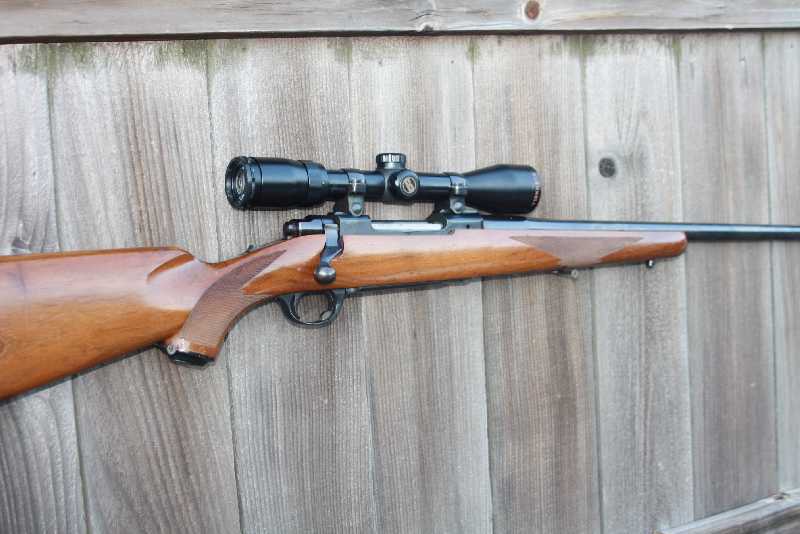
In 1968, Bill Ruger began production of a standard sporting bolt action rifle. The Model 77. Early models were round-top recievers, but soon thereafter he began milling the scope base directly into the top of the rifle. If you wanted to mount a scope, all you needed was the rings, and Ruger often shipped the rings with the rifle. However, guys who swap scopes from one rifle to another soon found that the rings on a Ruger rifle aren't the same size. Oh, no. The front portion of the rifle is higher than the rear portion, so for the scope to align with the bore, you'll need two different ring sizes.
So, the system evolved to use basically four ring sizes. You could call these short, medium, tall, and extra tall, but nowadays they are simply called #3, 4, 5, and 6. With those four rings, you can mount almost any size scope to your Ruger 77.
Left to right, #3, 4, 5, and 6. The smaller ring goes in front, the larger ring to the rear. Most common 3X9X40 hunting scopes use a #3 front and a #4 rear. On my Ruger 77 I wanted to mount a scope with a larger objective bell, a Swift 6X18X44, and that necessitated taller rings, a #4 in front and a #5 at the rear. The other rings are in my kit, and available if I ever want to change scopes.
Some folks don't particularly like the Ruger system, but I find that it serves me just very well. It's served hundreds of thousands of riflemen just fine over the years. I can buy rings at my local gun store for about $35.00 apiece, with tax, out the door, and if I need one ring, I can buy one ring. Not a bad option for mounting a scope.
Wednesday, September 07, 2011
Decisions
Well, damn. I bought a Ruger Model 77 in .25-06 several years ago and I really like that rifle. It's a shooter, averaging under an inch with my handloads. The only problem is that I gave it to my son. While I've never regretted that gift, I've been looking for another to add to the battery.
So, here's the quandary. The gun shop doesn't have any .308s and I've got several. I bought them as grandkid rifles, but haven't decided yet which grandkid is going to get them. Yet, there's that Ruger 77 sitting forlornly in the rack. I'm trying to decide if I should take one of the .308s, probably a Remington 700 ADL and go swap for that Ruger.
Decisions, decisions.
Sunday, December 15, 2024
Ruger RXM
Evidently, Ruger just ginned up a shit-storm with their new Ruger RXM pistol. From all accounts, it is made in collaboration with Magpul and is virtually a direct clone of the Glock 19. Patents expire, and Gaston is rolling in his grave.
Street prices are under $400.00. From what I understand, Magpul is making stuff for this pistol and it should be very weel supported. I admit that I am tempted. I've been thinking about a new carry pistol and this one might make the cut.
My younger son, who is a cop in New Mexico, bumped me about this pistol today. I admit that I am both amused and intrigued. I've never been a Glock fan-boy, but I do own several Ruggers. Generally, I like Ruger firearms. I'm a fan of the Ruger Model 77, and of course, the Blackhawks and Super Blackhawk, and the Vaquero series. My daughter takes deer with a Ruger American that she adores. And, my younger son has a Ruger #1 that he hunts with.
My very first centerfire handgun was a Ruger Security Six that I carried until I got my Model 66. The one Ruger handgun that I don't like much is a little Ruger LCP that has been problematic at best. But I don't maintain it, and I don't shoot it much.
I may have to look more closely at this new Ruger offering.
Friday, September 30, 2011
Old Sierra Bullets
Anonymous writes:
PawPaw, I Googled "sierra harris machine co" and found this from a 2009 post on handloadersbench.com.Interesting. I also googled and found that thread. If Sierra was spun off of Harris Machine Co in 1952, that makes those bullets older than PawPaw, who was born in 1953. The other three boxes are marked "Whittier, CA", so if they moved from Whittier in 1963, those bullets are almost 50 years old. Great stuff.
Harris Machine Co. began manufacturing Sierra Bullets in 1947 in Riviera, Ca. In 1952 they became an independent co, Sierra Bullets Inc., and sold by Harris. They were in Whittier Ca.from 1952 or 53 until 1963 when they moved to Santa Fe Springs, Ca.
I'd bet that they were probably intended for the .250 Savage, which was at the height of it's popularity back then. I remember an old article that I read as a kid, where either Jeff Cooper or Elmer Keith was talking about the .250 Savage and said that they believed that 87 grain bullets were just a little bit light for whitetail deer in the .250 Savage.
Another anonymous commenter writes:
late 50's, part of the reloading boom post Korean war.Early 25-06 experiments were likely done with those.Quality will be high but likely thicker jackets than these days. Metal drawing technology was not the same as now.I'll take your word on the jackets and the metal drawing technology of the late '50s early '60s. I have no idea about that and no reason to dispute it. I disagree, though, that they were probably early experiments with the .25-06. The .25-06 was a very early wildcat, the brainchild of a guy named Charlie Newton. In 1912 he looked at the .30-06 cartridge and thought "What if?" Later, A.O. Neidner began producing rifles for the cartridge, using 117 grain bullets from the .25-35. That cartridge has been around for a long time.
It's one of my favorite cartridges and it's all I can do to leave a rifle in the used gun rack when I see that it's marked as a .25-06. We've got one in the family, a Ruger 77 that lives at my son's house. Very accurate rifle with 117 grain bullets. He's normally a magnum shooter, but says that the more he shoots that cartridge the more he likes it. I did the workups on that rifle with Reloder 22 powder and we're getting something north of 2900 fps with 117 Gamekings.
Just recently, I found another Ruger 77, this one an earlier model, probably made in 1970. I couldn't stand it, so it's on layaway at my favorite gun shop. Which reminds me, I need to run by there next week and give them another payment.
Monday, December 26, 2016
The .25-06 Remington
Designed by the renowned Charles Newton in 1912, it's certainly not a new cartridge. It was a wildcat for many years, until being standardized by Remington in 1969. It was a whiz-bang cartridge back then and it's a whiz-bang cartridge today. I bought my first one in 2008, a used Ruger 77 off the resale rack at a pawn shop. Even then, it was the older, tang-safety model and I got a good price on it. I took it home, studied it, and started searching about for brass and bullets. I started with a load of Reloder 22, 50.0 grains, which filled the cartridge to the case neck, then seated one of Sierra's 117 grain Gameking bullets on it.
When I took it to the range, I got settled on the bags and started shooting a string, it threw them all into 0.8" at 100 yards with boring regularity. On a later trip, I got out my chronograph and pushed those little Sierrras over the screens. The numbers showed 2971 fps with a low Sd and Es, and I said the hell with load development. I was done. An old used rifle, turning those numbers with MOA accuracy is nothing to sneeze at.
Since then, I've bought four rifles in that caliber. Two Savages, and another Ruger, and they all turn in great accuracy, each of then below MOA with that same load. I am of the same opinion now that I was in 2008; don't mess with it. And, I admit today that I don't currently own a rifle in .25-06. They went to family members who showed a liking for the cartridge, like my daughter-in-law, who I featured earlier in a post.
That grin is the one that I usually get when someone shoots that rifle. Women and young shooters find it easy to hit with an accurate rifle, and the .25-06 is accurate. It has lighter recoil than many other long-action cartridges, the long, slender Gameking, or an equivalent bullet from Hornady or one of the other manufacturers carries well, and from what I can tell from the gong targets we shoot, it hits like the hammer of Thor.
I consider the .25-06 Remington to be one of the pre-eminent cartridges for medium game in the US today. Why it hasn't caught on with more shooters today is a mystery. Maybe because it's not a "new" cartridge and the gun writers don't talk about it much, but like its parent, the 30-06, it's just as useful today as it was when Newton designed it, over a hundred years ago.
Last week, my son came over and asked if I'd reload some for him. We looked at my stock of bullets and I found that I was out. There were no more of those lovely, slender 117 Gemkings on the shelf. I fixed that today by ordering some bullets and some extra brass. For a hundred-year-old cartridge, it's got a lot to offer.
Friday, September 09, 2011
Decisions II
Next to it on the rack was a Remington Model 7. I asked to look at it as well, and it's a fine example, in 7mm-08. It sports a Leupold VXII scope and they had it priced at $699.00. I told them that was a fair price for the Remington, but that the Ruger was a bit rough. With the cheap scope, it wasn't nearly the value that the Remington is, but they had the Ruger marked at $469.00.
"So, the question becomes," I looked at the counter-guy with a piercing glare, "what's MY price on the Ruger?"
He looked at the rifle, hemmed and hawed for a bit, then scribbled on his note pad. "How does $350.00 sound?"
I reached into my wallet and took out a Franklin. "Sounds like a reasonable price to me. Let's put it on layaway, okay?"
From the serial number, it looks like that rifle was made in 1970, which makes it one of the very early models. A dollar bill can't slide betixt the stock and barrel, and the wood, though scuffed, will respond well to a little oil. In a couple of months I'll get it off layaway and start prepping it for shooting. If I don't keep it for myself, I'm sure one of the grandkids will love to have it. They're going to wind up with it eventually anyway.
Wednesday, November 19, 2008
Quarter bore
Still, it's a cartridge that's been around for a long time and has a loyal following. It's basically a .30-06 necked down to .25 caliber, so it'll fit in any action that the .30-06 will handle. Compared to more modern cartridges, the .25-06 is about equal to the brand-new .25 Winchester Super Short Magnum and is only a couple of hundred feet per second behind the .257 Weatherby Magnum. In short, it's a fast cartridge, one that can reach out across valleys and plains. It has a reputation as being a very accurate cartridge.
I've always wanted a .25-06 since those financially broke days in the late '70s. It's been on my back burner wish list since then. I'd still look at the gun magazines from time to time and wonder if I'd ever have the opportunity to own one.
You might recall a few days ago I was in my favorite pawn shop looking at a Ruger Model 77 in .270. I like the Ruger action because it's a newer, updated version of the Mauser 98. The action has that big Mauser claw extractor and is just as slick as butter. Fifteen years ago Ruger bolt actions had a reputation for being average shooters. Then we learned about free-floating barrels and bedding stocks. With just a little tweaking, a Ruger action can be made to shoot just fine. Still, I didn't want a .270 and it was priced a little high, at $450.00 for a used rifle. Plus, the action was a weird color, being kind of a deep purple rather than a rich blue.
I hemmed and hawed with the counterguy and decided to put the rifle back on the shelf. He wasn't through with me, though. "I've got another Ruger over here, an older one with the tang safety." He picked up the rifle and handed it to me.
"Oh, really", I said. I looked down and saw the caliber .25-06 stamped on the barrel. "I bet this one's overpriced too." I looked at the tag and saw it was marked at $350.00.
"We don't have as much money in that rifle." He said. "It's an older one with the tang safety and it's in a caliber no one wants. How about $300.00?"
"Hell", I said. "It's against my better judgment, but give me a 4473."
It's got a 4X Bushnell scope mounted. That scope will go in a pile for grandkids .22 rifles. It's got a lot of closet dust in the crevices and the barrel needs to be floated. While I've got the action out of the stock, I'll go ahead and bed it. The serial number reveals it was manufactured in 1992.
Saturday, April 07, 2012
Two Bullets
So, I Loaded the same brass with the same primer and powder and seated two different bullets. The first load was 46.0 grains of Reloder 19, half seated with the Hornady, half seated with the Sierra.
Then I loaded another series with the same brass and primer, but used 50.0 grains of Reloder 22. Half seated with the Hornady and half seated with the Sierra.
Then I pushed them over the chronograph. For reasons I haven't divined yet, the Hornady bullets flew faster than the Sierra with both powders.
117 Hornady, 46.0 RL19, 2728 fps
117 Sierra, 46.0 RL19, 2667 fps
117 Hornady, 50.0 RL22, 2870 fps
117 Sierra, 50.0 RL22, 2797 fps.
Who'd have thought that changing the bullet would change the velocity by that amount? Not the weight of the bullet, but the brand? That's the beauty of this hobby; you learn something new every time you go out, and just about the time you think you know what you're doing, you find something new that makes you scratch your head.
Friday, May 28, 2010
Range Day
Second son came with me, to shoot his Savage 11 in 7mm Magnum and his Ruger 77 in .25-06. The Ruger is a hunting rifle, plain and simple, with a sporter barrel, a wooden stock, and a fixed power scope. We were easily able to hit a 200 yard gong with that rifle. He's confident now that any deer he sees he can hit.
We went out to the 300 yard berm and he put up a target to try to wring out his Savage. We long ago found a load or 4831 shooting a Nosler Ballistic Tip bullet that his rifle really likes. It easily shoots MOA when he does his part, but he's never shot it over 200 yards.

First and second shots nearly touching at 300 yards, 2 inches above the mark. Third through sixth shots opened up as the barrel heated. The first two inside half an inch, the last four inside 4 inches. The orange target is a 4" target dot. Any of those shouts would be inside the kill area on a deer. That's fine shooting.
Sunday, December 28, 2008
Ruger .25-06
I'm impressed.
It's a pawn shop rifle and I picked it up for a good price. Before I started making ammo for it, I took it down, gave it a good cleaning and floated the barrel. Ruger puts a little ledge on the forward end of the stock to put upward pressure on the barrel. Everything I had read told me that floating the barrel would go a long way toward making the rifle shoot.
I picked Sierra Gameking bullets because this rifle is going to be a hunting companion. Gameking's are a standard boat-tailed spitzer bullet of conventional construction. Because the little cartridge is overbore, I figured that a slow burning powder would be best and the Alliant guide told me that Reloder 22 would be a good place to start.
So, I loaded some 117 grain Gameking bullets over varying charges of Reloder 22. I started at 49 grains and worked up to 52 grains at one grain intervals. I didn't do anything special to the Winchester brass other than full-length sizing and camfering it.
When I got to the range today, the weather was drizzling rain intermittently, but the wind was dead calm. Temperatures were about 60 degrees. I set up some sand bags and began at 25 yards. The scope was close, about an inch low at 25 yards, so I took the target out to 100 yards and settled down behind the scope.
This rifle wears an old Tasco fixed 6X scope. I like fixed power scopes on hunting rifles. My Savage .30-06 wears a 6X Weaver. I was pleasantly surprised that the old Tasco was as clear as it was. The targets were 2" target dots and they were easily viewed through the glass. All targets were three-shot strings with the rifle allowed to cool 5 mintes between strings.
This target, below, was shot with 50.0 grains of Reloder 22. When I looked through the spotting scope, I was pleasantly surprised.

After cooling I fired a string with 51.0 grains of Rel 22 which was no great load. I put in the last test rounds, 52.0 grains of Rel 22 and settled in behind the rifle.

That's also a fine target, and it's considerably narrower than the one above. I may have pulled that last shot, throwing it high. The width of that group is just over a half-inch, but the height of the group makes it almost 9/10ths of an inch.
Still, the little Ruger is a shooter. With both 50.0 grains and 52.0 grains of Rel 22 it turns in fine accuracy. I didn't put anything over the chronograph today, but my data tells me that both loads are running on the far side of 2800 fps.
I think I'm going to like this rifle a lot.
Tuesday, September 22, 2009
Pawn Shop Crawling
The counter guys told me that they'd called five distributors this morning and hadn't had any luck finding the Handi. Their main distributor has 30 of them on backorder. I don't know what the problem is in filling an order of .30-30s, but hunting season is coming.
However, they had one rifle in the rack that piqued my interest for reasons I don't understand. This is a Ruger Model 77/44. It's a bolt action Model 77 chambered for the .44 magnum cartridge. I've got dies and brass for that caliber, but I'm trying to understand the niche of a bolt-action .44 magnum. It's marked at $529.00 and I can get them to shave several dollars off that price, but the question becomes, do I want the rifle? I don't currently have any .44 magnum revolvers, but I've got plenty of .357 magnums.
It might make a good grandkid rifle and it would be a nice companion piece to a Ruger Blackhawk. The irons would suffice, but a low-power scope would make it shine. It's a lightweight, blued, walnut stocked rifle and seems to be in pretty good shape. The price seems right, and I could dicker with them.
Decisions, decisions.
**UPDTE** I've talked myself out of that rifle. The .44 magnum is a pistol cartridge, suited to revolvers and lever guns. A bolt action in that caliber is a niche rifle that I don't have a niche to fit. As unique as it might be I don't really see a use for it that justifies the expense.
Monday, May 30, 2022
What Goes Around
As I get older, I am convinced that there is nothing new under the sun. For example, as I browse through YouTube videos. I'm starting to see youngsters touting the .25-06 Reminton as a long-range hunting cartridge. They are a bit late to the party. Maybe it's just the algo rhythm playing with my head, but I'm seeing a lot of videos talking about A.O. Neidner's old cartridge. He invented it in 1920 by necking down the then new US Government cartridge to .25 caliber. Remington standardized it in 1969.
I bought my first one in 2008, and I was late to the party. After finding a used Ruger 77 in a pawn shop rack, I started reloading for it and fairly quickly settled on a load that uses Sierra's GameKing bullet and Reloder 22 powder. It throws that 117-grain bullet at 2971 and keeps them all inside an inch at 100 yards. I was done tinkering with that rifle and passed it along to my second son. A bit later, I found another one in a used gun rack and picked it up cheap. I eventually passed it to my elder son. We now have four of them in the family.
That combination is quite lethal on our smallish Louisiana deer. It's a great cartridge. If I were working up loads for it today, I would probably work up a load with one of the newer copper bullets, but I still have a stock of those GameKing bullets and no real reason to start tinkering again.
So, to all you fellows who are just now discovering the .25-06, welcome to the party, pal. It's over 100 years old, and still doing what we ask it to do. A.O. Neidner knew what he was doing back then, and it's still doing it today.
Friday, July 20, 2018
Is It Worth It? Good Question!
How much do you do precision shooting versus just plinking? I'm finding that cheap stuff for plinking is about the cost of reloading, even before I put the time into it, so I at this point I don't reload much. Have the higher prices for components, particularly bullets, changed how or when you reload?I don't do much "precision shooting" any more. I assume that you mean long-range shooting form a bench. Two years ago, I was diagnosed with macular degeneration and that has affected my ability to see anything with precision, including a scope reticle. But, I see your point, so lets look at what a box of regular store-bought ammo would cost if we loaded it at home.
We'll use Midway USA as our resource, and look at some prices.
Sierra Matchking bullets cost $34.03 per hundred, or 34 cents apiece
Winchester large rifle primers cost $34.99 per thousand, or 3.5 cents apiece.
Reloder 15 powder costs $26.99 per pound. My load is 43.0 grains. That equals 162 shots pound (700043), which means 16.6 cents per shot.
If my math is correct, the component cost for one round of very good ammo is 54.1 cents per shot. A box of 20 costs me $10.82. That same box of ammo, at the same store, costs $23.39.
How much is your time worth? That's a valid question, and everyone has to answer it in his own way. How much minutiae are you willing to invest on uniforming primer pockets, turning necks, etc? Some handloaders get very particular with their preparations and spend a lot of time prepping cases. Sorting primers by weight, sorting bullets by weight, and marking cases so that they are always oriented in the chamber the same way.
But, if you start casting your own bullets, the component cost drops almost to zero. As you amortize the initial cost of a smelter and molds over 100,000 bullets, the cost of equipment drops toward zero on a per-shot basis, but you're going down a wormhole that many shooters don't want to go down. I once figured that the cost of my ammo for .38 special, or .45 ACP, (or .30-30 Winchester) was less than 5 cents per shot.
C.E. Harris,in this article, describes how The Load is safely assembled. This load features 13.0 grains of Red Dot in military cases and is very accurate. Mr. Harris did some fantastic precision rifle shooting with this load. Mr. Harris is also the guy who invented Ed's Red, a bore cleaner that you can assemble at home.
But, each shooter has to answer the question; How much is my time worth? In my case, and in the context of the posting you asked about, I used that time to introduce my grandson to handloading ammo.
![]() |
| Grandson, Brett, introduced to handloading. |
![]() |
| 2nd son, stretching out the Ruger 77 in .25-06 |
I hope that I've answered your question. For more information on cast bullet shooting, go to the Frugal Outdoorsma and read some of the articles that Junior and I wrote at the turn of the century.
Sunday, April 15, 2012
Sunday Musings
The .250 Savage, also known as the .250-3000 was one of the first factory cartridges to break the 3000 fps barrier. It's been eclipsed by the other quarter-bores, most notably its older brother the .25-06. The .250 Savage is neither fish nor fowl, not a varmint cartridge and not really a big game cartridge. Yeah, it'll make 3000 fps with the little 87 grain pills, but it doesn't carry well with the bigger bullets. It can push a 117 grain bullet to between 2500-2600 fps, which isn't screaming, it's only adequate for a number of tasks. The .25-06 will push that same 117 grain bullet faster and if you want screaming speed, the .257 Weatherby will make it go even faster. My Lee manual puts the .25-06 with the 117 grain bullet at the 2900 fps range and that's what I'm seeing with my Ruger 77.
There's not much to recommend the .250 Savage except that it's built in light rifles, has light recoil, and is easy to shoot. It's getting harder to find factory rifles chambered in the little cartridge, but Savage makes two. A stainless steel synthetic stocked rifle called the Model 16 FHSS and a wood stocked version they call the Model 14 American Classic.
I've got a .25-06 leaning in the corner and I've got other rifles, most notably my go-to rifle, the .30-06. The .250 Savage is about as useless to me as it can be. Still, that little cartridge jumped into my mind this morning when the preacher was talking about Doubting Thomas. There's got to be a lesson there, but I'll have to pray over it.
Sunday, December 28, 2008
.17 HMR
I'm going to like this little rimfire, although it needs a better scope. The little 2X7 that's on it is a low-end scope and it didn't seem to have good definition. The target wasn't sharply defined, always seemingly a bit out of focus regardless of how I'd set the focus ring or the power settings. The little rifle deserves a better scope and it'll get one in the spring.
Still, the rifle was surprisingly accurate, capable of one-hole groups at 25 yards and sub one-inch groups at 50 yards. At 100 yards the group really opened up, but I think that's a function of the scope more than a failing of the rifle. We may have had parallax issues at 100 yards, which certainly mitigates against good shooting.
Still, at 50 yards I wouldn't be uncomfortable taking a shot at small game. I was using one-inch target dots against white paper and a representative five-shot group looks like this.

That's with the 17 grain Hornady ammo. I'll have to get a box of the 20 grain stuff, and try the Remington and Federal ammo, but so far I'm pleased with this little rifle.
It'll be fun to put a good scope on it and see what it'll do.
Thursday, February 20, 2020
The .25-06 Remington
He uses 7828, which I suppose is a fine powder. My pet load for that cartridge is 50.0 grains of Reloder 22 with a 117 grain bullet. My chronograph registers 2971 wit that combo out of a Ruger 77. Not quite the magical 3000 fps, but I doubt that any coyote or whitetail deer could tel the difference. It throws them all into 0.8" at 100 yards with boring regularity.
I guess I'd better get the keys to the truck and run into town. I need butane, and I'm thinking about cooking a big pot of spaghetti. Zach told me on his way out the door that it's been a while since we had spaghetti, and it seems like a good day to make some.
Friday, December 30, 2011
Range Friday
I went outside and looked on the bench and found a box of Sierra 125 grain Pro-hunter bullets. Then I started researching loads. What I was looking for isn't necessarily in the manuals, so I was breaking untrod ground. I settled on a load starting at 41.0 grains of IMR 4895 and loaded some ammo, then increased the charge to 42.0 and 43.0 grains of powder just in case that first load didn't fly.
I got to the range and set up at the 100 yard line. Fired a couple of fouling shots into the berm. Then I got steady on the bags.
That's a one inch target dot and it was fired at 100 yards. The subsequent loads opened up quite a bit. Not surprisingly, I fired the last two rounds of my #3 load (43 grains of IMR 4895 and that Sierra Prohunter) through my Remington 700. The Remington didn't like the #1 load, but it liked the #3 load, firing it into just 0.75 inch. If that Remington becomes a grandkid rifle too, I know which kid load to build for it.
I figure that load is traveling about 2600 fps, plenty good medicine for the whitetail deer around here. Recoil is light, the load is easy on the shoulder. I think that the grandkids will like it fine.
On the way home, I recalled that I had a rifle on layaway and it was time to get it out. I went to my favorite pawn shop and dropped some change on the counter guy.
That's a Ruger 77, tang model, in 25-06. According to the serial number, the rifle was pushed out the door in 1971, the same year I started college. It came with a Bushnell Banner scope, probably made about the same time the rifle was made. The counter guy threw in a new soft gun case so I wouldn't have to carry it from the store naked.
That one is not a grandkid rifle. PawPaw has been lusting over this rifle since I was in college and this one is mine.
Saturday, June 30, 2012
Field Trials
I didn't get any pictures of the gongs, but I did manage a couple of snaps of my daughter-in-law, Kim, trying her hand. Below, she's lining up using my Ruger 77 in .25-06.
Then, just after she pulled the trigger.
Yeah, she hit it. There were several of us there, including step-grandson Jeffery, who did really well with a Remington 700 in .308. We ran the gamut of centerfire deer cartridges this morning, from .35 Remington, to .243 Winchester, .25-06, .30-06, .308 and 7mm Rem Mag. We even function tested a 12 gauge shotgun and a .40 cal SW Sigma.
Hot out there this morning, and yes, we sprayed everyone down for chiggers. It was a great morning, although a hot one, to be in the woods with family.
Thursday, June 21, 2012
Bug Holes and Flyers
That's a five shot group. The first two went into a bughole, the third shot went down into the doldrums, and the next two simply widened the bughole. Four shots into an incredible 0.335 inches and that flyer opened the group to 1.35 inches. Gaah!
So, then, I took out my Savage 110, a standard .30-06 hunting rifle. It's my favorite and it likes 165 grain Sierra Gameking bullets and the standard Garand load of 47.0 grains of 4895. Once again, a flyer ruined a nice little group.
That's the clean-bore shot on the left, then three for meat shots. Two touching and that third shot down below. The rifle still put those three in under an inch, but I would have been really pleased if all three were touching. That's not my karma today, so I packed up and came home.
I might have been flinching., Before I started with the scoped rifles, I tried out a new load in the Handi-rifle. I went to the Hodgdon website and looked up cast bullet loads, found a load for the .45-70 of 45.6 grains of IMR 4895. I used a 405 grain, soft lead bullet. It's listed as a starting load, suitable for trapdoor rifles, but when I touched the first one off, just damn! Four more and I was finished with that rifle, much preferring to shoot the .30-06. The Hogdgon website says that the load should be running about 1500 fps, and that may be wo, but it was throwing pieces of berm 15 feet into the air. That may be a starting load, but shot from that lightweight Handi-rifle, it was quite a handful. I'll need to make an appointment at the dentist, simply to see if my fillings were jarred loose in the recoil.
Monday, January 16, 2012
Reloading Woes
I went out and reloaded some .308 Winchester, with some youth loads I want to try. That went quickly, then took out a box of new .25-06 brass and got down my manuals.
Back in September, a gracious reader sent me some ancient .257 bullets that he had no use for. I thought I'd load some with Reloder 19 powder and see how they do in my Ruger 77. The Nosler manual says that RL19 powder is great for that weight bullet.
So, I started weighing powder and seating bullets; I got about 20 done when I lifted one cartridge and realized it was leaking powder. Turned the brass over and saw that I'd forgotten to prime the brass. Well, crap! I took down my bullet puller and started whacking bullets from the cases. Dumped powder and bullets into a suitable container. After I'd cleaned up the mess and started sorting bullets from the powder, I realized that I had totally wrecked the noses of all those bullets. A simple whack with the bullet puller was sufficient to upset the lead nose past being usable.
I primed all the brass and started over, loading a series of cartridges with those bullets. It'll probably be a week or so until I can see how they fly, but I know that those are very soft bullets. Probably designed for the .250-3000. I remember reading an article back in the '60s where Jeff Cooper was talking about the .250-3000 as a cartridge for the Savage 99 rifle. Here's his latest thoughts on the cartridge, from his Commentaries, Vo 7, No 1.
The manufacturer made a point of issuing it in caliber 250-3000, maintaining that you could reach the magical 3000 fps figure with an 87-grain 25-caliber bullet. The 250-3000 (or 250 Savage) was a good enough deer gun, if your deer were not too big, and it was gentle as a lamb to shoot.Well, if Cooper says that the 87 grain bullet is sufficent for deer, then our smallish whitetails around here should certainly qualify. I'd feel better shooting at them with a 115-117 grain bullet and I've got some of those worked up too, but I just had to load some of those 87 grain bullets to see how they shoot. I have no doubt that I can push them past 3000 fps with the bigger case of the .25-06 and new propellants, but that's not the purpose of this exercise. I never approached a max load, preferring accuracy over velocity. Those bullets are plenty soft and should upset well at any reasonable velcity. I bet they'd vaporize a crow, or do just fine for coyotes or like-sized varmints.